
"How do I get a car in Bulgaria?" is one decision with two routes (buy here vs import from the UK) and six administrative stages (purchase, notary, KAT registration, GTP inspection, insurance, local tax). The Bulgarian system is more paperwork-front-loaded than the UK system but materially less expensive over the life of the car: Civil Liability is cheap, local vehicle tax in regional cities is often 30-90 EUR a year, the GTP runs at roughly UK MOT cost, and the annual e-vignette is around 50 EUR for a private car. The big decisions, then the big traps, then the operating year. This guide is the operating manual for all six stages, the UK-after-Brexit import lane, and the five compulsory in-car documents the Pathna Politsia (Traffic Police) actually ask to see at a checkpoint.
Car needs depend on which kind of British expat you are. Find yourself in the table; the rest of the guide explains each row.
| If you are... | Recommended route | First action |
|---|---|---|
| New mover with a residence card, settling in a regional city | Buy a 5-10 year old Bulgarian-plated car for 4,000-12,000 EUR from a dealer who handles the paperwork | Get a Bulgarian personal-ID number (LNCh / EGN); check Mobile.bg and Cars.bg. |
| UK pensioner relocating with a beloved UK car (under ~5 years old) | Import the UK car using the Council Regulation 1186/2009 personal-effects relief (the EU's ToR1 equivalent) | Tell DVLA you are permanently exporting; verify residence-relief eligibility for Bulgarian customs. |
| UK pensioner with an older or modestly-valued UK car | Sell in the UK; buy locally in Bulgaria; cheaper than the import paperwork stack | Sell on UK market via Auto Trader or webuyanycar; buy in Bulgaria from a regional dealer. |
| Working-age remote worker in Sofia, cares about emissions zone | Buy a Euro 5 or 6 Bulgarian-plated car, or import an EV from the EU | Filter Mobile.bg to Euro 5+; check Sofia LEZ rules at AirSofia. |
| Village-house owner needing a tough rural runabout | Buy an older diesel 4x4 or estate locally (Hyundai Tucson, Skoda Octavia 4x4, Dacia Duster) | Check GTP history (every car has one); ask for the LPG conversion paperwork if fitted. |
| Brit running a small business or guesthouse | Register the vehicle to the EOOD / OOD company for VAT recovery, with the right operating-purpose rules | Consult our Business in Bulgaria guide for VAT recovery limits on company vehicles. |
| Family with second car, just for school runs | Buy an inexpensive runabout (Citroen C1, VW Polo, Renault Clio, 1,500-4,000 EUR) | Skip Casco insurance; budget for one-off repair fund instead. |
| Just here for the summer in Sunny Beach / Burgas | Don't buy; rent monthly or use long-stay rentals from a Burgas-airport agency | Compare monthly hire vs. 1,500 EUR runabout total cost; rental usually wins under 4 months. |
Every car-ownership journey in Bulgaria runs through six discrete administrative stages, in this order. Knowing the order saves an enormous amount of weight-shifting from one office to another and back again.
| Stage | What happens | Where | Typical time |
|---|---|---|---|
| 1. Source | Find the car: dealer lot, private classified, online platform (Mobile.bg, Cars.bg), or import from the EU / UK | Online or in-person | Days to weeks |
| 2. Purchase contract | Sign a written contract of sale; signatures certified by a Bulgarian notary public | Notary's office | 30-60 min on the day |
| 3. KAT registration | Register the change of ownership and (for first registration) issue Bulgarian plates and the registration certificate | KAT Pathna Politsia (Traffic Police), regional office | 1-3 hours in person, by appointment |
| 4. Insurance | Buy compulsory Civil Liability (Grazhdanska otgovornost); optional Casco own-damage | Broker or insurer; can be same day as KAT | 30 min |
| 5. Annual road-use payment | Buy the e-vignette (BGTOLL) for the period you want to drive; goods vehicles use TollPass distance-based instead | Online (bgtoll.bg) or petrol-station counter | 5 min |
| 6. Local vehicle tax | First-year tax due to the municipality; thereafter annual; payable in two halves or as a single discounted annual | Municipality online portal, Easypay, or cash desk | 5 min online |
For an EU-import or UK-import car, there is a Stage 0 (Customs) that sits in front of Stage 1, covered in Sections 7 and 8.
Every Bulgarian-plated car on the public road must carry five documents at all times. The Pathna Politsia (Traffic Police, traditionally called KAT) check this list at routine stops. Missing one is a fine. Missing two is the start of a bad afternoon.
| # | Document | Bulgarian name | What it proves |
|---|---|---|---|
| 1 | Registration certificate part 1, the large A4-sized paper certificate (golyam talon) | Svidetelstvo za registratsiya, chast I | Comprehensive technical and registration data: VIN, engine number, fuel type, axles, mass, owner history. The master document. |
| 2 | Registration certificate part 2, the small credit-card-sized coupon (malak talon) | Svidetelstvo za registratsiya, chast II | Driver's everyday document. Carry in the car or on your person; the Pathna Politsia inspect this at a stop. |
| 3 | Civil Liability insurance | Grazhdanska otgovornost | Mandatory third-party motor insurance in force |
| 4 | Annual technical inspection certificate | Godishen tehnicheski pregled (GTP) | Roadworthiness, valid annually if the car is over 3 years old |
| 5 | Driving licence valid for Bulgaria | Svidetelstvo za upravlenie na MPS | The driver is authorised to drive the category of vehicle |
Plus the compulsory in-car equipment: high-visibility vest (placed in the passenger compartment, not the boot), warning triangle (in the boot), first-aid kit (boot), fire extinguisher (boot, in date). Missing equipment is a separate fine to missing paperwork.
The two parts of the Bulgarian registration certificate have different jobs. Part I, the large A4 paper certificate (golyam talon), is the comprehensive master document with the full technical record and the ownership history. It is the document a notary or KAT inspector cross-checks for ownership and major transactions. Keep it at home, in a fireproof safe or with the rest of your important paperwork; do NOT keep it in the car. Part II, the small credit-card-sized coupon (malak talon), is the driver's everyday document. Keep it on your person or in the car at all times; this is the one a Pathna Politsia officer inspects at a roadside stop. The security logic: keep Part I at home so that a thief who steals the car cannot easily sell it on with both documents in hand.
For most British expats settling in Bulgaria, buying a used Bulgarian-plated car is faster, cheaper and less paperwork-intensive than importing from the UK. The Bulgarian used-car market is large, well-served by online platforms and dotted with small dealer lots in every regional town.
| Aspect | Dealer | Private sale |
|---|---|---|
| Price for same car | 10-25% higher | Cheaper |
| Paperwork handover | Dealer does notary + KAT for you | You arrange the notary and KAT yourself |
| Warranty / aftercare | Often 6-12 months limited mechanical warranty included | Sold as-seen, no warranty |
| Title / outstanding finance check | Dealer is supposed to clear; verify anyway | You must check; ask for proof of clear title at the notary |
| VAT | Sometimes the price is "with VAT"; check if dealer is VAT-registered | No VAT |
| Test drive | Easy and routine | Often resistance; insist anyway |
| Independent inspection | Often refused, ask anyway; reputable dealers say yes | Usually fine if the seller is genuine |
Watch for these on any Bulgarian used-car purchase:
Every Bulgarian motor-vehicle sale must be evidenced by a written contract with the signatures certified by a Bulgarian notary public. This is the legal heart of the transaction. The notary is not signing for the price or the condition; the notary is certifying that the two named individuals are the people whose signatures appear on the document.
The notary's role is narrow:
The notary does NOT inspect the car, test-drive it, or verify mechanical condition. That is on the buyer.
The notarial act needs to be in Bulgarian to be enforceable through the Bulgarian courts. A pure English-language contract may not be recognised. The standard approach is a bilingual two-column document (Bulgarian left, English right) with a clause stating the Bulgarian version controls in any dispute. Any reputable Bulgarian notary will have a standard template; ask for it in advance.
After the notary, the change of ownership (or first-time registration of an imported car) is recorded at KAT, the Pathna Politsia regional traffic-police office. This is the stage that produces the new talon in your name and (for first-time registration) the Bulgarian plates.
The deeper guide: this is the registration step. For the full driving picture once the car is on Bulgarian plates: licence exchange, vignettes, the 0.5 alcohol limit, winter tyres, speed limits, parking and the accident protocol, see our dedicated Driving in Bulgaria guide.
KAT operates regional offices in every oblast capital and in some larger municipalities. Some operate by walk-in; many require an online appointment via the MVR (Ministry of Interior) portal. Sofia, Plovdiv, Varna and Burgas all use appointment systems; smaller regional offices (Shumen, Yambol, Vidin) often accept walk-ins. Check the MVR portal for your oblast.
Importing a used car from another EU member state (commonly Germany, Italy, France, Netherlands) is the dominant supply route for the Bulgarian used-car trade. The customs picture is simple inside the EU: free movement of goods means no customs duty and no import VAT (on a used car from a private seller); the buyer pays the Bulgarian one-off registration formalities and any Bulgarian VAT only if the car counts as "new means of transport" (under 6 months old AND under 6,000 km).
A car imported from the EU is treated as a "new means of transport" under EU VAT rules if it is either:
If either limb is met, the buyer pays Bulgarian VAT at 20% on the purchase price even though it was bought from a private EU seller. This is a meaningful tax line; if you are eyeing a near-new German lease car, do the maths first.
Since Brexit, the UK is outside the EU customs union. A UK-registered car driven to Bulgaria is therefore a customs import from a third country. The Bulgarian customs authority applies the standard EU import tariff: 10% customs duty on the customs value, plus 20% VAT on (customs value + duty). For a 10,000 EUR car this is around 3,200 EUR in duty and VAT before you have set foot in a KAT office. The exception that almost every British mover relies on is the EU personal-effects relief under Council Regulation 1186/2009, which is the EU equivalent of the UK's ToR1.
| Lane | When it applies | Cost | Paperwork |
|---|---|---|---|
| Full customs | Default: any UK car imported into Bulgaria where the personal-effects relief is not available or not claimed | 10% customs duty + 20% VAT on the customs value; for a 10,000 EUR car, around 3,200 EUR | Customs declaration (T1 / IM4), CoC, V5C, invoice, insurance, freight docs |
| Personal-effects relief (Council Regulation 1186/2009) | You are transferring your normal residence from the UK to Bulgaria AND you have owned the car for at least 6 months before the move AND you have lived in the UK for at least 12 continuous months before the move | Customs duty: 0; VAT: 0; you still pay KAT, GTP and insurance | Declaration of permanent residence transfer, proof of 12 months prior UK residence, proof of 6 months prior car ownership, customs application form |
Both the EU and UK versions of this relief (the EU one under Regulation 1186/2009; the UK one under ToR1) share the same logic. You get the relief once per move; the relief is on personal effects including vehicles, household goods, instruments and tools.
Cross-reference our Moving to Bulgaria: 90-Day Countdown guide for the customs-relief paperwork in the wider context of the move, and our Shipping Your Life to Bulgaria guide for the Four Piles framework that decides whether the car is even worth the import in the first place.
UK-spec headlights are angled to throw their main beam DOWN-LEFT to illuminate the UK nearside kerb. In a right-hand-drive country (Bulgaria, the rest of the EU, mainland Europe) this geometry blinds oncoming drivers and floods the wrong side of the road. The Bulgarian GTP inspector will fail the headlight-aim test on an unmodified UK car. Two fixes: (1) replace the headlight clusters with the equivalent left-hand-drive part (typically 150-600 EUR a pair for a mainstream model, much more for premium marques with adaptive units); (2) fit permanent beam-deflector lenses (lower cost, 20-80 EUR for stick-on or clip-in deflectors, but some inspectors reject these as a temporary workaround so confirm acceptance in advance with the local KTP). Self-adjusting LED matrix headlights on modern cars sometimes have a software-mode switch for continental driving; check the car's handbook or the manufacturer dealer before paying for hardware.
The Bulgarian customs authority is strict on the personal-effects relief conditions. If you have owned the car for 5 months and 25 days, you do not get the relief. If you spent 11 months and 10 days in the UK before the move (perhaps because you took a long Christmas in Bulgaria with parents), you do not get the relief. Plan the move so that both clocks have ticked past their minima before the day you cross the border. The downside of getting the timing wrong is paying 30-35% of the car's value in duty and VAT.
For most British movers with a car under 10,000 EUR market value, the right answer is sell the UK car and buy in Bulgaria. The reason is the stacked friction even when the personal-effects relief is available:
For higher-value cars where you have a real emotional or specification attachment (a near-new Land Rover Discovery, a Tesla Model Y, a low-mileage BMW M car) the import maths shifts. For a 5-year-old Ford Focus the maths almost always says sell-and-rebuy.
Every Bulgarian-registered vehicle pays an annual local vehicle tax to the municipality where the owner is registered. The amount is set by the municipality within national-law bounds; the same car in Sofia and in Shumen can pay different amounts.
The formula uses three inputs:
The Bulgarian system is electronically linked: if you have unpaid local vehicle tax, the GTP test station's software refuses to issue a pass result. There is no manual override at the station. The same block applies to the e-vignette (you can buy it but the camera-enforcement system flags arrears) and to KAT change-of-ownership. Pay the tax on time; the alternative is going to the municipality, paying with penalty interest, and then going back to the test station.
Bulgaria operates a two-track road-use payment system: e-vignettes for private cars (under 3.5 tonnes) and a distance-based toll for goods vehicles (over 3.5 tonnes). The two systems share infrastructure but the products are different.
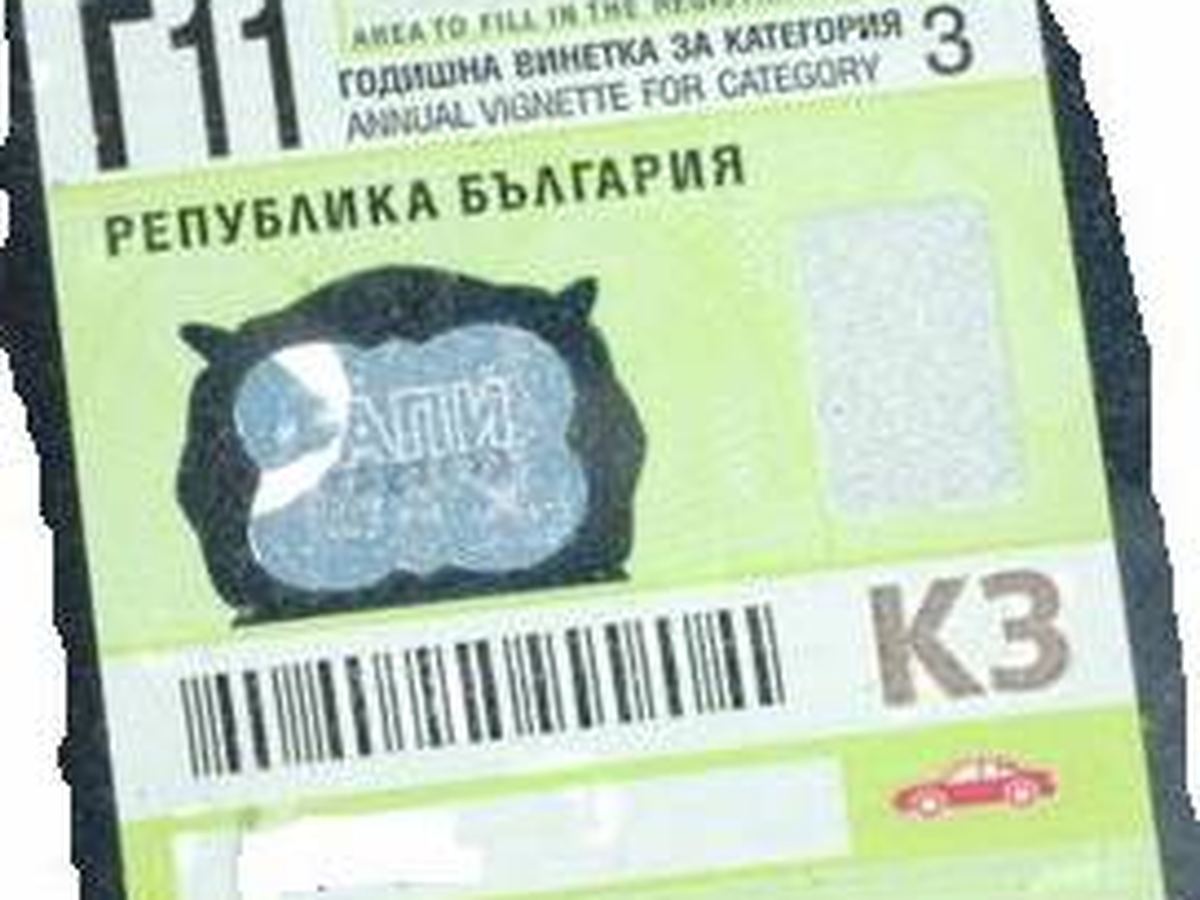
The e-vignette is mandatory for any vehicle under 3.5 tonnes using the Bulgarian national road and motorway network. There is no physical sticker; the system records the registration plate against the period purchased.
For a Bulgarian-resident with daily use, the annual vignette is the obvious buy. For a UK-pensioner couple who use the car twice a week to Shumen and back, the annual is still cheaper than calculating six weekend purchases a year.
Bulgarian motorways and main roads have automatic plate-reader cameras that check every passing plate against the e-vignette database. Driving without a valid vignette is detected within minutes; the fine arrives by post to the registered address (or the dealer / leasing company who then bills you) and is materially more than the cost of the annual vignette.
Vehicles over 3.5 tonnes use the distance-based TollPass system. Options:
British expats running a guesthouse, a small business with a van, or a campervan above 3.5 tonnes (some larger motorhomes) need TollPass rather than the e-vignette. Confirm the gross vehicle weight (GVW); a 3.5 tonne GVW vehicle is e-vignette; 3.501+ is TollPass.
The godishen tehnicheski pregled (GTP) is Bulgaria's roadworthiness test, the equivalent of the UK MOT. It is the second cheapest non-negotiable item on the annual car-ownership cost stack (after Civil Liability) and the one that catches out British expats who forget the renewal date.
Licensed test stations (kontrolno-tehnicheski punkt, KTP) are everywhere; you cannot drive 30 km on any main road without passing several. Stations near Sofia, Plovdiv, Varna, Burgas and Shumen are well-equipped; rural stations sometimes have older equipment but are perfectly competent for standard tests. Walk-ins are usually fine outside summer holiday peaks.
Bulgarian cities are catching up with the European city-centre low-emission zone (LEZ) pattern. Sofia is the largest and most-developed scheme; Plovdiv, Burgas and Varna are following.
Sofia operates two concentric zones during the winter air-pollution season (typically 1 December to 28 February):
The exact threshold tightens each winter; the 2026-27 winter season is expected to add Euro 4 to the peak-alert ban list in the central zone. Cars registered outside Sofia visiting briefly are subject to the same rules during alerts.
Automatic plate-reader cameras at zone entry points record non-compliant entries during active alerts and issue fines by post. The first-offence fine is typically 50-150 EUR; repeats escalate.
Cross-reference our Driving guide for the broader road-rule picture (KAT traffic stops, fines, the cult of krushki chasing back-roads-style overtakes) and our Weather for winter air-pollution context.
Getting out of a Bulgarian car is largely the buy-it process in reverse, with one critical addition: the seller must remove the car from registration (otpisvane) before the buyer's KAT process is complete, OR the buyer must complete their change-of-ownership in the seller's presence on the same day.
The number-one Bulgarian car-selling mistake is the seller relying on the buyer to do the otpisvane. The buyer takes the car abroad, never deregisters it, and the seller is still on the Bulgarian register six months later, accumulating local vehicle tax and any traffic fines the new driver picks up across the EU. Always do the otpisvane in person at KAT before handing over the keys. If KAT will not deregister without the new foreign registration evidence, deregister at the same KAT appointment that the buyer collects the export plates.
A car at the end of its life (irreparable, terminally rusted, written off by insurance) is scrapped at an authorised end-of-life vehicle (ELV) facility:
The ELV facility may pay a small sum for the scrap value (typically 50-200 EUR for a complete vehicle), or may charge a small fee for collection and dismantling, depending on condition and current scrap-metal prices.
Five special categories that British expats meet regularly and that each have their own rules layered on top of the standard car-ownership stack.
Around 30% of the Bulgarian private-car fleet runs on LPG, a dual-fuel petrol-LPG system fitted as an aftermarket conversion. The price gap at the pump (LPG roughly half the EUR-per-litre cost of petrol for a typical small car) drives the popularity.
Cross-reference our Business in Bulgaria guide for the VAT, BIK and operating-purpose rules in full; this stuff is more nuanced than a one-section summary can do justice to.
The questions British expats actually ask, with answers tied back to the relevant section.
Not for long. Bulgarian law requires a Bulgarian resident's vehicle to be on Bulgarian plates within roughly three months of residence registration. A UK-plated car driven by a Bulgarian-resident driver after that point is at risk of police impoundment, tax pursuit and a void Bulgarian insurance. Register on Bulgarian plates within the first three months. → Section 8 (UK import lane)
Without personal-effects relief: roughly 30-35% of the car's value in customs duty + VAT, plus the KAT, GTP, insurance and tax stack. With the Council Regulation 1186/2009 personal-effects relief (the EU's ToR1 equivalent): the customs duty and VAT drop to zero; you still pay the KAT, GTP, insurance and Bulgarian local tax. The relief is conditional on 12 months prior UK residence, 6 months prior car ownership, and a real residence transfer to Bulgaria. → Section 8 (UK import lane)
The godishen tehnicheski pregled is Bulgaria's MOT-equivalent roadworthiness test, run by licensed test stations (KTP). Annual for cars over 3 years old. Cost 30-60 EUR. Bring the talon, Civil Liability certificate, previous GTP, ID. The system checks electronically that local vehicle tax is paid; an outstanding tax balance blocks the pass result. → Section 11 (GTP)
Yes, for private cars under 3.5 tonnes. The e-vignette is entirely electronic, tied to your plate. Buy at bgtoll.bg, tollpass.bg, petrol stations or post offices. Periods range from weekend (~7 EUR) to annual (~50 EUR). Goods vehicles over 3.5 tonnes use the separate TollPass distance-based system. Enforcement is by automatic plate-reader cameras. → Section 10 (Vignette and BGTOLL)
The Five Documents: talon part 1, talon part 2, valid Civil Liability insurance, valid GTP certificate, and a driving licence valid for Bulgaria. Plus the compulsory equipment: high-vis vest in the passenger compartment, warning triangle, first-aid kit and fire extinguisher in the boot. → Section 3 (Five Documents Rule)
Dealers cost 10-25% more, handle the notary + KAT paperwork for you, and usually offer a short mechanical warranty. Private sales are cheaper but you take on full responsibility for verifying mileage, accident history, clear title and the notarial contract. For a first Bulgarian car the dealer markup is usually worth it for the documentation handover alone. → Section 4 (Buying)
An annual tax paid to the municipality where the owner is registered, calculated on engine power, age and Euro emissions class. A 1.6 petrol Euro 5 family car in Shumen is 50-70 EUR a year; the same car in Sofia is 70-100. EVs get a near-zero reduction. Payable in two halves (30 June and 31 October) or as a single discounted annual payment by 30 April. Unpaid local tax electronically blocks GTP renewal. → Section 9 (Local tax)
Yes. Sofia operates a central LEZ and an outer LEZ during the winter air-pollution season. During peak alerts, Euro 3 and below private cars are banned from the central zone; Euro 4 is expected to join the ban list for the 2026-27 winter. Plovdiv, Burgas and Varna are following with their own zones. Check AirSofia or municipal portals before any winter visit; non-compliant entry is a fine. → Section 12 (Sofia LEZ)
Yes but with limits. The buyer needs a Bulgarian LNCh (foreigner's personal-ID number) before KAT can issue the talon in their name. Without an LNCh the practical workaround is registering to a Bulgarian-resident family member or to a Bulgarian company. For most British expats with WA or new-D-visa residence, the LNCh comes with the residence card. → Section 6 (KAT)
The EU customs picture is the same as ICE (no duty, no VAT for a used private import that is not "new means of transport"). The Bulgarian local tax advantage is real: most municipalities apply a 90-100% reduction for pure EVs, often making the annual tax 5-15 EUR. Charging infrastructure is dense in Sofia and intermittent on the main motorways; rural and coastal areas are patchy. → Section 14 (EVs)
Yes. Notarial-signature-certified contract; deregister (otpisvane) at KAT; hand documents and keys to the buyer; they re-register in their country. The critical rule: do the otpisvane in person at KAT BEFORE handing over the keys, or the car remains on the Bulgarian register accumulating tax and fines under your name. → Section 13 (Selling and exporting)
Yes. ~30% of the private fleet runs on LPG. Conversion 1,000-2,000 EUR; payback 1-3 years at typical mileage. The car must be registered as dual-fuel at KAT (talon shows Benzin / Gaz), the LPG certificate must be current, the GTP has an LPG-specific leak test, and Civil Liability and Casco insurers must be notified or the conversion voids your cover. → Section 14 (LPG)