Bulgaria has the lowest corporate tax in the EU, one of the largest IT sectors per capita in Eastern Europe, and meeting culture closer to Mediterranean Europe than to Berlin. This is what British business visitors need to know in 2026: how a Sofia meeting actually runs, what to wear, where to host, and the practicalities of incorporating. Travelling for a holiday? See our Visit Bulgaria guide.
The headline numbers do most of the work. Bulgaria has the EU's lowest corporate tax (10% flat), the EU's lowest personal income tax (10% flat), full Schengen membership for goods and people since January 2025, and the euro since January 2026. Combine that with English fluency in the under-40 city workforce and average salary costs that run roughly a quarter of UK levels, and the case for a Bulgarian shared-service centre or back-office writes itself.
That is the fiscal story. The cultural story is that Bulgaria is closer to Mediterranean Europe than Northern Europe in how meetings actually run. Relationship first, hierarchy respected, decisions made by senior people who are often not in the first meeting, and rakia or coffee before substance. If you arrive expecting Berlin or Stockholm efficiency you will leave frustrated. If you arrive expecting Athens or Madrid pace, you will be pleasantly surprised by how directly Bulgarians eventually get to the point.
Bulgaria's economy is not a monoculture. Different cities anchor different sectors. If you are choosing where to base, where to recruit, or where to host a conference, the rough geography:
The IT sector contributes around 5 to 6 percent of GDP and employs over 100,000 people. Shared-service centres for HP, IBM, SAP, Coca-Cola, VMware, Telenor and many UK and EU mid-market firms. Investment banking and Big Four professional services concentrated here.
An outsized startup scene anchored by NPO and several incubators. Trakia Economic Zone is one of the largest industrial parks in southeastern Europe, with German and Italian automotive and electronics suppliers operating out of it.
Black Sea port plus Lukoil Burgas (the largest refinery in southeastern Europe) make Burgas the logistics capital. Useful for any business with a freight or fuel-product angle. Also the gateway airport for Sunny Beach corporate retreats.
Bulgaria's "marine capital" hosts the navy, shipping, and the largest summer tourism volume on the northern coast. Varna airport serves 65 airlines and over 35 countries seasonally, useful for combined business and leisure trips.
If you are in food and drink, Bulgaria's five wine regions (Northern, Southern, Eastern, Sub-Balkan, South-western) offer realistic incorporation routes for vineyard or distribution work. Native varietals (Mavrud, Shiroka Melnishka, Rubin, Gamza, Dimyat) have export potential UK importers are increasingly noticing.
Bulgaria's main ski resort is increasingly used for corporate incentive weeks and small offsites. UK groups like the cost (a week in Bansko is materially cheaper than the French Alps), the English-speaking ski school and the boutique hotel options like Kempinski Grand Arena.
Bulgarian business culture is closer to Mediterranean Europe than to Berlin or London: relationship-first, hierarchical, slower than the UK tech sector but very direct once trust is established. The big things to know:
Smarter than the UK tech sector. A suit and tie is still standard for senior meetings, especially in finance, government, law and traditional industry. Smart-casual is acceptable in startups and creative sectors. Bulgarian counterparts will dress up rather than down for a first meeting. If in doubt, overdress: a dressed-up Brit signals respect, a dressed-down Brit signals indifference.
This is not a tourist quirk. It happens in business meetings, in negotiations, in legal sign-offs. Younger urban Bulgarians sometimes use Western gestures with foreigners, which makes it worse, not better. Always confirm verbally with Da (yes) and Ne (no), spoken aloud, especially when someone says they will sign, send, agree or pay.
A small UK-themed gift (Scotch single malt, Fortnum's tea, branded London chocolates) is appreciated at a first meeting but not expected. Avoid extravagant gifts which can be misread.
Lunch meetings are rare. Coffee meetings (often 30 to 60 minutes, back-to-back) are the local norm. A successful first relationship-building meal is more often dinner than lunch, and rakia will appear before menus do. Refusing the rakia toast is a small but real social offence; a small sip and "Nazdrave" (cheers) is enough if you do not drink heavily.
The 2012 indoor smoking ban is in force, so offices are smoke-free; smoking is still common at outdoor meetings, on bar terraces and around the entrances of older Sofia office blocks. Do not expect to find a smoke-free terrace at a four-hour client dinner.
In Bulgarian service culture, saying blagodarya ("thank you") at the moment you hand over cash to settle a bill is widely read as "keep the change". Hand over the cash, wait silently, take your change, then say blagodarya on the way out. It is genuinely hard to break the British politeness reflex, and at a 200-euro client dinner the difference is not trivial. If you are expensing an exact amount or splitting on cards, this is moot. If you are paying cash and expecting change, mind the muscle memory.
If you have a couple of weeks before a Sofia trip, working through the first week or two of bg60day.com dramatically changes how the small-talk part of a meeting goes. The course is completely free, built by Shumen.UK editor Adrian Dane, and structured for English speakers from zero to functional in 60 days. Handing over a business card with a couple of basic phrases in Bulgarian is the cheapest rapport-building move you will make all year.
Visit bg60day.com (free) →If you are organising a meeting, conference, exhibition or trade event rather than just attending one, the named venues to know:
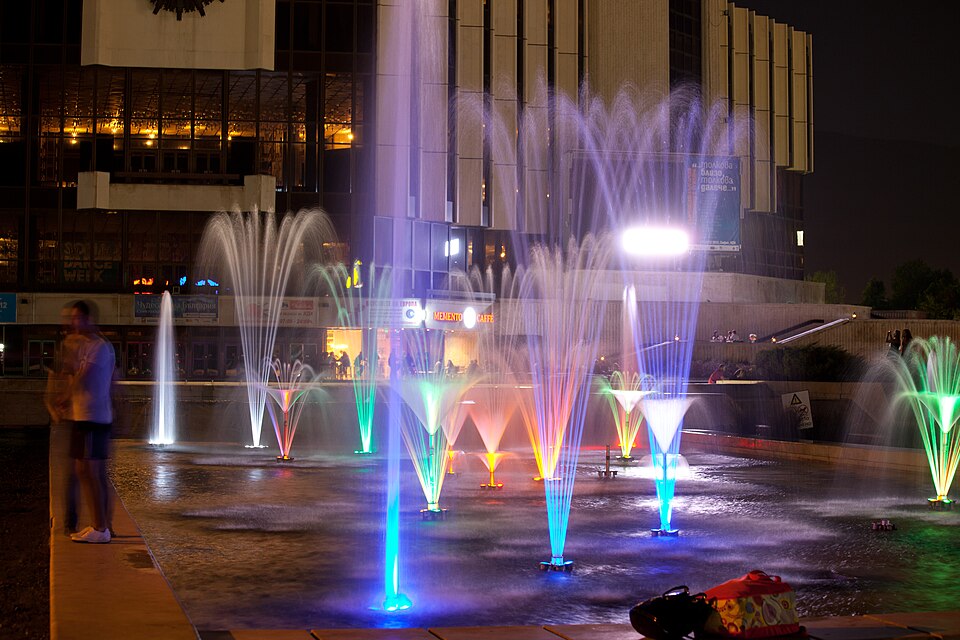
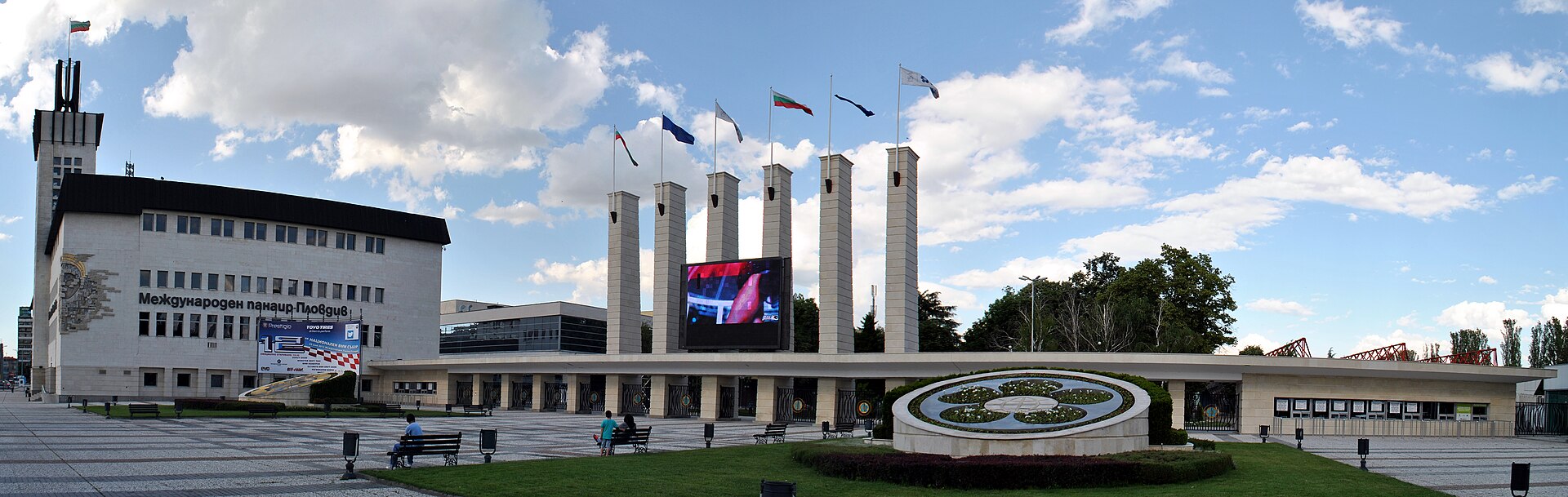
Bulgaria's largest dedicated congress space, with six pavilions of 1,500-capacity each. Ten minutes from Sofia Airport. The default trade-fair and large-exhibition venue.
Eleven levels, 15,000 m² of halls and 6,000 m² of unconventional exhibition space. Named "Best Congress Centre in the World" at the 2005 international awards. The default Sofia plenary and city-centre venue.
Bulgaria's oldest exhibition organiser, founded in 1892 as the First International Agricultural and Industrial Exposition. First Bulgarian member of UFI (the global exhibition industry association, joined 1936). Site spans 352,000 m² with 17 multifunctional halls totalling 159,100 m² of exhibition space.
Twelve multifunctional halls from 50 to 1,000-capacity. Useful base for Black Sea conferences and combined business/leisure trips. Varna airport serves 65 airlines and over 35 countries seasonally.
Six-kilometre beach line, gala capacity 1,000-plus seated, with all-inclusive resort accommodation on site. The default for combined conference plus family-resort programmes (clients can bring families on the company tab and not awkwardly).
For mid-size events of 100 to 500 guests, the Sofia Hotel Balkan, Grand Hotel Sofia, Sense Hotel and Marinela Hotel all have ballrooms suitable for plenaries, gala dinners or board offsites.
Bulgaria has the lowest combined direct-tax burden in the EU. The flat 10 percent rate applies to corporate profits, to personal income for residents, and to capital gains. Dividends are taxed at 5 percent. Social security on salary is split employer 18.92% and employee 13.78%, with caps on the contributory salary base. VAT is 20 percent standard. There is no wealth tax, no inheritance tax between spouses or children, and no significant local business taxes outside specific municipal levies.
Full mechanics, the UK double-tax treaty and how UK pensions are treated are in our Taxes guide.
For British business visitors the practical implications:
If you are moving from "occasional Sofia visit" to "set up a local presence", the routes are well-trodden and cheap. Two main vehicles cover most use cases:
OOD (Дружество с ограничена отговорност, "company with limited liability") is the Bulgarian equivalent of a UK Ltd. Two or more shareholders, minimum capital of €1 (the Commercial Act was amended in late 2025 to denominate this directly in euros, kept low for symbolic reasons), shareholder liability limited to capital contribution. The most common form for SMEs and small subsidiaries.
EOOD (Еднолично дружество с ограничена отговорност) is the single-shareholder OOD. Same minimum capital, same liability cap. Used by sole-trader-style operators or 100-percent-owned UK subsidiaries. The "E" prefix simply means the sole-shareholder variant.
If you do not want a separate Bulgarian legal entity at all, you can register a branch (клон, clon) of your existing UK company. The branch is not a separate legal entity, has no minimum capital, and is taxed in Bulgaria only on its Bulgarian-source profits. Useful where you want a Bulgarian VAT presence and a local hire base without setting up a sister company.
| Feature | OOD | EOOD | Branch (clon) |
|---|---|---|---|
| Separate legal entity | Yes | Yes | No (extension of UK parent) |
| Shareholders | 2 or more | 1 (sole) | n/a (parent owns) |
| Minimum capital | €1 (~€1) | €1 (~€1) | None |
| Liability | Limited to capital | Limited to capital | Parent fully liable |
| Setup turnaround | 3-5 working days | 3-5 working days | 5-10 working days |
| Audit threshold | BG SME thresholds apply | BG SME thresholds apply | Parent's UK audit applies |
| Setup cost (corporate-services firm) | €800-1,500 | €800-1,500 | €1,200-2,000 |
| Setup cost (Big Four) | €3,000-5,000 | €3,000-5,000 | €4,000-6,000 |
| Best for | JVs, multiple founders | UK subsidiary, sole trader | UK Ltd extending into BG |
Capital, audit thresholds and costs verified May 2026 against the Bulgarian Commercial Register at portal.registryagency.bg and the National Revenue Agency at nra.bg. Big Four costs from public quotations (KPMG BG, EY BG, PwC BG, Deloitte BG).
Total typical setup cost using a Bulgarian corporate-services firm: 800 to 1,500 euros. Working with a UK-registered Big Four office in Sofia (KPMG, EY, PwC, Deloitte) is closer to 3,000 to 5,000 euros all-in. Both are dramatically cheaper than incorporating a UK subsidiary in Bulgaria from London-based legal counsel; if cost matters, hire local.
Residency vs business visitFor details on residency permits (separate from incorporation), see our Residency guide. You can own a Bulgarian company without being a Bulgarian resident; the two are independent.
A short checklist of operational details for a Bulgarian business trip that tend to catch first-time visitors:
10 percent flat. Bulgaria has the lowest corporate tax rate in the European Union and one of the lowest personal income tax rates (also 10 percent flat). The combination is the single largest reason multinationals locate shared-service centres in Sofia and Plovdiv.
Smarter than the UK tech sector. Suit and tie is still standard for senior meetings in finance, government, law and traditional industry. Smart-casual is acceptable in startups and creative sectors. Bulgarian counterparts will dress up rather than down for a first meeting.
Almost certainly in tech, finance and outsourcing in Sofia, Plovdiv, Burgas and Varna. Sectors like manufacturing, legal substance, government and traditional industry vary, and it is worth bringing a translator for legal or technical detail. The under-40 generation in cities is fluent; older generations often speak Russian as a second language rather than English.
Yes. The OOD (Дружество с ограничена отговорност, similar to a UK Ltd) is the most common form for SMEs and small subsidiaries. The minimum capital is €1 (about 1 euro). The single-shareholder variant is the EOOD. Registration is online via the Commercial Register; turnaround is typically 3 to 5 working days.
Not expected, but appreciated. A small UK-themed gift such as a single-malt Scotch, branded Fortnum and Mason tea, or London chocolates is well received at a first meeting. Avoid extravagant gifts which can be misread as inappropriate. Branded company items are fine.
The two default venues are the National Palace of Culture (NDK), with 11 levels and 15,000 m² of halls in central Sofia, and the Inter Expo and Congress Center, Bulgaria's largest dedicated congress space at 42,000 m² across six pavilions, ten minutes from Sofia Airport. NDK is the city-centre plenary choice; Inter Expo is the trade-fair and large-exhibition choice.
Substantial and growing. Bulgaria's IT sector contributes around 5 to 6 percent of GDP and employs over 100,000 people. Sofia hosts shared-service centres for HP, IBM, SAP, Coca-Cola, VMware, Telenor and many UK and EU mid-market firms. Plovdiv has a punchy startup scene anchored by NPO and incubators. Burgas is on the Black Sea logistics map. The 10 percent flat corporate tax and EU membership are the two underlying reasons.
You will need to attend a branch in person at least once for KYC. The major banks for foreign-owned entities are UniCredit Bulbank, DSK Bank, Postbank, Eurobank Bulgaria and Raiffeisenbank Bulgaria. Required documents typically include the company's commercial-register extract, the founding documents, your passport, the appointed manager's tax ID, proof of registered address and a description of intended activity. Setup time once you are at the branch is usually 1-2 weeks for a foreign-owned OOD or EOOD. Some banks (Postbank in particular) have foreign-clients desks in central Sofia that handle British corporate clients in English.
The UK-Bulgaria double tax treaty (in force since 2017, replacing the 1987 treaty) prevents the same income being taxed in both jurisdictions. For most people the practical effects are: UK pensions taxed in the UK pay no further tax in Bulgaria; Bulgarian salary taxed at 10% in Bulgaria is credited against any UK liability if you are still UK-resident; dividends from a Bulgarian company to a UK shareholder are subject to a treaty withholding cap (5% if held over 10%, 15% otherwise). For the full mechanics, see HMRC's UK-Bulgaria DTA page and our Taxes guide.
UK nationals need a work permit for paid employment in Bulgaria, since Brexit ended free movement. The standard route is the Single Permit (combined work and residence permit), which the prospective Bulgarian employer applies for. EU Blue Card is also available for highly-qualified workers earning above the standard threshold. Self-employed Brits running their own Bulgarian OOD or EOOD do not need a separate work permit, since they are not "employed" in the legal sense, but do still need a residence permit if staying past 90 days. Our Residency guide covers the routes in detail.
Total social contributions on a Bulgarian salary in 2026 are around 32-33% of gross, split between employer (~18.92%) and employee (~13.78%). The contributions cover state pension, health insurance, unemployment, and accident at work. There is a cap on the contributory salary base (around €1,800 a month from 2026, verify with NRA), so high earners pay social charges only up to the cap. Net take-home for an employee earning €2,000 gross is roughly €1,520 after social charges and the 10% personal income tax. Verify rates each January at nra.bg; the cap typically rises annually.
Indicative ranges from public Sofia tech-recruiter data and StackOverflow Bulgaria 2024-2025 surveys (verify, salaries have moved with the euro changeover): junior developers €1,200-1,800 net per month, mid-level €1,800-2,800 net, senior €2,800-4,500 net, principal/lead €4,500-7,000+ net. Total cost to an employer is the gross plus the ~19% employer social charges. By comparison: a senior developer in London on £80,000 gross is roughly €5,400 net; the same role in Sofia is ~€3,500 net to the employee at roughly half the all-in cost to the employer. This is the labour-cost arithmetic that makes Bulgaria a serious shared-services destination.
Yes, but with care. If you are personally Bulgarian tax-resident (more than 183 days here per year) and are the sole director making management and control decisions in Bulgaria, HMRC and the Bulgarian NRA may both claim taxing rights over the UK Ltd's worldwide profits. The standard fix is either (a) maintain genuine UK substance (a non-Bulgarian director making management decisions in the UK, UK board meetings, UK customers) so the UK Ltd remains UK-resident under HMRC's rules, or (b) re-domicile by setting up a Bulgarian OOD/EOOD and winding the UK Ltd down. Get a UK chartered accountant and a Bulgarian tax adviser who have done this combination before; the UK central management and control test is the trap.

