
In the UK you are a customer. In Bulgaria you are a petitioner. The sooner that lands, the easier every counter, queue and stamp becomes.
This is the hard-won field manual every long-stay British expat eventually writes in their head. We have written it down. Use it before your first ODMVR visit, your first notary appointment, your first KAT registration. It will save you days.
If you only read one section before your first appointment, read this one. The rest of the guide is the long-form behind each row.
| The situation | The British instinct | The Bulgarian move |
|---|---|---|
| You walk into an Obshtina office with no ticket machine | Stand by the door, wait to be acknowledged | Say "Koy e posleden?" out loud, find your place in the invisible queue |
| The clerk says your application is impossible | Sigh, apologise, leave, complain on Facebook | Ask "What is the specific law?" and "What document would help you say yes?" |
| You are asked to sign a form | Sign in whatever pen is offered | Sign in blue ink, in your own pen, matching your passport signature exactly |
| The clerk slowly shakes her head sideways | Walk out assuming a no | That is yes. Wait for the verbal "Da" before reacting |
| You finish a difficult interaction and want to say thanks | A warm smile and a "thank you very much" | Add a small box of chocolates or a packet of coffee, after the work is done, "Tova e za kafe" |
| It is 11:50 and you still have not been seen | Wait until you are called | Politely ask the queue manager; if she says "after lunch" come back at 13:30, not 13:00 |
| A document hands over without a stamp | Fold it, walk out | Ask "Ima li pechat?" until the round blue stamp is on it |
| You are told "the system is down" at 15:35 on a Friday | Argue, escalate, demand a manager | Smile, leave, come back Monday at 09:30. You have just met the weekend |
| Your UK birth certificate is being rejected | Argue that it is the original | Ask which version, authentication or translation step failed, then fix that exact layer |
| The clerk is curt and seems hostile | Match the tone, get defensive | Stay warm, calm, slightly humble. The fastest way through a curt clerk is a polite foreigner |
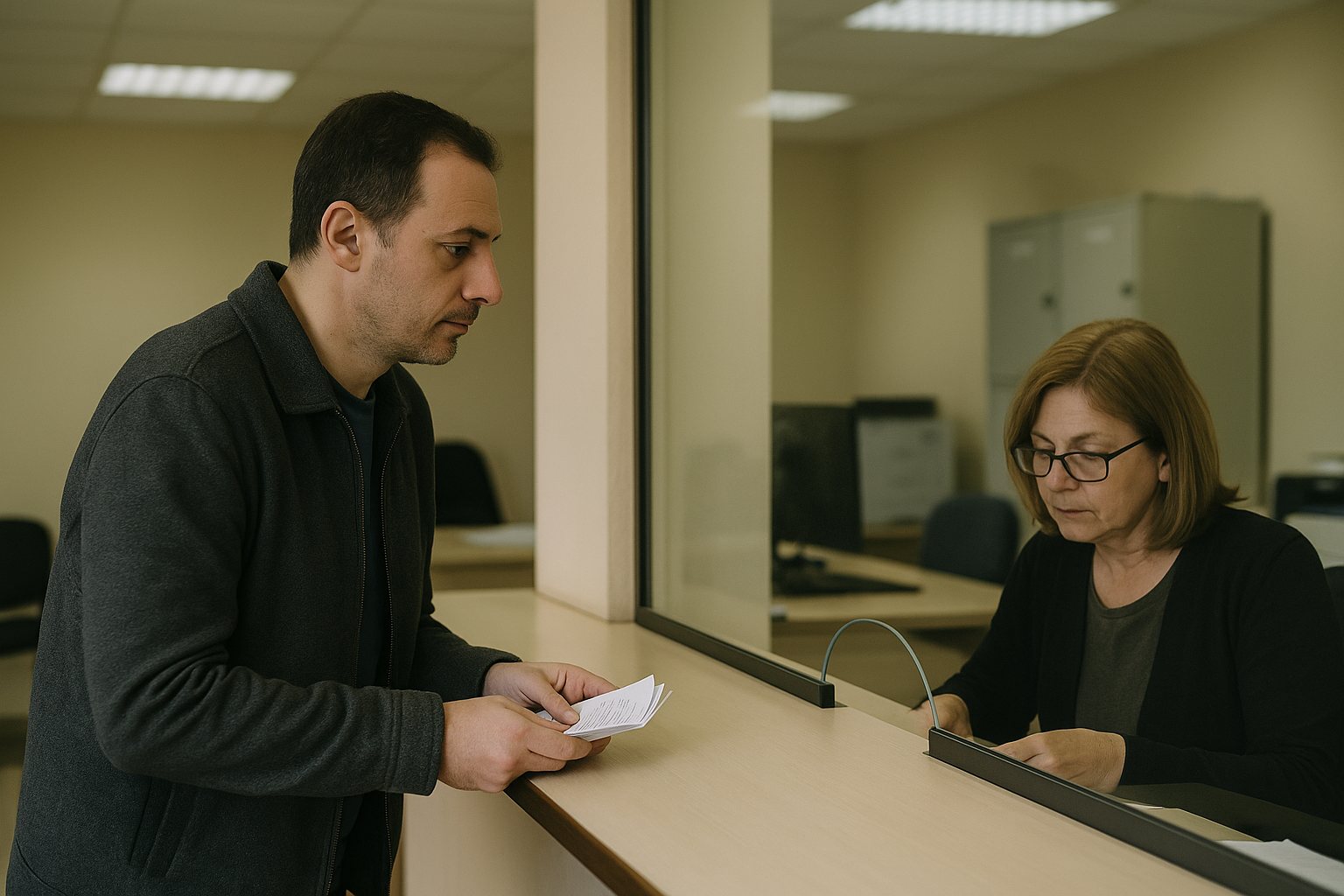
The single biggest culture shock for British expats at a Bulgarian counter is not the language, the queue or the stamp. It is the loss of the customer-service contract.
In the UK, the public sector has spent forty years rewriting itself in the language of customer service. The NHS calls you a service user. HMRC has a customer charter. DVLA refers to "our customers" even when they are issuing fines. The premise is that the state owes you something, and friendliness, signage and queue-tickets are the visible marks of that promise.
None of that applies in a Bulgarian Obshtina office. The clerk on the other side of the glass is not your service provider; she is the gatekeeper of a process the state has decided you must complete. She does not, in any meaningful sense, work for you. She works for the building, the procedure, the law. You are there to ask permission, supply evidence, and accept her ruling. The faster you accept this, the faster everything else works.
This is not Bulgarian incompetence and it is not Bulgaria being "backward". It is a different administrative tradition with deep roots: post-Ottoman registries, the people's councils of the socialist period, an EU accession sprint that grafted modern forms on top of old hierarchies. The system that emerged is rule-bound, paper-heavy and personality-driven all at once. It works on its own terms; it does not pretend to be Tesco.
British expats who arrive in fight-mode lose every contest they enter. The clerk has infinite procedural patience: she does this all day, every day, and a foreign man going red in the face is the eleventh person who tried that on her this year. She will not bend the rule. She will, however, quietly downgrade your visit from "we will find a way" to "we will follow the procedure exactly". You will walk out with less, not more.
Anger also breaks the relational fabric. Bulgarian small-town administration runs partly on personal vrazki (connections) and partly on collective memory: the office knows who you are, who your neighbour is, who your notary is. The reputation of the rude British man in the green jacket spreads through the building in a morning. Be the calm, respectful one. The cost is one breath. The benefit is a working career of polite cooperation.
She holds the keys to your Bulgarian life. Understand who she is, what her day looks like, and the rest of the etiquette writes itself.
In Bulgarian administrative offices, the front-line role is overwhelmingly female. She is typically in her forties or fifties, has worked in the same building for ten to twenty years, knows every form by its number, and has seen every version of the foreigner who shows up confused. The phrase "Lady Behind the Glass", coined by long-stay British expats and now bilingual shorthand on the Shumen and Sofia expat Facebook groups, captures the role with affection: she is the gatekeeper, not the enemy.
She arrived at 08:30. She has already processed forty file numbers in the queue system. She has had two arguments with citizens who came without the right document. She is on her third coffee. She has half an eye on her colleague to the right who is taking too long with a Russian-passport application. She has a strict procedural manual in her head and limited discretion outside it. Most of the small kindnesses she can offer (interpreting a borderline document liberally, telling you which day next week is quieter, accepting a slightly imperfect signature) are gifts, not entitlements.
If a Bulgarian document does not carry a Pechat, it does not exist. This is the single most consequential rule in the whole administrative tradition, and the easiest to forget.
The Pechat (Bulgarian: печат, literally "stamp" or "seal") is the round rubber stamp pressed in dark blue ink onto official paperwork. It contains the institution's name in Cyrillic, often a serial number, and sometimes a small national crest. It is the visible mark that an authorised official has handled the document on behalf of the institution. Without it, your paper is just paper.
Effectively, any document that will later be presented to another institution must carry the issuing institution's stamp. A signature alone is not enough. A printed letterhead is not enough. A signature plus letterhead is not enough. The stamp is what makes the document a document.
Има ли печат?
Ima li pechat?
"Is there a stamp?" Ask this every single time, before you slide the document into your folder and walk away from the counter. If the answer is "Not yet", wait. If she says "Not needed for this document", believe her, but make a mental note for your follow-up at the next counter.
The cost of asking is one polite sentence. The cost of not asking is the trip back across town three days later when the notary refuses your unstamped birth certificate.
Bulgaria is slowly digitising. A growing number of offices now issue PDF documents with a digital signature and a QR-coded verification stamp. Officially these are equivalent to the wet stamp; in practice, some receiving institutions still ask for a paper original. The safe move when collecting a document: ask for both the digital version (emailed to you) and a printed, wet-stamped original (handed over at the counter). The printed original is your insurance against the next clerk who has not caught up with the e-government roll-out.

Many processes require a stamp from Office A before Office B will even look at your file: an address registration stamp from the Obshtina before ODMVR will issue a residency card, a tax-clearance stamp from NRA before the notary will sign a property transfer. Always ask the receiving office which prior stamps they need to see, and then collect them in the right order. Trying to skip a stamp upstream is the most common reason a foreigner makes four trips for a one-trip job.
All Bulgarian signatures, on all official documents, must be made in blue ink. Black ink is regularly rejected. Carrying your own blue pen is the smallest tactical upgrade in this whole guide.
The reasoning is practical, not aesthetic. A blue signature visibly differs from a black photocopy, which proves the document you are holding is the original. Bulgarian administrative paper is duplicated, scanned, faxed and re-printed constantly; the blue signature is the visual anchor that distinguishes a master copy from any derivative. A black-ink signature can be mistaken for a printed copy and is therefore presumed invalid until proved otherwise.
Long-stay British expats carry a small zipped pencil case with: two blue BICs, two black BICs (for the rare form that asks for black), a glue stick (for occasional photo attachment to forms), and a small stapler. The whole kit weighs 200 grams, fits in a tote bag, and saves at least one trip per appointment. The Lady Behind the Glass clocks it instantly and treats you with the respect she reserves for citizens who know what they are doing.

A rejected UK document is often a chain problem: the wrong version, the wrong signature authenticated, an incomplete translation or an unmet freshness rule. Confirm the receiving office's checklist before you spend.
The Hague Apostille authenticates the origin of a public document, such as its signature, official capacity or seal. Bulgaria and the UK are both parties to the Apostille Convention, but this does not mean every UK document for every Bulgarian purpose needs one. The receiving authority decides which evidence it accepts.
An Apostille does not certify that the document's contents are true. It also cannot cure the wrong kind of copy, the wrong signature, a missing page or an unmet recipient freshness rule. Ask the clerk what defect must be corrected before ordering another treatment.
Bulgarian counters routinely compare the signature you make on a new form against the signature on file: your passport, your earlier residency card, your previous notarial act. Any visible difference is grounds for rejection. The Shumen and Sofia expat Facebook groups report a steady drumbeat of "signature mismatch" stories every month.
The fix is preventive. Before any significant appointment:
Bulgarian institutions distinguish ruthlessly between originals (with wet stamps and blue signatures) and copies (photocopies, scans, screenshots, printed PDFs). Re-printing a colour scan of an original is not equivalent to producing the original. If you are presenting a document at multiple institutions and need parallel copies, ask the issuing institution for two or three originals at the same time, or have a notary make certified copies (a notarial nóterski prepis) for around 3 to 5 EUR per page.
A Bulgarian queue is mostly invisible. You join it by asking the right question out loud, and you hold your place by being ready when called. The mechanics are simple; the discipline is everything.
The Bulgarian word gishe (гише) means "service window" or "counter": the place where the public meets the institution. The protocol around the gishe varies slightly by office type, but three patterns cover ninety per cent of cases.
This is the pattern that catches British arrivals out most. There is no machine, no signage, no obvious order. People are seated on chairs along the wall, standing in the corridor, drifting in and out of view. The queue exists; you just cannot see it.
The protocol is verbal, and the question that unlocks it is:
Кой е последен?
Koy e posleden?
"Who is last?" Ask this clearly the moment you walk in, even if the room looks empty. Whoever answers (often a small nod or a raised finger as much as a word) is the person directly in front of you. You watch their movements; when they go in, you are next.
The reciprocal obligation matters: the next person who walks in will ask the same question, and you must answer "Az" ("Me") or raise a hand. If you fail to answer, the next arrival accidentally cuts in front of you, and you have lost your place through silence. Standing mute in a Bulgarian queue does not protect your position; it forfeits it.
Booked online or by phone. Turn up ten minutes early. Sit and wait until your name is called. Do not try to get seen earlier just because the queue looks short; appointments and walk-ins are different streams.
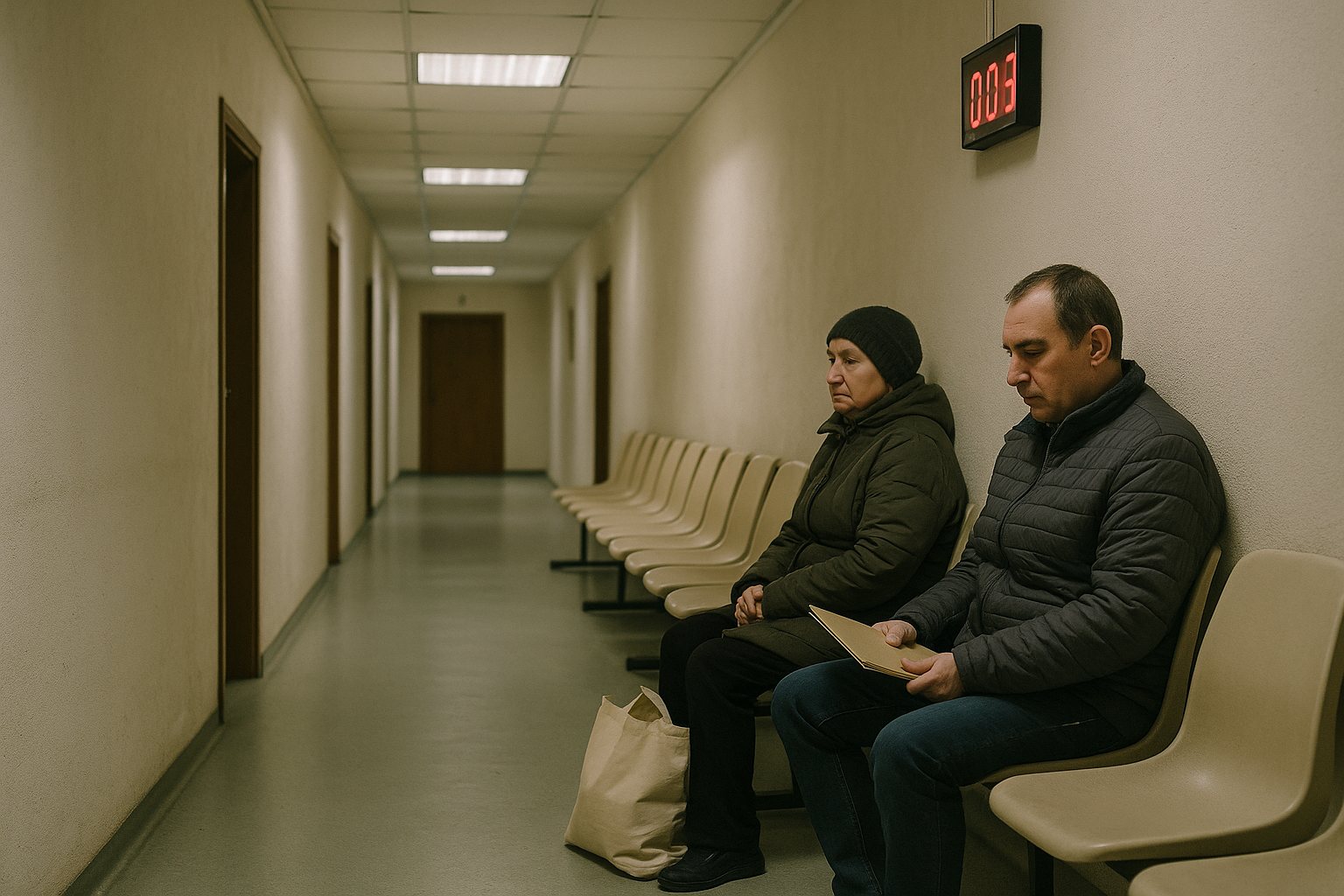
When you arrive matters more than what you carry. The Bulgarian administrative day has rhythms; respect them and your hit-rate doubles.
Most Bulgarian municipal, migration and tax offices open at 08:30 or 09:00 and close at 17:00 or 17:30, Monday to Friday. CAO ("front desk") windows often start a little later and close a little earlier than the back-office bureaucracy: 09:00 to 17:00 is a safe assumption, with last application received at 16:30. Friday closing is sometimes 16:00. Banks have shorter public-facing hours, typically 09:00 to 16:00 or 16:30.
The website printed hours are correct in the abstract and approximate in practice. The clerk's coffee, the system's mood and the day of the week all bend them.
The single most important time-window to internalise. The official lunch break is 12:00 to 13:00. In practice, the building empties from about 11:45 (clerks tidying up to leave) and refills around 13:15 (clerks settling back in with a fresh coffee). Anything you try to do in this 90-minute window will be politely deferred, ignored or half-done. Walk-ins are turned away. Phones are not answered. The system, mysteriously, is often "down".
This is not malice. It is a hard cultural norm. The lunch break is sacred. Across the country, in offices, building sites, schools and shops, twelve o'clock is the moment the working day pauses. Do not try to fight it. Plan around it.
| Window | Why it works | Caveat |
|---|---|---|
| 09:30 to 11:00 Tuesday to Thursday | Staff fresh, queues short, system reliably up | Monday mornings can be busier with the weekend backlog |
| 13:30 to 15:00 Tuesday to Thursday | Post-lunch, staff calm, queues shorter than pre-lunch | Avoid if you need a colleague who left for a half-day |
| 09:00 sharp on Wednesday | The administrative sweet spot. Cleanest queues of the week | None worth listing |
"The system is down" (Sistemata ne raboti) is sometimes literally true and sometimes a polite Bulgarian way of saying "I cannot help you right now". Decoding it:
The correct response in every case is the same: "Razbiram, mersi, shte se vurna" ("I understand, thank you, I will return"). Push back and you bank a refusal; smile and leave and you keep the option open.
The Bulgarian head gestures for yes and no are the inverse of the British ones. Misreading them once costs you an appointment; misreading them twice costs you a week.
You ask "Mozhe li da podam dokumentite dnes?" (Can I submit the documents today?). The clerk pauses, looks up, and slowly tilts her head side to side. Your British instinct reads this as "no, sorry, can't help you". Her actual meaning was "yes, of course". You collect your papers, apologise, and walk out. She is mildly puzzled. You return three days later to do exactly what she would have done for you on day one.
In any consequential exchange, do not read the gesture. Read the verbal answer.
| Bulgarian word | Meaning | Translation |
|---|---|---|
| Да (Da) | Yes | Unambiguous yes |
| Не (Ne) | No | Unambiguous no |
| Може (Mozhe) | "It is possible" | Effectively yes, sometimes with conditions |
| Съжалявам (Suzhalyavam) | "I'm sorry" | Soft no, sometimes negotiable |
| Не може (Ne mozhe) | "It is not possible" | Hard no, often negotiable on closer questioning (see Section 10) |
| Очаквайте (Ochakvayte) | "Wait" / "expect" | You are in the queue or pipeline; sit down |
If the gesture and the word disagree, trust the word. If you are unsure, ask "Da ili ne?" (Yes or no?) and pause for the verbal answer. A second confirmation never offends; a misread gesture often does.
In Bulgarian administration, "no" is rarely a final answer. It is the first move in a longer conversation. Knowing the moves changes everything.
The Respectful Persistent Foreigner is the tactical posture that long-term British expats develop, usually unconsciously, after their third or fourth Obshtina visit. It has three components, in that order: respect first, persistence second, foreignness third. Getting the order wrong is the difference between a clerk who quietly helps you and a clerk who has decided you are a problem.
Once you have established yourself as a respectful interlocutor, persistence becomes possible without offence. The two questions that turn a flat "no" into a workable plan are:
Кой е конкретният член от закона?
Koy e konkretniyat chlen ot zakona?
"What is the specific article of the law?" This question is respectful (you are accepting that there is a law) but persistent (you are asking to see it). Half the time she will point at a printed reference. The other half she will pause and reconsider whether the rule actually applies to your case.
Какъв допълнителен документ би помогнал?
Kakuv dopulnitelen dokument bi pomognal?
"What additional document would help?" This is the magic question. Most flat refusals in a Bulgarian counter are about an evidence gap, not a principled rejection. Asking what specific extra piece of paper would change her mind shifts the conversation from confrontation to collaboration.
Other useful persistence moves, in escalating order:
Being visibly foreign is sometimes an asset, sometimes a liability. Used right, a small admission of confusion ("I do not understand this Bulgarian procedure, I have only lived here for X months, please help me get this right") triggers the helpful instinct most clerks have for visibly out-of-their-depth foreigners. Used wrong (demanding English service, complaining about the system, citing "what we do in Britain"), it triggers the defensive instinct and the file goes to the bottom of the pile.
The line is: present your foreignness as a reason you need her expertise, never as a reason the rule should bend.
Sometimes the answer really is no and no amount of polite persistence will change it. Signs you have hit a real wall: the clerk has consulted a printed regulation, has shown you the regulation, and has invited you to read it; or she has fetched a colleague who confirms the answer; or she has politely written down what you need to do differently next time. In those cases the right move is gracious acceptance. "Mersi mnogo za vremeto. Shte podgotvya dokumentite kakto trrabva." ("Thank you very much for your time. I will prepare the documents as required.") Then leave. The relational dividend matters more than this one visit.
A small thank-you gift after the work is done is normal Bulgarian etiquette. Cash, ever, anywhere, is a crime. The line between the two is sharper than first-time expats think.
This is the section British expats worry about most and need the clearest guidance on. Let us draw the line first, then explain it.

Bulgarian criminal law (Penal Code articles 301 to 307) treats bribery of public officials as a serious offence, with penalties of up to ten years' imprisonment for the giver and the receiver. The line is not "what the clerk will accept"; it is "what the law forbids". Cash is forbidden. A request for cash from a clerk should be politely declined and reported (the Inspectorate of the Council of Ministers has an anti-corruption hotline; the Anti-Corruption Commission accepts complaints).
A thank-you gift after the work is done is not a bribe. A small payment to make a problem go away is. The distinction is the law's, not the clerk's. Stay firmly on the right side of it and your Bulgarian administrative career will be untroubled by it.
An older piece of bilingual expat folklore: town clerks (Sofia, Plovdiv, Varna, Shumen city centre) generally prefer premium imported coffee (Lavazza, Illy, Segafredo) as a small gift, while village kmetstvo clerks and older rural officials often prefer Jacobs (the long-established Bulgarian-market favourite). The folklore is half-joking but contains a useful kernel: match the gift to the recipient's tastes, not your own assumption that "more premium is more respectful". A 200g vacuum-pack of Jacobs Kronung handed over with the right words is a perfect village-hall gift; a 250g tin of Illy in the same setting can read as a foreigner showing off.
Six offices cover ninety per cent of a Shumen British expat's administrative life. Here is what each one looks like, what to bring, and the etiquette quirks specific to each.
Address: Blvd. Slavyanski 17, Shumen 9700. Phone: +359 54 857 777. Website: shumen.bg.
The administrative heart of the city. Ground floor houses the CAO (Centre for Administrative Services), the single most-used desk for British expats: address registration, civil-status certificates, local-tax payments, parking permits, building permits.
Migration Address: Blvd. Slavyanski 30. KAT (Traffic Police) Address: ul. Universitetska 1. Phone: +359 54 854 444 (general police line, ask for Migration).
The single most important office for non-Bulgarian citizens. Residency cards, status changes, address updates within Bulgaria, visa renewals, certificate-of-status requests.
Address: ul. Universitetska 1, Shumen. Same complex as the broader ODMVR but separate counters.
Vehicle registration, driving licence exchange (UK to Bulgarian), licence renewal, vehicle deregistration, change of ownership. The classic foreigner KAT visits are the post-arrival driving-licence exchange and the post-purchase vehicle registration.
For the full driving-licence process, see our Driving in Bulgaria guide; this section covers the etiquette layer only.
Asya Asenova: Blvd. Slavyanski 13. Central, professional, used to working with expats. Stanimir Ganchev: ul. Saedinenie 105. Property-focused, strong on stamp work.
The temple of the Pechat. You meet a notary for property purchases and sales, marriage settlements, wills, powers of attorney, and any document where Bulgarian law requires notarial form. Notarial acts are formal, recorded in a registry, and effectively unappealable once signed.
See our Buying Property guide for the substantive process around notarial property transfers.
Central branches on Blvd. Slavyanski. Used for state-fee payments where the office requires bank-paid (rather than POS-paid) fees, for opening or operating a Bulgarian current account, for property-purchase fund transfers, for residence-supporting bank confirmations.
See our Banking in Bulgaria guide for account-opening and ongoing banking operations.
Two distinct offices, easily confused. NRA (Natsionalna Agentsia za Prihodite) handles income tax, VAT, social contributions, and tax residency. The local tax office, inside the Obshtina ground floor, handles property tax, garbage tax, vehicle tax.
For tax substance, see our Bulgarian Tax guide. This section is etiquette, not tax law.
Strictly speaking not a state office, but translation providers are often part of cross-border administration. Ask the receiving office or notary which translator qualifications and signature certification it accepts before choosing a provider. A convenient local agency is not automatically authorised for every legal purpose.
Bulgarian state fees are small by UK standards, but the payment mechanics are fiddlier than they need to be. Get the kit right and you save a trip.
| Document | Standard (~30 days) | Fast (~10 days) | Express (~3 days) |
|---|---|---|---|
| Permanent residence card | ~23 EUR | ~46 EUR | ~115 EUR |
| Long-term residence card | ~23 EUR | ~46 EUR | ~115 EUR |
| Address registration certificate | ~3 EUR | ~5 EUR | ~8 EUR |
| Birth/marriage certificate copy | ~3 EUR | n/a | ~5 EUR |
| Notary signature verification | ~3 to 5 EUR per page | n/a | n/a |
| Notary certified copy | ~3 to 5 EUR per page | n/a | n/a |
| Translation (per civil-status doc) | ~10 to 20 EUR | same | ~20 to 35 EUR same-day |
| UK paper Apostille | 45 GBP plus return delivery | No public fast paper route | No public same-day paper route |
All Bulgarian fees are 2026 euro estimates from Shumen offices, verified May 2026. Bulgaria adopted the euro on 1 January 2026 (fixed conversion 1 EUR = 1.95583 BGN); the lev is no longer legal tender, though older officials and printed fee schedules occasionally still quote the legacy lev figure. Always confirm the current euro fee on the day; minor adjustments happen at the start of the fiscal year.
Most Shumen administrative offices now accept card payments via a counter-mounted POS terminal. A few still charge a small (50 cents to 1 EUR) convenience fee for card use; many do not. Some smaller kmetstvo village halls have no POS at all and are cash-only.
Practical rule: always assume cash will be needed as a fallback, even where POS is normally available. The terminal can be down, the receipt printer can be out of paper, the card network can be temporarily unreachable. Carrying 25 EUR in 5s and 10s (and an additional 100 EUR in 20s for express fees if you are at ODMVR) takes the friction out of every visit.
For some larger or older fee categories, the office cannot accept payment at the counter and instead issues you a payment slip with a reference number; you walk to a UniCredit Bulbank or DSK Bank branch, pay there, get the stamped bank receipt, and bring it back to the originating office. This is procedural, not a personal inconvenience. The bank receipt itself becomes part of your file.
Allow 30 minutes for the bank round-trip in central Shumen, longer at month-end or pension days.
Every payment generates a receipt; every receipt is potentially needed later. Build the habit of folding the receipt into the application file on the day, not into a wallet pocket. Receipts that prove a state fee was paid have saved British expats from repeat payments more than once when "the system" lost a record.
How you leave a counter shapes how the next visit begins. Spend the final ninety seconds of every appointment well and you bank credit you will draw on for years.
The farewell "Priyatna rabota" deserves a dedicated note because it is so culturally specific and so warmly received. Literally "pleasant work", it acknowledges that the person you are leaving still has hours of work ahead. British "have a nice day" is generic; "priyatna rabota" is specific to the situation, recognises the labour, and reads as the speech of someone who understands the local context. Older Bulgarians especially appreciate it.
Every time you leave a counter politely, prepared, on time and with a small kindness, you put a coin in a relational savings account with that office. The deposits accumulate. After three or four visits, you are no longer "a British expat"; you are "the polite Mr Dane who comes on Tuesdays". The Lady Behind the Glass remembers. Her colleagues hear about you. The building changes shape around your visits.
Over a year, this dividend is enormous. Documents are accepted with less scrutiny. Soft deadlines are interpreted in your favour. A clerk you have not previously met will quietly ask a colleague "is this the British man Galina mentioned?" and the answer is "yes, he is fine". You will never see this happening; you will only see the smoother visits as the cumulative result.
Treat every counter like the start of a ten-year relationship, even when you only need a single certificate. The cost is one box of chocolates per six months and a deliberate sixty-second exit. The benefit is the rest of your Bulgarian administrative life.
The questions Shumen.UK readers ask most about Bulgarian bureaucratic etiquette, with answers anchored back to the main text.
It is the affectionate British expat shorthand for the clerk seated behind the service counter at any Bulgarian government office: the municipality (Obshtina), the migration desk (ODMVR), the traffic police (KAT), the tax office (NRA), the property registry, the notary. She (it usually is a she) decides whether your paperwork is complete, whether your signature is acceptable, whether the system "sees" you today. The phrase is not pejorative; long-term expats use it with respect. She is the gatekeeper of your Bulgarian life, and winning her over by being calm, prepared and respectful is the single most useful skill you will learn here. → Section 3 (Lady Behind the Glass)
Pechat (печат) is the rubber office stamp. In Bulgarian administration, an unstamped document does not legally exist, no matter how many signatures it carries. Always ask "Ima li pechat?" (Is there a stamp?) before you walk away from any counter. The stamp is usually round, dark blue, and contains the institution's name and a serial number. A document without it is fit only for the bin. → Section 4 (Pechat)
Because a blue ink signature visibly differs from a black photocopy and proves the document you are holding is the original. Black ink can be mistaken for a printed copy and is regularly rejected. Carry your own blue ballpoint pen to every appointment; it marks you out as a pro-mover rather than a tourist. Some clerks will hand you a chained pen at the counter, but bringing your own is faster, cleaner and saves the small humiliation of being told "not that one, the blue one". → Section 5 (Blue ink)
If there is a ticket machine (CAO desks in larger Obshtinas have them) you take a number and watch the screen. If there is not, the queue is invisible and you join it by walking in, looking around and asking out loud "Koy e posleden?" (Who is last?). Whoever answers is the person you follow. After you join, the next person to arrive will ask you the same question. Standing silently without asking marks you as a queue-jumper, even if you have not jumped. It is the single most British-friendly piece of Bulgarian etiquette because it solves the very British problem of not knowing how to start a queue. → Section 7 (Gishe protocol)
The lunch break, roughly 12:00 to 13:00 and in practice closer to 11:45 to 13:15, when most counter staff disappear and the building goes quiet. Major business attempted in this window will be politely deferred or quietly ignored. Friday afternoon after 15:30 has a parallel pattern: "the system is down" is often code for "the weekend has started". Plan your visits for 09:30 to 11:30 or 13:30 to 15:00 and your hit-rate on getting things done in one trip jumps dramatically. → Section 8 (Ghost Hour)
Yes, traditionally and in older or rural settings, a sideways head shake (a slow horizontal wobble) means yes and a nod (a downward jerk of the chin) can mean no. Younger urban Bulgarians and anyone who has worked with foreigners often switch to the international convention to avoid confusion, but at a municipal counter, especially with older staff, you will meet the original gesture. The safe move is to read the verbal answer rather than the head: "Da" is yes, "Ne" is no, "Mozhe" is "it is possible". When in doubt, ask "Da ili ne?" (Yes or no?) and let the words settle it. → Section 9 (Gestures)
A small thank-you gift after the work is done, presented openly with the words "Tova e za kafe" (this is for coffee), is socially normal and not a bribe. A box of chocolates (Lindt, Ferrero Rocher, Milka), a packet of good ground coffee (Lavazza or Illy in town, Jacobs in a village kmetstvo) or a single bottle of wine at Christmas all fit this category. What is a bribe and is illegal: cash in any amount, a request to skip the queue, an offer to pay a "special price" for a faster decision. Never offer the gift at the start of the conversation; only after the clerk has helped you, or on a return visit to thank her for past help. The gift acknowledges the human effort in a rigid system, not the outcome. → Section 11 (Gifts)
Do not assume the only problem is a missing Apostille. The office may need a different original or certified copy, a particular signature authenticated, a complete translation, a fresher underlying certificate or a different certification route. Ask the receiving clerk to identify the exact defect in writing. A UK Apostille authenticates the document's origin, not its contents, and the standard paper service costs 45 pounds plus return delivery with processing normally within 25 working days, checked 12 August 2026. Use the official-documents guide's rejection diagnostic before ordering again.
The tactical mindset for navigating a Bulgarian counter when the first answer is no. Respectful: dress smartly, greet politely in Bulgarian ("Dobur den, gospozho"), wait for eye contact before sliding paperwork through, never raise your voice, never argue the principle. Persistent: when told no, do not leave. Ask what specific law applies, ask what specific extra document would help her say yes, ask whether a different colleague handles this case. Foreigner: lean into being slightly confused and clearly out of your depth; many clerks would rather quietly help you than spend ten minutes explaining why they cannot. The combination converts most flat refusals into a workable plan within two or three visits. → Section 10 (Managing no)
At ODMVR (the migration office) in 2026, the standard track is around 30 calendar days for roughly 23 EUR of state fees, a fast track is around 10 days for roughly 46 EUR, and an express track is around 3 working days for roughly 115 EUR. Fees are paid at the office POS terminal or, in some smaller offices, in person at a UniCredit Bulbank or DSK Bank branch with the original receipt brought back. Always confirm current fees on the day, ask whether the office POS accepts your card, and carry 25 EUR in 5 and 10 EUR notes as a fallback. Practical figures from Obshtina Shumen and ODMVR Shumen, May 2026. → Section 13 (Fees)
Bulgarian counters routinely check your signature against the one on your passport, ID card or earlier filed document, and reject anything that visibly differs. The fix is preventive: practise an exact-match version of the signature on your most recent UK passport before any appointment, and use that one consistently across every Bulgarian document. If your real signature has drifted over the years, slow down at the counter, take a breath and copy what is on the passport rather than freestyling. A "signature rejection" is one of the most common single reasons a British expat walks out of an Obshtina without their document, and it is entirely avoidable. → Section 6 (Documents)
Yes. A Bulgarian-speaking friend may help with an ordinary counter enquiry, but a notarial act, court filing, marriage or other formal procedure may require a professional interpreter or translator with qualifications the receiving body accepts. Ask the office or notary in advance who may interpret, whether an appointment is needed and how any written translation must be certified. Brief the person on the purpose and documents before the visit so they can explain the request clearly rather than discover the case at the window.
"Dobur den, gospozho" (Good day, madam) or "Dobur den, gospodine" (Good day, sir), said clearly, with eye contact, and then wait. Do not slide your papers across the counter until she asks. If she has not looked up, give her a moment; she is mid-keystroke on the previous case. The opening greeting carries enormous weight: it marks you as someone who has bothered to learn the local form, which buys you patience for the rest of the conversation. → Section 3 (Lady Behind the Glass)
Bulgarian bureaucracy is not broken. It is a coherent administrative tradition with its own rituals, rhythms and rewards. British expats who arrive expecting customer service spend their first year bouncing off it; British expats who arrive understanding the petitioner posture spend the same year learning a craft that serves them for the rest of their life here.
Five rules hold the whole craft together:
Practise these five and the Lady Behind the Glass quietly becomes an ally. Skip them and she stays, by default, a gatekeeper. The choice is yours, and you make it every time you walk through the door.
Related guides: Residency & the Type-D visa · Getting Married in Bulgaria · Buying Property · Driving in Bulgaria (KAT) · Banking in Bulgaria · Bulgarian Taxes · Legal Basics · Funerals, Wills & Inheritance · Bulgarian Phrasebook · All guides.