Getting Around Bulgaria Without a Car: The British Expat's 2026 Transport Guide
"Can I live in Bulgaria without a car?" is five questions in disguise, because Bulgaria does not have one transport system, it has five. BDZ trains for the intercity grid. A fragmented intercity coach network with no national planner. A dense urban tram-and-bus mesh in the bigger cities, plus the Sofia Metro that has quietly become one of the cleanest, cheapest underground systems in Europe. Marshrutka minibuses for the last-mile to villages. Taxis and the two ride-hailing apps that have made night travel safe. The art is knowing which mode to use for which leg, and how to bridge the missing aggregator (no Trainline-equivalent exists; you build journeys across multiple operator sites). This guide walks through the Five-Mode Network, names the Single-Planner Gap and explains the Last-Mile Rule that decides whether car-free life is workable in your chosen Bulgarian town. Cross-links to the Driving guide if you eventually decide you DO want a car, and to the Buying a Car guide for the import / ownership mechanics.
By Adrian Dane · First published May 2026 · Last reviewed May 2026
🚆 Five-Mode Network⚠ Single-Planner Gap🚌 Marshrutka = the last mile🚇 Sofia Metro < 1 EUR a ride🚗 TaxiMe / Yellow! over street hail🇨🇩 UK rights via EU 1371 / 181
Transport needs depend on which kind of British expat you are. Find yourself in the table; the rest of the guide explains each row.
If you are...
Your best transport mix
First action
Settling in central Sofia, want to skip car ownership entirely
Sofia Metro + tram / bus monthly pass; TaxiMe at night; BDZ + coach for trips to Plovdiv / Varna / Burgas; rental car for the occasional village run
Buy the 25 EUR monthly Metro+surface pass on the MPass app; install TaxiMe and Yellow!.
Settling in Plovdiv or Varna, want minimal driving
City bus network + occasional taxi; BDZ to Sofia; coach to nearby regional centres
Buy a monthly city pass at the operator counter (typically 20-30 EUR); install local urban-transit app.
Settling in Shumen, Pleven, Vidin, Sliven, Ruse
Local taxis for in-town; intercity coach for Sofia / Varna; train for some routes; rental car for villages
Identify the avtogara (bus station) and walk it before you need it; save TaxiMe to your phone.
Bought a village house, no car
Marshrutka to the nearest town once or twice a day; bicycle for short hops; an occasional Sofia trip via coach or train
Stand at the village bus stop on a weekday morning to learn the actual marshrutka pattern; talk to the village shop.
Living in Sunny Beach / Burgas region (seasonal)
City bus 15 to Burgas airport; bus 16 / 18 between Burgas city and Sunny Beach; ride-hailing for nightlife
Pick up a Burgas regional bus timetable on arrival; cross-reference with our Sunny Beach guide.
UK pensioner staying with family / second home
BDZ for scenic intercity (Sofia-Veliko Tarnovo-Varna is a beautiful train); coach for everything else; airport-day metro to Sofia
Buy a BDZ senior discount if you qualify (over-60 fare reductions on certain services).
Travelling Sofia-Plovdiv-Veliko Tarnovo-Varna for tourism
BDZ rail trip combined with a couple of coach legs; budget hotel walking-distance to each station
Book BDZ at bdz.bg/en a day or two ahead for advance fares; coach legs at the station counter on the day.
Need to get to the Balkan or Rhodope mountains for hiking / skiing
Coach + marshrutka combination; some routes have direct ski-resort buses from Sofia in winter
For Bansko, the dedicated Sofia-Bansko coaches run hourly in winter from the Ovcha Kupel and Central Bus stations.
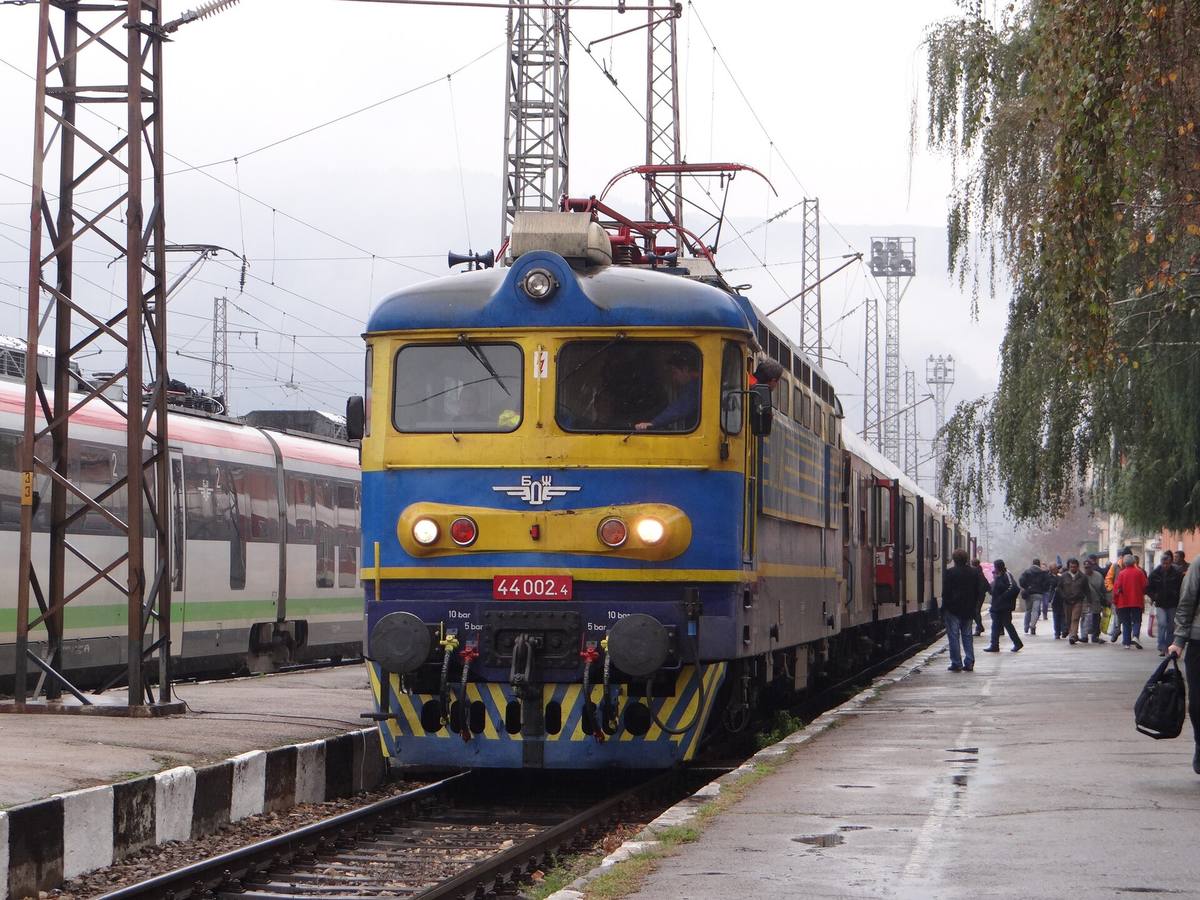
A BDZ class 44 locomotive at Pernik railway station, on Bulgarian State Railways' western network. BDZ is one corner of the Five-Mode Network: slow but reliable, cheap by European standards, and the easiest way to read while the country moves past your window. Photo: bdz_trainspotters via Wikimedia Commons, CC BY 3.0.
Section 2
The Five-Mode Network
Bulgaria has five distinct transport modes that connect British expat life to the rest of the country. Each has its own operator, its own ticketing logic, its own strengths and its own failure modes. The art of car-free life is knowing which mode to reach for in which situation.
Mode
What it does well
What it does badly
Typical British-expat use
1. BDZ rail
Cheap fares, scenic, predictable timetable, comfortable for long sit-down journeys, big-luggage friendly
Slower than coach on many routes, fewer services than Western Europe, smaller stations have limited English
Fastest mode for most A-to-B journeys, frequent services on the main corridors, modern fleet, motorway running on Trakia / Hemus / Struma
Operator-fragmented, no national online planner, terminals can be chaotic, luggage limits
Sofia-Shumen, Sofia-Veliko Tarnovo, regional centre to regional centre
3. Marshrutka / village bus
The only mode that reaches actual villages; cheap; flexible drop-off points
Sparse timetables, often only 1-3 services a day, no online planner, no English signage
Town to surrounding village; first-and-last-mile linkage to the rail or coach grid
4. Urban transit (metro / tram / bus / trolleybus)
Dense in Sofia / Plovdiv / Varna / Burgas; cheap monthly passes; sane apps; high frequency
Mostly limited to the city limits; older trams in Sofia and Plovdiv can be slow
Daily commute, shopping, school run, hospital appointments in cities
5. Taxi and ride-hailing (TaxiMe, Yellow!)
Door-to-door, 24/7, app-based fare lock; safer than street hail; cheap by Western European standards
Taxi-scam exposure on unmarked vehicles at airports and tourist sites; app coverage thinner in smaller towns
Airport transfer, late-night returns, suitcase-heavy day, hospital trips, village runs where no marshrutka fits the time
The mode-stacking habit. A real Bulgarian journey is almost always two or three modes stacked end-to-end. Example: Shumen village house to a Plovdiv hospital appointment is marshrutka to Shumen avtogara, intercity coach to Plovdiv, then Plovdiv city bus to the hospital. Each leg costs 2-10 EUR; the whole trip is materially cheaper than a hire car and much less stressful than driving down the Hemus motorway in winter. Get comfortable thinking in stacks, not single trips.
Section 3
The Single-Planner Gap
The single biggest difference between Bulgarian and UK transport is the absence of a nationwide planner. There is no Trainline, no National Rail Enquiries, no Citymapper-equivalent that covers every mode in one search. The journey-building skill that British movers learn first is how to bridge this gap.
Why the gap exists
BDZ owns rail. The intercity coach market is dozens of operators (Union Ivkoni, Etap-Adres, Karat-S, Eurobus, Plovdiv Trans, Hebros Bus, Pomorie Bus and many regional carriers). Each operates from a separate counter at the Central Bus Station. Each prints its own timetable. None share a single booking platform. Marshrutka operators are even more fragmented, often individual owner-drivers with paper-only timetables. The European-Union-funded TAP (Travel Application) and the Bulgarian government's modal-integration projects have been talked about for years; in 2026 there is still no functioning aggregator.
How to build a journey anyway
The reliable workflow:
Decide your origin and destination cities. Treat them as the two stations you need to connect, not the door-to-door journey.
Check rail first. Visit bdz.bg/en for the full BDZ timetable and online tickets. If the train exists at a sensible time and you have luggage or a child or a bike, often the right answer.
If rail does not fit, check the origin city's Central Bus Station website. Sofia is centralnaavtogara.bg (English supported). For other regional bus stations, search "[city] avtogara" and use the operator-listings page.
Cross-check the destination city. Some smaller routes only appear on the destination-end bus station's page, not the origin's.
For first-and-last-mile (village to nearest town): walk into the local avtogara and ask at the counter. The wall timetable in Cyrillic is your friend; photograph it with your phone for next time.
Cross-validate with Google Maps' transit layer for sanity-check, especially on Sofia urban transit. Do NOT rely on Google Maps alone for intercity coach; it lags real schedules.
BalkanViator and 12go.com are partial
Two third-party aggregators (BalkanViator and 12go.com) cover many Bulgarian intercity coach routes but charge a 5-15% booking surcharge and routinely miss less popular legs. They are useful for a quick sanity check on routes and prices but should not be your only source. Always cross-check with the actual operator or the Central Bus Station page before relying on a connection.
Section 4
BDZ trains
Bulgarian State Railways (Balgarski Darzhavni Zheleznitsi, BDZ) operates the national rail network. Trains are slower than the Western European norm but materially cheaper, the scenery on some lines is spectacular, and the operating culture is built around the timetable, not vague "next train when full" arrangements. For a Brit used to Northern Rail, BDZ feels familiar.
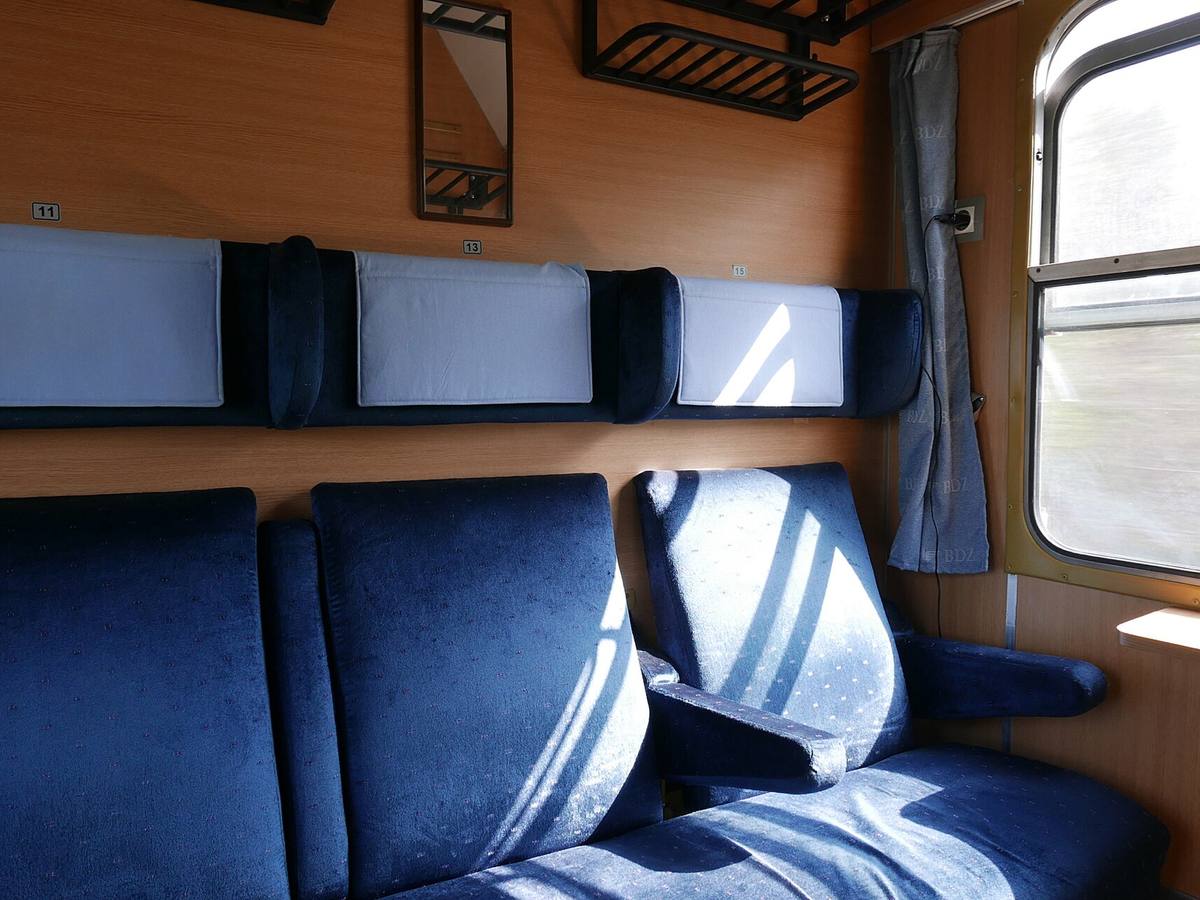
BDZ second-class carriage interior, the typical setting for a Sofia-Plovdiv or Shumen-Varna ride. Cheap fares, sit-down comfort, big-window scenery, slower than the equivalent coach: BDZ's niche is the journey you want to read on, not the one you need to win. Photo: NAC via Wikimedia Commons, CC BY-SA 4.0.
The service types
BV (Barz Vlak, fast train): the main intercity express. Stops at major stations only. Sofia-Plovdiv, Sofia-Burgas, Sofia-Varna, Sofia-Ruse.
MBV (Mezhduekspres Barz Vlak): a faster subset of BV on heavily-used corridors. Sofia-Plovdiv has the fastest service of the network.
PV (Patnicheski Vlak, passenger train): regional / stopping service. Cheaper, more stations, slower, useful for small-town hopping.
KPV (Krupatnicheski PV, suburban): dense local service around Sofia and a few other regional centres.
Sleeper services: overnight Sofia-Varna and Sofia-Burgas, with second-class couchettes and first-class sleepers. Pleasant if you can sleep on rails.
Ticketing
Online: bdz.bg/en. Accepts EUR card payment. Email PDF / QR ticket; show on phone or print.
Station counter (kasa): cash or card. English is variable; have your destination written on a piece of paper if unsure.
Self-service kiosks at larger stations (Sofia Central, Plovdiv, Varna, Burgas, Ruse): English UI; card or cash.
Conductor on board: some local services accept cash from the conductor, but for intercity always have a ticket before boarding.
Fares (2026 indicative, second class one-way)
Sofia-Plovdiv (fast BV): 8-12 EUR, around 2 hours 30.
Sofia-Burgas (fast BV): 17-22 EUR, around 6-7 hours.
Sofia-Varna (fast BV): 18-25 EUR, around 7-8 hours.
Sofia-Ruse: 14-18 EUR, around 7 hours.
Sofia-Veliko Tarnovo (via Gorna Oryahovitsa): 12-16 EUR, around 5 hours.
Shumen-Varna (regional): 5-9 EUR, around 2 hours.
Shumen-Sofia (via Karnobat): 17-22 EUR, around 6-7 hours.
Sleeper supplements (couchette): around 10-15 EUR on top of second-class fare.
Live information
The BDZ live arrivals / departures portal at live.bdz.bg shows real-time data for every station with a board. Shumen's own page is at live.bdz.bg/en/shumen; bookmark it before any train day. Delays are honestly reported; cancellations rare on the main intercity routes, more common on regional PV services in winter.
Senior, child and group discounts
Children under 7 travel free, under 10 at half fare.
Pensioners (Bulgarian and EU-equivalent, including UK State Pensioners with valid documentation): around 25-40% off on certain services, varies by route and class.
Students with valid Bulgarian ISIC or university card: discounted fares.
Family / group of 4+: an "office sale" group ticket is materially cheaper than four individuals on intercity routes.
Old rolling stock vs new EMUs: pick the new ones if you can
Not all BDZ trains are equal. The newer Siemens Desiro and Skoda electric multiple-unit (EMU) sets are clean, modern, air-conditioned, with sealed windows and tidy interiors; they run on many of the busier Sofia / Plovdiv / Burgas / Varna corridors. The older Soviet-era locomotive-hauled compartment carriages are still in service on some routes, with thirstier ventilation in midsummer and ageing toilets. The variance between the two generations is night-and-day. When you book on bdz.bg/en, the train type and series are listed in the result, and EMU services usually carry a clearly different number. If you have the choice between two trains 30 minutes apart, take the EMU; the comfort difference is worth the small wait.
Things BDZ does NOT do well
High-frequency commuter service. Beyond Sofia's KPV, most routes run 3-8 services a day, not 30.
Air-conditioning on older rolling stock in midsummer. The newer Siemens Desiro and Skoda fleet is better; older Soviet-era coaches are not.
Last-mile from station to actual destination. Most Bulgarian stations are 10-20 minutes' walk from the town centre; budget a taxi or local bus.
English-language announcements at smaller stations. Major terminals (Sofia, Plovdiv, Varna, Burgas) are fine; smaller stations less so.
Section 5
Intercity coach network
For most A-to-B journeys between Bulgarian regional centres, the intercity coach is faster than the train and as cheap. The catch is the operator fragmentation: every coach company runs its own counter, its own timetable, its own ticketing. Getting good at the coach network is the single highest-leverage transport skill for car-free life.
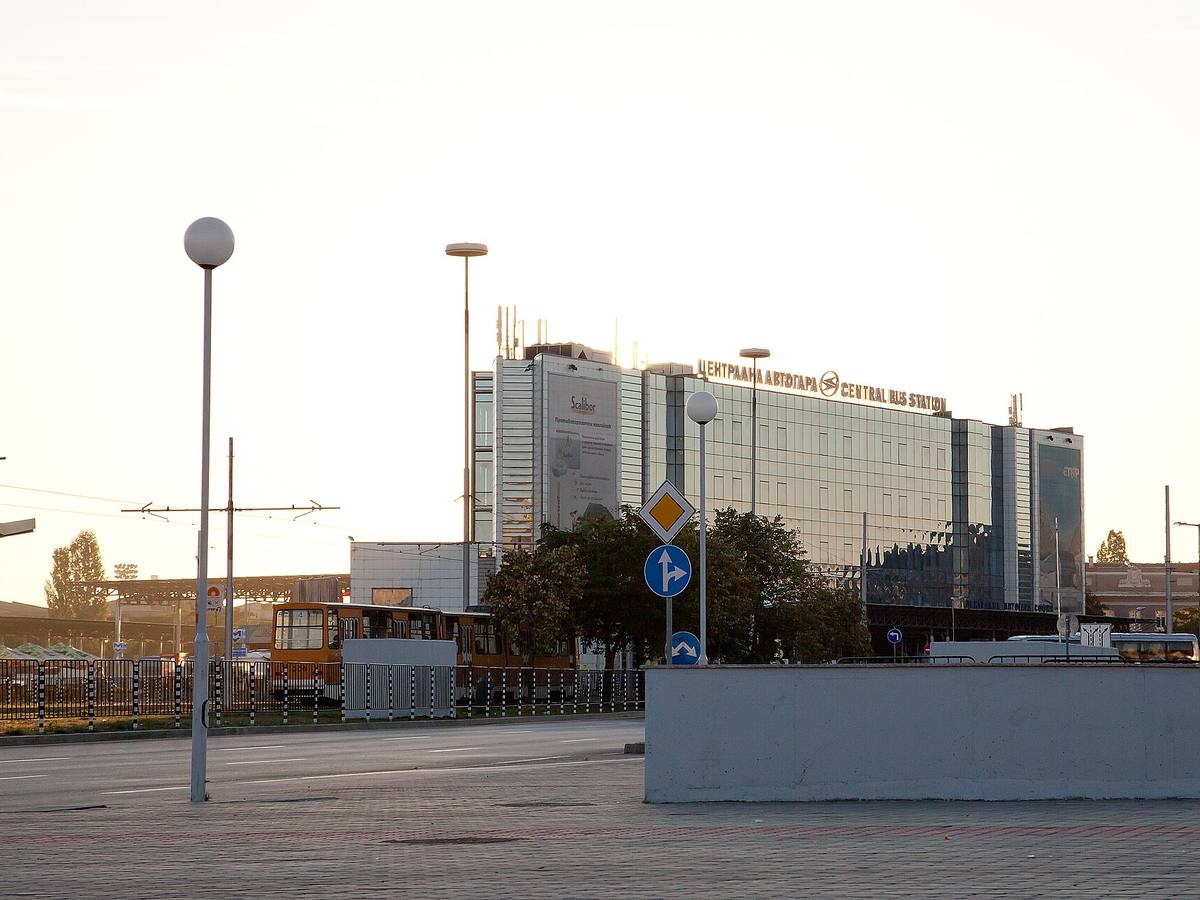
Sofia Central Bus Station (Tsentralna avtogara), right next door to the Central Railway Station. Every major intercity coach route originates here; the counters are arranged by operator, not destination, which is the single hardest part of buying your first ticket. Photo: Bin im Garten via Wikimedia Commons, CC BY-SA 3.0.
The main hubs
Sofia Central Bus Station (Tsentralna avtogara): the national hub, next door to Sofia Central Railway Station and Metro M2 Central Railway Station stop. centralnaavtogara.bg supports English. Departures to every regional centre, plus international services to Greece, Romania, Turkey, Serbia and beyond.
Sofia Ovcha Kupel: second-tier Sofia terminal, used for some Western and Southern routes (Bansko, Blagoevgrad, Greek border).
Sofia Yug (South): smaller terminal, some Southern routes.
Plovdiv Avtogara Yug / Sever / Rodopi: three Plovdiv terminals, each serving different directions. Plovdiv-Sofia is from Sever; Plovdiv-Smolyan from Rodopi.
Varna Central Bus Station: coach and marshrutka hub serving the Black Sea coast and the East.
Burgas South Bus Station: coach hub for the southern Black Sea coast, plus Sunny Beach and Sozopol seasonal services.
Shumen Central Bus Station: walking distance from Shumen Railway Station; the gateway to the wider Shumen Province villages and the link to Sofia, Varna and Veliko Tarnovo.
The main operators (you will see these names everywhere)
Union Ivkoni: large fleet, modern coaches, the dominant operator on Sofia-Varna and many other long-distance routes.
Etap-Adres: another national-scale operator, strong on Sofia-Burgas and Sofia-Plovdiv corridors.
Karat-S: focused on Sofia-Sliven, Sofia-Yambol, and routes through Stara Zagora.
Eurobus: international and select domestic routes.
Hebros Bus: Plovdiv-based, dominant on Plovdiv-Sofia and regional Trakia-corridor routes.
Plovdiv Trans: Plovdiv-area coach.
Pomorie Bus: Black-Sea seasonal coast services.
Ticketing
Almost always at the operator's counter at the originating bus station. Cash and card both accepted; English variable.
For high-demand routes (Sofia-Varna in summer, Sofia-Bansko in winter, holiday weekends) book 24-48 hours ahead.
For routine routes (Sofia-Plovdiv, regional centre to regional centre on a weekday): walk-up 30 minutes before departure is usually fine.
Online: some operators sell tickets on their own websites (Union Ivkoni, Etap-Adres, Hebros Bus all have functioning online portals). Cross-check the destination side too.
BalkanViator and 12go.com aggregate many routes for a small surcharge; useful for a quick sanity-check on prices.
Fares (2026 indicative, one-way)
Sofia-Plovdiv: 8-12 EUR, around 2 hours.
Sofia-Burgas: 18-25 EUR, around 6 hours.
Sofia-Varna: 22-28 EUR, around 7 hours.
Sofia-Veliko Tarnovo: 12-18 EUR, around 3 hours.
Sofia-Shumen: 18-25 EUR, around 5-5.5 hours.
Sofia-Bansko (winter): 15-20 EUR, around 3 hours.
Plovdiv-Burgas: 12-18 EUR, around 3.5 hours.
Burgas-Sunny Beach (seasonal direct): 5-8 EUR, around 45 minutes.
On-board experience
Modern coaches on the main routes have air-conditioning, USB charging, free Wi-Fi (often unreliable), reclining seats and a small toilet. On longer routes the driver typically takes one 20-30 minute break at a motorway service area for fuel, food and a smoke. Carry water and a snack; some service stops are limited.
Section 6
Marshrutka and the Last-Mile Rule
Marshrutki (singular: marshrutka) are fixed-route minibuses that connect Bulgarian towns to the surrounding villages and run short-haul links inside larger urban areas. They are the last-mile transport that turns the intercity coach + rail grid into actual door-to-rural-house journeys. Most British movers settling outside the cities discover the marshrutka network only after they have already bought the property; learning the local pattern in advance is the difference between a workable car-free village move and a regretted one.
What a marshrutka is
A 15-25 seat minibus, typically a Mercedes Sprinter, Iveco Daily or similar.
Operated by a small local company or owner-driver under a regional licence.
Runs a fixed route between two end points (usually a town centre and a particular village) with intermediate stops.
Stops at official roadside marshrutka stops (a tin sign with a number) AND on flag-down request between official stops.
You pay the driver in cash, exact-change strongly preferred, when you board or sometimes at the end of the trip. See the small-change rule below.
No reserved seats; first-come, first-served. Standing is not allowed by law but happens at peak times.
The Last-Mile Rule
Whether car-free village life is workable comes down to one question: does your village have a marshrutka link to a town with an intercity bus and rail connection, at times that work for your typical week? Three patterns:
Daily-frequent village (workable car-free): a marshrutka in each direction every 1-3 hours during daylight. Common for villages within 15 km of a regional centre on a main road. You can get into town for shopping, the doctor, the bank, and back the same day. Examples: villages on the Shumen-Veliki Preslav road, villages within 20 km of Plovdiv along the Trakia.
2-3 services a day (workable with planning): a school-run morning service, a midday return, an evening service. You can do single-day trips but the schedule rules the day. Most "decent rural Bulgaria" villages are in this bracket.
One service a day or less (not really workable car-free): a weekday morning service in, an afternoon return, nothing at weekends. You need a car. Many remote-Strandzha, deep-Rhodope and small-Balkan-range villages are in this bracket.
How to find the marshrutka pattern for a specific village
The honest answer is in-person, not online:
Visit the nearest town's bus station (avtogara); walk to the small-platforms section away from the intercity coach bays.
Look for the wall timetable (razpisanie) listing villages on the left and times across the top. Photograph it for reference.
Ask at the counter: "Kakvi se marshrutki kam [village name]?" ("What marshrutki to [village]?"). Counter staff usually know.
Talk to the village shop, the kmet (mayor's office), or a neighbour. The locally-known pattern is often more accurate than the wall timetable.
Stand at the village marshrutka stop on a Monday morning for a half-hour to see what actually rolls past.
Marshrutka drivers run a fast-paced, cash-only operation. Handing the driver a 20 EUR or 50 EUR note for a 1.80 EUR village fare will routinely produce an explosive, fast-talking Bulgarian lecture and the very real possibility that you are asked to get off at the next stop because there is no float. Keep a dedicated "transit jar" at home filled with 1 EUR and 2 EUR coins plus 5 EUR notes specifically for the morning run; refill it each time you withdraw cash. The same rule applies to many rural taxis, village shops and farmers' markets, but it bites hardest on the marshrutka because the queue behind you is still waiting to board.
The car-free village move that fails. The most common pattern: British buyer falls in love with a "five-bedroom stone village house, 15 minutes from Veliko Tarnovo, 25,000 EUR" listing. They buy without checking the marshrutka schedule, assume "we'll figure transport out". They arrive to find the village has one weekday-morning service in and no Sunday service at all. Within six months they are car-shopping with the wrong urgency. Check the marshrutka schedule BEFORE you sign the purchase contract; it determines whether your retirement years here are pleasant or a slow grind.
Section 7
Sofia urban transit and the Metro
Sofia has one of the cleanest, cheapest and most-functional urban transport systems in Eastern Europe. For a Brit settling in Sofia, the Five-Mode Network shrinks to one mode and a couple of taxis. The Metro alone covers most of central Sofia and the main residential districts; trams and buses fill the gaps.
Sofia Metro
Three lines: M1 (red), M2 (blue), M3 (green). M4 is the extension stub from Slatina to Geo Milev.
Frequency: 4-6 minutes peak, 6-10 off-peak.
Hours: roughly 05:00 to 00:30 daily.
Coverage: Lyulin, Vrazhdebna, Sofia Airport, Mladost, NDK, Vitosha, Slivnitsa, Sredets, several university stops.
Cleanliness: high; the rolling stock is largely Siemens Inspiro, new and air-conditioned.
Cost: roughly 0.80 EUR single, 2.40 EUR day-pass, 25 EUR monthly. The monthly pass is also valid on city trams, buses and trolleybuses.
Tickets: vending machines at every station, ticket counters, contactless bank card (Visa / Mastercard) tapped directly at the gate, or via one of the Sofia transit apps (see the app hierarchy below).
Trams, buses, trolleybuses
Sofia's tram network has been gradually modernised; the newest fleet (Pesa Swing, Bombardier Flexity) is comfortable and air-conditioned.
Trolleybuses run on dedicated wires through residential districts; quiet but slower than buses.
City buses cover routes the trams do not reach.
Ticketing: same as Metro. On surface vehicles you validate by tapping a contactless bank card, a Sofia City Card, or scanning a QR code from your phone against one of the blue electronic validator screens mounted near every door. Tap the same card you boarded with at every onward connection within the validity period. The old orange / yellow mechanical paper-punchers have been entirely removed and any guide telling you to "punch" a paper ticket is out of date.
The Sofia app hierarchy (this is the bit visitors get wrong)
"Which Sofia transit app?" is more confusing than it needs to be because there are several official and quasi-official apps with overlapping names. The three you actually need on your phone, in priority order:
MPass, the official digital-ticketing platform. English UI; handles single tickets, day passes, monthly passes and seamless card loading. Buy tickets here; validate by QR-scan at the on-vehicle screen. This is the only app that issues a Sofia transit ticket.
Sofia Traffic, Sofia Ride or Sofia Bus (pick one, they're functionally similar), for live virtual timetables, GPS bus mapping and arrival predictions. Highly-rated, English-friendly, useful for "is my tram coming or do I walk?" decisions. They do NOT sell tickets.
Sofia Plus, the official municipal app. Used mostly for car-parking-zone management, SMS parking and clamp-fee payments. Do NOT install Sofia Plus thinking it is the transit app, this is the most common mismatch in new-resident expat forums.
The previous Centre for Urban Mobility (CGM / Tsentar za Gradska Mobilnost) "UGT Sofia" branding still appears on some signage and older guidebooks; the operational reality on the ground today is MPass for tickets, one of the Sofia-* apps for live timetables, with everything else converging through the contactless-tap-at-the-door model.
Fare hygiene
Tap or scan AT EVERY door entry, on every vehicle. The tap is the validation; there is no separate "punching" step any more.
Use the same payment instrument throughout (the same bank card or the same MPass QR) so a connection check matches the original validation.
Contactless tap-on at every Metro gate (no need to tap-off).
Inspectors (kontroli) ride trams and buses in plain clothes and produce ID only after stopping you. The fine for travelling without a valid tap or ticket is around 20-40 EUR on the spot.
See our Where to Live in Bulgaria guide for how Metro access shapes apartment-hunting in Sofia: a flat within 5 minutes' walk of a Metro station materially outperforms a cheaper flat 20 minutes' walk away on every quality-of-life axis.
Section 8
Plovdiv, Varna, Burgas, Ruse city transit
The other major Bulgarian cities run smaller-scale urban networks: tram, bus, trolleybus, and in some cases water bus. None match Sofia's Metro but all are workable, cheap and usable by a non-Bulgarian speaker with a printed map and a couple of routes memorised.
Plovdiv
City bus network covers the old town, central pedestrian zone, the university district, and the outer residential areas.
No tram, no metro; the city is compact enough that walking covers most central distances.
Tickets at the kiosk or on board (cash to driver); roughly 1 EUR single, 25-30 EUR monthly.
The Plovdiv-area marshrutka network connects the city to surrounding villages on the Trakia corridor.
Varna
City bus and trolleybus network; no tram, no metro.
Compact; most central distances walkable or short bus hops.
Tickets at the kiosk or on board; roughly 1.50 EUR single, monthly pass around 25-30 EUR.
Seasonal water buses (vodni linii) along the seafront in summer.
City bus 409 links the airport to the centre in around 30 minutes.
Burgas
City bus network; no tram, no metro.
City bus 15 from Burgas airport to central Burgas, 25-35 minutes, roughly 1.50-2 EUR.
Burgas-Sunny Beach via city bus 16 / 18 in summer, hourly, 5-8 EUR; see our Sunny Beach guide for the wider seasonal coastal transport picture.
Ruse
Bus and trolleybus network; small-city scale.
Ferry across the Danube to Giurgiu, Romania, in walking distance of central Ruse, useful for Romanian day trips and the Danube-route rail to Bucharest.
Section 9
Airport transfers
Four Bulgarian airports take regular international traffic: Sofia (SOF), Varna (VAR), Burgas (BOJ) and Plovdiv (PDV). Each has its own transfer pattern, and each has a tout-versus-official-taxi exposure that catches first-time arrivals every season.
Sofia Airport (SOF)
Metro M1 from Sofia Airport (Terminal 2) directly to the city centre. 30-35 minutes; 0.80 EUR; runs roughly 05:30 to 00:00. Trains every 4-6 minutes peak. This is the right answer almost always.
Terminal 1 arrivals: take the free inter-terminal shuttle bus to Terminal 2 for the Metro (around 10-15 minutes; signposted).
Official taxi: OK Supertrans (or other yellow-livery operators) at the regulated taxi desk INSIDE the arrivals hall. Fare to the city centre 12-18 EUR. Always use the desk, never accept a tout in the car park.
Private pre-booked transfer: 20-40 EUR. Useful with bulky luggage or late-night arrivals where you want to skip the metro stairs.
Varna Airport (VAR)
City bus 409 to central Varna, around 30 minutes, 1.50 EUR. Frequent during the day.
Official taxi at the regulated rank: 15-25 EUR to central Varna.
Pre-booked transfer to Golden Sands / Albena: 30-60 EUR depending on season.
Burgas Airport (BOJ)
City bus 15 to central Burgas, 25-35 minutes, 1.50-2 EUR.
Official taxi rank: 15-25 EUR to central Burgas, 25-40 EUR to Sunny Beach, 40-60 EUR to Sozopol.
Seasonal direct buses to Sunny Beach in summer; check the Burgas Airport public-transport page.
The Burgas taxi market has a documented tout-and-overcharge problem for tourists; ALWAYS use the official desk inside the terminal, not the car park. See our Sunny Beach guide for the specific Sunny Beach taxi rules.
Plovdiv Airport (PDV)
Small regional airport; limited international service.
Taxi to central Plovdiv 12-20 EUR.
No regular city bus link; check for charter coordinated transport when relevant.
Never take a tout taxi at any Bulgarian airport
The single highest-leverage rule of Bulgarian airport arrival: walk past the touts in the arrivals car park and use the regulated taxi desk inside the terminal, or the city public-transport link. The tout taxi is typically an unmarked private car with a meter set to 5-8 EUR per kilometre (genuine taxi rates are 1-1.50 EUR per km). On a Sofia-airport-to-central-Sofia run that is the difference between 15 EUR and 120 EUR. The drivers are practised at routing newly-arrived tourists who do not yet know what good looks like. The fix is trivial: ignore everyone outside the terminal door and walk to the kassa.
Section 10
Taxis and ride-hailing
Bulgarian taxis used by app are cheap, safe and the default late-night transport for any urban Brit. Bulgarian taxis hailed at the wrong street corner are the most-reported scam in Sofia tourist forums. Knowing which is which is a two-minute skill.
The two ride-hailing apps that actually work
TaxiMe: Bulgaria's dominant ride-hailing app. English UI, in-app fare estimate, credit-card or cash, driver rating system, lost-property reporting, scheduled rides. Works in Sofia, Plovdiv, Varna, Burgas, Stara Zagora, Veliko Tarnovo, Ruse and several smaller cities.
Yellow!: The number-two app. Functionally similar to TaxiMe. Sometimes has shorter wait times in the same city.
Install both before your first trip. Uber and Bolt do NOT operate in Bulgaria.
Why apps are materially safer than street-hail
The fare is shown before you accept the ride; the driver cannot change it mid-trip.
The driver is identified by name and number; the trip is logged.
The vehicle's plate is shown before pickup; you can confirm the right car.
Payment can be by card (no cash exchange at all).
If the route is suspicious you can flag it in the app post-trip.
If you must hail on the street
Check the per-kilometre price sticker on the rear window. Day rate (denonoshten tarif) should be around 1-1.50 EUR per km in Sofia; night rate up to 2 EUR. Anything materially higher is the scam-taxi pattern (some show 5-9 EUR per km).
Check the meter is on and resets to the starting price. If the driver says "the meter is broken" or "we agree a fixed price", walk away.
Have a destination phrase or written address. Avoid giving "I am a tourist" body language.
Pay with a denomination close to the fare. The "I don't have change" gambit is a classic.
Get the receipt (kasov bon) if you want a record.
Names of the safe operators
The largest licensed taxi operators in Sofia, in declining size: OK Supertrans, Eurotaxi, Yellow!, TaxiMe. In Plovdiv: Sofia Taxi Plovdiv, TaxiMe Plovdiv. In Varna and Burgas: each has 3-4 licensed brands plus the two apps. Use the apps when you can; use the named operators when you cannot.
Section 11
Shumen-specific routes
As the Shumen.UK editorial home, Shumen gets its own section. The city is well-served by the wider network: a rail station with direct services to Varna and Sofia, a coach station 10 minutes' walk away, and a marshrutka mesh reaching most villages in Shumen Province.
To Sofia: fast BV via Karnobat, 6-7 hours, 17-22 EUR.
To Veliko Tarnovo: no direct train; change at Gorna Oryahovitsa.
To Bucharest: change at Ruse for the Danube-route service; total 8-10 hours including border crossing.
Shumen Central Bus Station (Avtogara)
10 minutes' walk from the railway station; clean, modern, English-friendly counter.
To Sofia: 5-5.5 hours via the Hemus motorway, 18-25 EUR, multiple operators daily. Materially faster than the train.
To Varna: 1.5-2 hours, 8-12 EUR, frequent throughout the day.
To Veliko Tarnovo: 2-2.5 hours, 10-15 EUR, several daily services.
To Razgrad: 30-45 minutes, 3-5 EUR.
To Targovishte: 30-45 minutes, 3-5 EUR.
To Plovdiv: 5-6 hours, 20-25 EUR, sometimes via change.
To Burgas: 3-4 hours, 15-20 EUR.
Marshrutka to Shumen Province villages
Veliki Preslav: 30 minutes, frequent service throughout the day, 2-3 EUR. The most-used marshrutka route in Shumen Province.
Madara (Madara Horseman UNESCO site): 30 minutes, 2-3 services a day, 2-3 EUR.
Pliska (Bulgaria's first medieval capital): 30 minutes, similar service pattern.
Smyadovo, Kaspichan, Novi Pazar: each on its own marshrutka pattern, 2-5 EUR.
Smaller villages on side roads: typically 1-2 services a day at school-run times.
Shumen city transit
Modest city bus network covering the central residential ring and the outer estates.
Mostly walking and taxi by app for residents.
TaxiMe and Yellow! both work in Shumen; typical short-distance fare 2-4 EUR.
See our Shumen city guide for the wider local picture: the Tombul Mosque, the Monument to 1300 Years of Bulgaria, Shumen Fortress, the local food, the population trajectory.
Section 12
Luggage, bicycles and pets on Bulgarian transport
Travelling with stuff (or with the dog) is its own micro-skill on each mode. The rules are not uniform; each operator carries its own quirks.
Luggage
BDZ trains: normal hand luggage is free. Larger bags fit in the overhead racks or the floor area at the carriage ends. No formal weight or piece limit on most services.
Intercity coaches: typically 1-2 bags free in the under-floor hold, additional pieces 1-3 EUR. Heavy items (over ~30 kg) at the driver's discretion.
Sofia Metro: normal luggage fine; bulky items (large suitcases, ladders) at peak hours can be a problem, off-peak fine.
Marshrutka: small bags only; the minibus has limited boot space. If you have a large case, ask the driver or take a different mode.
Bicycles
BDZ trains: most regional PV services carry bicycles for a small fee (2-5 EUR); intercity BV services often require advance booking. Bicycles ride in the guard's compartment or a dedicated bike area.
Sofia Metro: bicycles NOT allowed at peak hours (07:00-09:30 and 17:00-19:30 on weekdays); off-peak allowed in the last carriage.
Surface urban transit (trams, buses): generally not allowed; folding bikes treated as luggage.
Coaches: at the driver's discretion; usually allowed for a small fee if the under-floor hold has space.
Pets
BDZ trains: small dogs and cats in carriers travel free; larger dogs on a lead and muzzle in dedicated compartments, with a pet ticket (around 5-10 EUR).
Sofia Metro: small dogs in carriers travel free; larger dogs on a lead and muzzle pay a single-ticket fare.
Coaches: mostly small dogs in carriers only; many operators do not allow larger dogs at all, especially in summer.
Marshrutka: at the driver's discretion; rural drivers usually accommodate a working dog on a lead, but it is not guaranteed.
Cross-reference our Pets guide for the broader Bulgarian pet-travel picture including the UK-import paperwork, EU pet passport, and the breed-specific liability rules.
Section 13
Passenger rights: rail, bus and air
EU passenger-rights regulations continue to apply in Bulgaria post-Brexit, and the British passenger in Bulgaria has the same protections as any other EU traveller. Two regulations cover most of what matters; one consumer-protection body handles cross-border complaints.
Rail: EU Regulation 1371/2007 (replaced by 2021/782 from 2023)
Refund or reroute right if the train is delayed by 60+ minutes.
Compensation of 25% of fare on 60-119 minute delays; 50% on 120+ minute delays on longer journeys.
Right to information about delays in real time.
Right to meals and refreshments during the delay (if delay reasonably long); accommodation if an overnight delay is caused.
Right to assistance for disabled passengers and reduced-mobility travellers.
Right to bicycle carriage on most services.
Claim through BDZ first; the form is on bdz.bg. Keep your ticket and any delay confirmation.
Bus and coach: EU Regulation 181/2011
Information rights about the journey, including delays.
Assistance for delays of 90+ minutes on journeys of 250+ km (meals, refreshments, accommodation if overnight delay).
Compensation of 50% of fare if the journey is cancelled or delayed by 120+ minutes.
Accessibility rights for disabled passengers and reduced-mobility travellers.
Right to information about your rights at every coach station and on every long-distance ticket.
Claim through the operator first; their website usually has a complaints form.
Air: EU Regulation 261/2004
Compensation of 250-600 EUR for flight cancellation or long delay (3+ hours), subject to airline-fault rules.
Right to assistance (meals, refreshments, accommodation) during long delays.
Right to refund or alternative routing on cancellation.
This applies to all flights departing from a Bulgarian airport, and to flights TO Bulgaria operated by EU airlines.
If the operator refuses your claim: the European Consumer Centre Bulgaria
The European Consumer Centre Bulgaria (ECC Bulgaria, ecc.bg) handles cross-border passenger-rights and consumer complaints. It is part of the European Consumer Centres Network co-funded by the European Commission. Free service, English-language support, useful both for compensation chases and for general advice when a Bulgarian operator stonewalls. Cross-reference with our Legal Deep-Dive guide for the wider Bulgarian consumer-protection landscape.
Section 14
Living car-free in Bulgaria: settlement planning
For a British expat deciding where to settle, transport is one of the four-or-five top factors. Get it right and Bulgaria becomes one of the easiest car-free retirement destinations in Europe; get it wrong and you discover six months in that you need a Skoda Octavia and a parking permit.
The four-tier walkability test for Bulgarian settlement
Tier
Type of location
Car-free workability
1
Central Sofia, within 5 min of Metro
Trivially easy. Metro + tram + bus + TaxiMe covers 95% of daily needs. Rental car or BDZ for trips.
2
Plovdiv / Varna / Burgas, central; or Sofia outer suburbs near Metro
Easy. Urban network plus occasional ride-hailing. Trip out of town by coach or BDZ.
3
Regional centre (Shumen, Pleven, Vidin, Sliven, Ruse), central
Workable. Local taxis + intercity coach + BDZ for trips. The marshrutka network reaches surrounding villages.
4
Village (any size)
Depends entirely on the Last-Mile Rule. Daily-frequent marshrutka village = workable; 1 service a day or less = you need a car.
Questions to answer before settling
How often will you need a hospital appointment? (Healthcare is concentrated in regional centres; if you settle in a Tier 4 village 30 km from the nearest specialist, the marshrutka schedule matters more than the rent.)
How often will you fly back to the UK? (A monthly Sofia Airport trip is trivial from Tier 1; from a remote Tier 4 village it is a half-day each way.)
Do you have school-age children? (School-bus links are usually a single morning service; if your village has only that, the school run rules every day.)
Do you work remotely or run a business with client meetings? (Sofia / Plovdiv / Varna are easy; a Strandzha village to a Sofia meeting is a 6-hour trip each way.)
Do you intend to drink socially? (Drinking and driving carries serious Bulgarian penalties; ride-hailing only works in towns where TaxiMe / Yellow! have driver coverage.)
Renting a car when you need one
For Tier 3 and Tier 4 settlement where 90% of life is car-free but the occasional trip needs four wheels, occasional car hire is cheaper than ownership. Bulgaria has dense rental supply from Europcar, Sixt, Hertz, Enterprise plus a number of strong local operators (Top Rent A Car, Sixtraxx, Easyride). Indicative 2026 rates: economy car at Sofia Airport 25-45 EUR a day in shoulder season, 40-70 EUR in peak summer; small SUV 40-80 EUR a day. For a once-a-month rural-shopping run, ownership is not worth it; for a twice-weekly run, it is. Cross-reference our Buying, Importing and Owning a Car guide for the Six-Stage Pipeline if the maths tips toward ownership.
The fundamental settlement rule. The cheapest car-free option in Bulgaria is a small central apartment in a regional capital with intercity rail and coach links plus a marshrutka mesh to the surrounding villages. The most expensive "car-free" option is a remote Tier 4 village that turns out to need a car after all. Tier matters more than the property price; choose the tier first, then the property within it.
Section 15
FAQ and common mistakes
The questions British expats actually ask, with answers tied back to the relevant section.
Can I live in Bulgaria without owning a car?
In most regional cities, yes, with some planning. Sofia is easiest (Metro + tram + bus + apps), then Plovdiv / Varna / Burgas. Smaller towns work with intercity coach + local taxi. Village life depends entirely on the marshrutka schedule (the Last-Mile Rule). → Section 14 (Settlement planning)
What is BDZ and how do I buy a train ticket?
BDZ is Bulgarian State Railways. Buy at bdz.bg/en, the station kassa, or self-service kiosks. Fares are cheap (Sofia-Plovdiv 8-12 EUR, Sofia-Burgas 17-22 EUR); the live.bdz.bg portal shows real-time arrivals and departures including a Shumen-specific page. → Section 4 (BDZ trains)
Is there a single planner like Trainline or National Rail Enquiries?
No. This is the Single-Planner Gap. BDZ handles rail; intercity coach is fragmented across many operators with no shared booking platform. You build the journey across multiple operator sites or by walking into the central bus station. → Section 3 (Single-Planner Gap)
What is a marshrutka and when would I use one?
A fixed-route minibus connecting a town to surrounding villages, or running short-haul links. Fares 1-3 EUR. Flag down between stops; pay the driver in cash. The single most important mode if you live in a village. → Section 6 (Marshrutka and the Last-Mile Rule)
How does Sofia Metro work?
Three lines, 0.80 EUR a single, 25 EUR monthly. Buy via UGT Sofia app, station vending machine, or contactless tap at the gate. Trains every 4-6 minutes peak. Connects Sofia Airport (Terminal 2) directly to the city centre in 30-35 minutes. → Section 7 (Sofia urban transit)
How do I get from Sofia Airport to the city centre?
Sofia Metro M1 from Sofia Airport (Terminal 2) in 30-35 minutes for 0.80 EUR. Official taxi from the regulated desk inside arrivals: 12-18 EUR. NEVER take a tout taxi from the car park. → Section 9 (Airport transfers)
Which apps actually work in Bulgaria for transport?
BDZ.bg + live.bdz.bg for rail. UGT Sofia for Sofia urban transit. TaxiMe and Yellow! for taxis. Google Maps for sanity-check on routes but not as the only source for intercity coach. Uber and Bolt do NOT operate in Bulgaria. → Section 10 (Taxis and ride-hailing)
Are Bulgarian taxis safe and how do I avoid scams?
App-based (TaxiMe, Yellow!) is safe. Street-hail is risky if you don't check the per-kilometre price on the rear-window sticker (genuine 1-1.50 EUR/km; scam 5-9 EUR/km). Always use the official desk at airports, never the touts. → Section 10 (Taxis and ride-hailing)
Can I travel with luggage, bicycle or a dog on Bulgarian transport?
Yes to all three with quirks. Trains: bikes for a small fee, dogs in carriers free, larger dogs muzzle + lead + pet ticket. Coaches: 1-2 bags free, bikes at driver's discretion. Sofia Metro: bikes peak-banned, off-peak last carriage. → Section 12 (Luggage, bikes, pets)
How do I get from Shumen to Sofia, Varna or Veliko Tarnovo?
Intercity coach is the right answer for all three. Sofia 5-5.5 hours / 18-25 EUR, Varna 1.5-2 hours / 8-12 EUR, Veliko Tarnovo 2-2.5 hours / 10-15 EUR. Train to Varna is fine; train to Sofia (via Karnobat) is slower than the coach. → Section 11 (Shumen-specific routes)
What passenger rights do I have if a train or bus is cancelled?
EU Regulation 1371/2007 (rail) and 181/2011 (coach) provide refund / reroute / compensation rights for long delays and cancellations. Claim through the operator first; if refused, escalate to the European Consumer Centre Bulgaria (ecc.bg). → Section 13 (Passenger rights)
The 12 most common British-expat transport mistakes
Taking a tout taxi from a Bulgarian airport car park.
Hailing a street taxi without checking the per-kilometre sticker.
Buying a village house without checking the marshrutka schedule first.
Assuming Uber / Bolt work in Bulgaria (they don't; use TaxiMe / Yellow!).
Relying on Google Maps as the only source for intercity coach timetables.
Boarding a Sofia surface tram or bus and forgetting to validate the paper ticket within the first minute.
Trying to take a bicycle on Sofia Metro at peak hours.
Buying a BDZ ticket to a wrong-spelling station name (Cyrillic transliterations vary; double-check).
Choosing the Sofia-Varna train over the coach for time reasons (coach is faster on this route).
Missing the last marshrutka home and discovering it.
Travelling without a ticket because "everyone else seems to" (inspectors fine on the spot, 20-40 EUR).
Booking a Sofia airport transfer through a hotel-recommended driver who turns out to be a tout in disguise.
The three rules to take away
The Five-Mode Network is real and the Single-Planner Gap is real. Build journeys mode-by-mode, operator-by-operator; do not expect a single app to solve it.
The Last-Mile Rule decides whether village car-free life works. Check the marshrutka schedule before you sign the property contract; ignore it at your cost.
Apps for taxis, official desks at airports, validated tickets on surface transport. Three habits that defuse the three most-common Bulgarian transport-scam exposures.
Related Shumen.UK guides
Driving: roads, licence exchange, KAT traffic stops, the cult of krushki.