
Every direct route, every airline's check-in window and baggage rules compared, what the four Bulgarian airports are actually like, and how the EU Entry/Exit System changed the border for British passport holders.
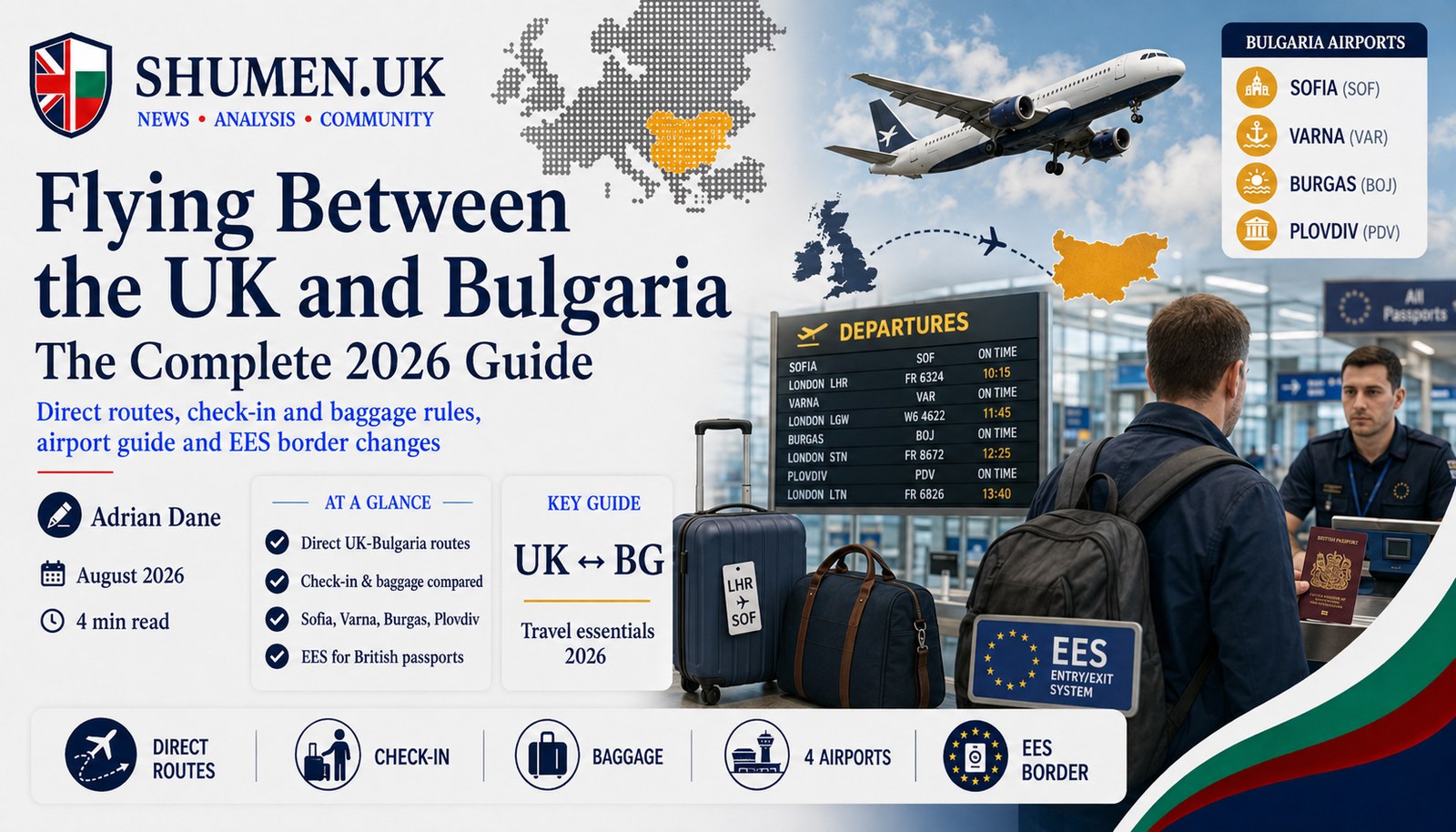
Seven carriers serve the route, but only one Bulgarian airport has meaningful year-round service. Get this wrong and you end up driving four hours from the wrong coast in February.
The single most useful thing to understand about this route is its seasonality. Sofia is the only Bulgarian airport with genuine year-round UK service. Burgas and Varna are summer beach airports. Their route maps look impressive in July and largely evaporate by November.
Between them, British Airways and Bulgaria Air were operating up to 13 flights a week on the Heathrow to Sofia pair in July 2026.
Burgas is the airport for Sunny Beach, Nessebar and the southern coast. Varna serves Golden Sands, Albena and the north. Both run roughly May to September or October, and both are dominated by holiday traffic rather than expat traffic.
Burgas ran over 70 direct destinations across its 2026 summer programme; Varna ran 60.
Plovdiv has exactly one UK link: Wizz Air from London Luton, operating around two to three times a week. It is one of only two scheduled routes from the airport. Useful if you are in the south, but thin enough that a cancellation leaves you with no same-day alternative.
If you live inland, flying to Sofia and connecting is often faster than driving to the coast. Bulgaria Air relaunched the domestic Sofia to Burgas route in June 2026, up to four times a week initially and daily from 30 June, cutting the journey to about 50 minutes against five hours by road. For everything on the ground once you land, see our guide to getting around Bulgaria.
Every airline on this route uses a different window, and three of them will charge you real money for getting it wrong. These are the numbers worth knowing before you book, not after.
The pattern is consistent: the cheaper the airline, the earlier online check-in closes, and the more it costs to check in at the airport. Full-service and package carriers are relaxed about it. Budget carriers treat the check-in desk as a revenue line.
Opens 24 hours before departure, or 30 days if you have paid for a seat. Closes three hours before departure, the earliest cut-off of any carrier here. Airport check-in costs about 13 euros if you buy it online in advance, rising to roughly 40 euros if you simply turn up at the desk. Airport check-in and bag drop open two hours and close 40 minutes before departure.
Opens 24 hours before, or 60 days if you bought a seat. Closes two hours before departure. If you arrive without having checked in online, the fee is 55 euros per passenger. This is the single most expensive mistake available on this route. Note also that Ryanair's airport desk currently closes 40 minutes before departure, moving to 60 minutes from 10 November 2026.
Opens 24 hours before, or 30 days on a FLEXI fare. Closes two hours before departure. No dedicated check-in fee, but a bag that has to go in the hold at the airport can cost up to 55 pounds.
Opens 28 days before departure, the most generous window here, but closes six hours before, which is unusually early. Miss it and you simply use the desk, with no penalty.
Opens 48 hours before, or 14 days on premium and seat-selected fares. Closes one hour before departure.
Opens 24 hours before and stays open until as late as 60 minutes before departure, varying by airport. No check-in fee.
Opens 24 hours before, closes 60 minutes before. The airline's other deadlines matter just as much: bag drop closes 60 minutes before, the airport desk closes 50 minutes before, and hand-baggage-only passengers must be at the gate 40 minutes before. Desk passengers are told to arrive two hours ahead.
Check in online the moment the window opens, and screenshot the boarding pass. On Wizz Air and Ryanair, treat online check-in as compulsory rather than convenient: between them, forgetting it costs 40 to 55 euros per person, per flight. For a family of four flying Ryanair, that is 220 euros for a clerical error.
You will have seen headlines saying the EU has banned cabin bag fees. It has legislated for it, but nothing has changed yet, and it will not change during 2026.
Here is the status, because it is widely misreported. On 13 June 2026 EU member state ambassadors reached political agreement on reform of air passenger rights, ending more than a decade of deadlock. On 7 July 2026 the European Parliament approved it by 646 votes to 12, with 3 abstentions.
The reform requires airlines to include, in the advertised fare, both a small personal item and a larger cabin bag, rather than selling the cabin bag as an add-on. Airlines will still be permitted to sell a cheaper fare to passengers who voluntarily travel without one.
It is not in force. Reporting points to the rules taking effect in 2027, after formal adoption, publication in the Official Journal and a transition period of around twelve months for airlines to change their systems. No exact date has been published. Until then, every fee below remains entirely lawful.
On Bulgaria Air, the Economy LIGHT fare includes no hold baggage at all. A standard Economy fare with baggage carries one piece up to 23 kg; Business carries two pieces up to 32 kg each. If you booked on headline price alone, check which fare you actually hold before you pack a suitcase.
One quirk in the airline's favour: on busy flights Bulgaria Air may gate-check compliant hand baggage free of charge. Take out valuables, electronics and medication before you hand it over.
The flag carrier is the one most British expats in the north and east end up using, and the one with the most rules worth reading in advance.
Bulgaria Air flies Sofia to London Heathrow, flights FB851 and FB852, from Terminal 4. That is its entire UK network. It does not serve Gatwick, Luton, Stansted or Manchester.
You may have seen reports of Bulgaria's first scheduled non-stop flights to New York and Chicago. Those are GullivAir, a different Bulgarian carrier. Bulgaria Air has no US service. The two get conflated constantly, including by aggregator sites; do not book on the assumption they are the same airline.
Several categories cannot use online check-in at all and must use the desk:
That third-from-last one catches people out. If you are flying your dog or cat to the UK, the web flow will simply refuse you. Our guide to bringing pets covers the airline-by-airline reality, which is considerably more restrictive than most people expect.
Seat selection is 25 euros per direction on most routes and 30 euros on a premium list that includes London, and it is non-refundable. Seat changes after online check-in can only be made at the airport counter. The mobile app is called simply Bulgaria Air and will push you a notification when check-in opens.
The airline completed its Airbus A220 renewal programme with the delivery of its seventh and final A220-300 on 15 March 2025, flown direct from Montreal. The fleet is now A220s, A320-family aircraft and Embraer E190s, with the older A319s being phased out. All seven A220s are named after European capitals.
In July 2026 the airline signed a distribution deal with WorldTicket by GO7, putting its flights in front of more than 100,000 IATA-accredited travel agencies. It also codeshares widely, including an expanded Air Serbia agreement from October 2025 that added Geneva, Lisbon, Milan, Rome and Porto.
Sofia is mid-transformation, Burgas and Varna are competent seasonal operations, and Plovdiv is a single-route outpost with rapidly rising parking charges.
Operated by SOF Connect under concession. The critical thing to know is that Sofia has two terminals and they are not interchangeable:
A free shuttle bus connects them, roughly five minutes. Check your terminal on the booking, not on memory, because the split is counter-intuitive: two budget carriers sit in different terminals.
Getting into town is genuinely easy. Metro Line M4 runs from a station inside Terminal 2 to central Sofia in 26 to 32 minutes for 0.80 euros. Terminal 1 has no metro station; use the shuttle to reach Terminal 2. A night bus, the N4, has covered both terminals since July 2025 for when the metro is shut.
Terminal 3 is coming. SOF Connect secured 450 million euros of financing in May 2026, with partners including the EBRD and UniCredit. Construction is scheduled to begin in autumn 2026 and run around five years to about 2031, targeting 34 gates and 20 million passengers a year. The build is phased (Terminal 3 first, then Terminal 2 renovation, then Terminal 1 closure) specifically to avoid disrupting passengers, but expect construction traffic and changing access routes for years.
Run by Fraport Twin Star, as is Varna. The modern Terminal 2, opened December 2013, handles the great majority of traffic: 31 check-in counters, 9 security lanes, 8 gates, and an arrivals hall split into Schengen and non-Schengen zones. A full runway rehabilitation was carried out over winter 2025 to April 2026, deliberately timed to be finished before the 2026 peak season.
Also Terminal 2 since 2013 for scheduled and charter passenger flights, with the old Terminal 1 used for overflow charter, government flights and back-office functions. Immigration runs two channels, EU nationals and everyone else, with e-gates for eligible biometric passport holders. Note the caution about e-gates in the residents section below.
Small, single-terminal, and currently subject to a re-tendered concession: the Transport Ministry announced plans in February 2025 for a new 35-year arrangement to fund a cargo terminal and runway works. Parking has become notably expensive, and fast: 2 euros an hour and 28 euros for three days in January 2026, rising to 3 euros an hour and 45 euros for three days by mid-March 2026. There are only around 70 marked spaces outside the terminal.
This is the biggest change to the route in years, and most of the coverage has been about the wrong airports. Bulgaria has handled it well. The risk is elsewhere on your journey.
The EU Entry/Exit System (EES) replaces passport stamping with a digital record of every entry and exit by non-EU nationals, capturing fingerprints and a facial image on first crossing and verifying them afterwards. Rollout began on 12 October 2025 and the system became fully operational at every Schengen external border on 10 April 2026.
Bulgaria applied EES at all air, sea and river crossings plus the Kalotina land crossing from 12 October 2025, then switched it on at all remaining land borders on 6 January 2026, roughly three months inside the EU deadline. It was the first country in Europe to procure a full EES border stack, with automated e-gates, self-service pre-enrolment kiosks and fingerprint-equipped counters across Sofia, Varna and Burgas.
No Bulgarian airport appears on any credible list of problem borders. Bulgarian coverage of EES queue chaos consistently frames it as something happening elsewhere.
The disruption has been real, just not here. On the first day of full operation, airport trade body ACI Europe recorded border waits of two to three hours at peak, and reported that one UK-bound aircraft departed missing 51 passengers still stuck in the queue. In a joint letter to the European Commission on 1 July 2026, ACI Europe, Airlines for Europe and IATA reported Schengen entry waits of up to five hours at peak, warning that airlines were facing half-empty aircraft at gate closing time. Pressure was worst at smaller airports serving major tourism destinations.
Ryanair has repeatedly named the worst-affected airports, including Palma, Alicante, Malaga, Tenerife South, Lanzarote, Madrid, Lisbon, Milan Bergamo, Milan Malpensa, Verona, Paris Beauvais, Berlin, Cologne, Krakow and Budapest.
The practical implication for anyone reading this in Bulgaria: if you fly Sofia to the UK direct, you are probably fine. If your route home connects through a Spanish, Portuguese or Italian leisure hub, that connection is where you will lose the time. Build in a much longer layover than the minimum the booking engine offers.
On processing speed, the official figures do not agree. The European Commission says registration averages 70 seconds per traveller. IATA's regional vice president for Europe put it at 90 seconds, against 20 to 25 seconds under the old stamp system. Either way it is three to four times slower than what airport arrival advice was built around.
If you drive or take a coach out of Bulgaria, note that EES applies at the Turkish, Serbian and North Macedonian crossings, which are external Schengen borders. It does not apply at the Romanian and Greek borders, which are internal.
Coach and freight traffic at the Turkish and Serbian crossings saw severe holds through summer 2026. In June 2026, tour operators reported coaches being held for 8 to 18 hours, including buses carrying children to summer camps, and blamed fingerprint checks. Bulgarian Border Police reporting from Kapitan Andreevo in July put waits far lower and attributed them to traffic volume and slow processing on the Turkish side. The sources genuinely conflict on cause. What is not in dispute is that the holds happened. Do not plan a tight schedule around a summer land crossing into Turkey or Serbia.
Separately from EES, the European Travel Information and Authorisation System will eventually require visa-exempt visitors, including British passport holders, to buy an online authorisation before travel. It costs 20 euros and lasts three years.
It has no confirmed launch date. The EU removed its own "last quarter of 2026" target from the official ETIAS page in mid-July 2026, and a revised timeline is expected after the responsible agency's board meets in September 2026. You will see April 2027 quoted widely; that is not an official date. When it does launch there will be a transition period of at least six months. Use only the official europa.eu portal when it arrives, because fake ETIAS sites charging inflated fees are already trading on the confusion.
This is the section that matters most to our readers, and the one most likely to save you a genuine problem at a border.
British expats holding a Bulgarian residence document are exempt from EES registration. This covers both cohorts: the Article 50 TEU card issued to Withdrawal Agreement beneficiaries who arrived before 2021, and ordinary long-term or permanent residence permits held by those who arrived after.
The UK government states it plainly on its Bulgaria entry requirements page: if you are long-term resident in a Schengen country, you are exempt from EES in all Schengen countries. The European Commission's own July 2026 guidance says the same, carving out only Cyprus and Ireland, which do not operate EES. Bulgaria does, so Bulgarian permits qualify. The underlying legal basis is Article 2(3) of Regulation (EU) 2017/2226.
Equally, your time living in Bulgaria does not count against any 90-day allowance. The 90-in-180 limit still applies to short trips you make to other Schengen countries, but not to living at home.
Here is the practical catch, and it is worth taking seriously.
An automated e-gate reads the chip in your passport. It cannot see your residence card. If you walk through one, the system has no way of knowing you are exempt, and can log you as an ordinary short-stay visitor. That starts a 90-day clock you are not legally subject to, and the consequence surfaces later, on a subsequent trip, as an apparent overstay.
So:
Residence-permit holders elsewhere in the EU have reported being funnelled into the wrong lanes since EES went live. We have seen no such report from a Bulgarian airport, and this is a precaution rather than a documented Bulgarian failure. But the cost of the precaution is a few minutes in a slower queue, and the cost of getting it wrong is an argument at a border months later.
The UK government's standing instruction is unambiguous: always carry your passport and residence card when entering, leaving or travelling within the Schengen area. Without proper residence documentation you risk being incorrectly flagged as a Schengen overstayer and refused entry.
Our post-Brexit rights guide covers the Article 50 card, the late-application route that is still open, and the exemptions in full.
Both ends of a UK to Bulgaria trip are covered by near-identical passenger rights regimes, but they are two different regimes and you claim from different places.
This trips people up on a Sofia to Heathrow round trip, so it is worth being precise.
The rights are near-identical. The enforcement bodies are not. For an EU-departure problem you escalate to Bulgaria's Commission for Consumer Protection; for a UK-departure problem, to the UK CAA.
For a delay over three hours, a cancellation at short notice, or denied boarding, where the fault lies with the airline:
Sofia to London is roughly 2,000 km, so the middle band applies to most of this route.
"Extraordinary circumstances" remove the compensation entitlement. Weather, third-party air traffic control strikes and similar events qualify. Bulgaria Air classed the January 2026 snow diversion of its Amsterdam flights to Brussels as force majeure, and that is a fair call.
Two things worth knowing:
Bulgaria Air holds a poor consumer rating on Trustpilot, with recurring complaints about cancellations, long delays and weak communication. That is a review-aggregator signal rather than an audited measure, but it is consistent enough to be worth factoring in. Keep your booking reference, note the actual arrival time at the gate, photograph departure boards showing the delay, and submit in writing rather than by phone.
Summer 2026 also saw a broad wave of European air traffic control and weather disruption affecting Bulgaria among many other countries. On that kind of network-wide day, compensation is usually not payable, but rebooking and duty of care still are.
For conditions at both ends of the route, compare the departure airport with the live Bulgaria weather map and seven-day city forecasts. Recheck close to departure because a national weather icon can hide very different coast, Sofia basin and mountain conditions.
British Airways, Bulgaria Air, easyJet, Ryanair and Wizz Air all serve Sofia, which is the only Bulgarian airport with substantial year-round UK service. Burgas and Varna are served seasonally, roughly May to October, by Wizz Air, Ryanair, Jet2, TUI and easyJet. Plovdiv has a single UK route, Wizz Air from London Luton.
Yes, but only one route: Sofia to London Heathrow, flights FB851 and FB852, operating from Terminal 4. Bulgaria Air does not serve Gatwick, Luton, Stansted or Manchester. Note also that the widely reported Sofia to New York flights are operated by GullivAir, a different Bulgarian airline.
It depends entirely on the carrier. Ryanair charges 55 euros per passenger if you have not checked in online. Wizz Air charges about 13 euros if you buy airport check-in online in advance, or roughly 40 euros if you just turn up. British Airways, Bulgaria Air, Jet2 and TUI do not charge a check-in fee. Always check in online for Ryanair and Wizz Air.
Wizz Air closes three hours before departure, the earliest here. Ryanair and easyJet close two hours before. Jet2 closes six hours before, which surprises people. TUI closes one hour before, Bulgaria Air 60 minutes before, and British Airways can stay open until 60 minutes before depending on the airport.
It has legislated for it, but the rules are not in force. The European Parliament approved the reform on 7 July 2026 by 646 votes to 12, following political agreement between member states on 13 June 2026. The change is expected to take effect during 2027 after formal adoption and a transition period of around twelve months, and no exact date has been published. Every current cabin bag fee remains lawful until then.
No. British expats holding a Bulgarian residence document are exempt, whether that is the Article 50 TEU card or an ordinary long-term or permanent residence permit. The exemption only works if you use it: present your passport and residence card together to a member of staff, and use a staffed desk rather than an automated e-gate. An e-gate reads only your passport chip, cannot see your residence card, and may log you as an ordinary visitor, starting a 90-day clock you are not subject to.
There is no evidence of serious EES queues at Bulgarian airports. Bulgaria completed its EES rollout on 6 January 2026, about three months ahead of the EU deadline, and was the first country in Europe to install a full EES border system. Bulgarian airports appear on no credible list of problem borders. The queues have been at Western European leisure hubs such as Palma, Alicante, Malaga, Lisbon and Milan Bergamo, so the risk is in your connection rather than your departure.
There is no confirmed launch date. The EU removed its own last-quarter-of-2026 target from the official ETIAS page in mid-July 2026, and a revised timeline is expected after the responsible agency's board meets in September 2026. The fee is 20 euros, it lasts three years or until your passport expires, and it is free for under-18s and over-70s, who must still apply. Widely quoted April 2027 dates are not official. Holders of a Bulgarian residence permit are exempt.
Two to two and a half hours is the usual advice for a Schengen departure and up to three hours for a non-Schengen one, with the busiest windows being roughly 05:00 to 08:00 and 16:00 to 19:00 in peak season. Bulgaria Air specifically asks desk passengers to arrive two hours ahead. Remember its other deadlines: bag drop closes 60 minutes before departure, the check-in desk 50 minutes before, and the gate 40 minutes before.
Yes, under EU261 if you departed Bulgaria and UK261 if you departed the UK. The rules are near-identical but enforced by different bodies. For most UK to Bulgaria flights, which fall in the 1,500 to 3,500 km band, compensation is 400 euros for a delay over three hours or a cancellation at short notice, where the airline is at fault. Weather and third-party strikes are excluded from compensation, but the airline still owes you rebooking, meals and accommodation.
Terminal 1 handles Wizz Air, easyJet and Bulgaria Air charter flights. Terminal 2 handles Ryanair, British Airways and Bulgaria Air scheduled flights including Heathrow. A free shuttle connects the two in about five minutes. The metro station is inside Terminal 2, so Terminal 1 passengers take the shuttle first. Check your terminal on the booking, because the budget carriers are split across both.