📅 ON THIS DAY IN BULGARIA, Wednesday 16 September
Most British expats will not have heard of Pavel Panov. Ask a Levski supporter over sixty and you get a different reaction entirely. He was born on this date in 1950, and in one European campaign he put two goals past Ajax and two past Barcelona.
What happened on this day
Pavel Panov was born on 16 September 1950. He came up through Septemvri Sofia, moved to Spartak Sofia in 1968, and in 1969 found himself at Levski when the two clubs were merged, a piece of administrative reorganisation the English entry describes, with some feeling, as forceful. He stayed twelve and a half years.
The bare numbers are 301 league games, four league titles and five cups. The Bulgarian and English entries disagree on whether he finished with 130 or 131 league goals, which tells you something about how records from that era survived. He was named Bulgarian Footballer of the Year in 1977.
The season that should have made his name abroad was 1975/76. Levski reached the quarter-finals of the UEFA Cup and Panov scored nine goals in eight matches getting there: two against Eskisehirspor, three against Duisburg, two against Ajax and two against Barcelona. A striker from a league nobody in Western Europe watched put four past that pair in a single run. His 22 goals in European club competition still leave him third among Bulgarians, behind Hristo Stoichkov and Dimitar Berbatov.
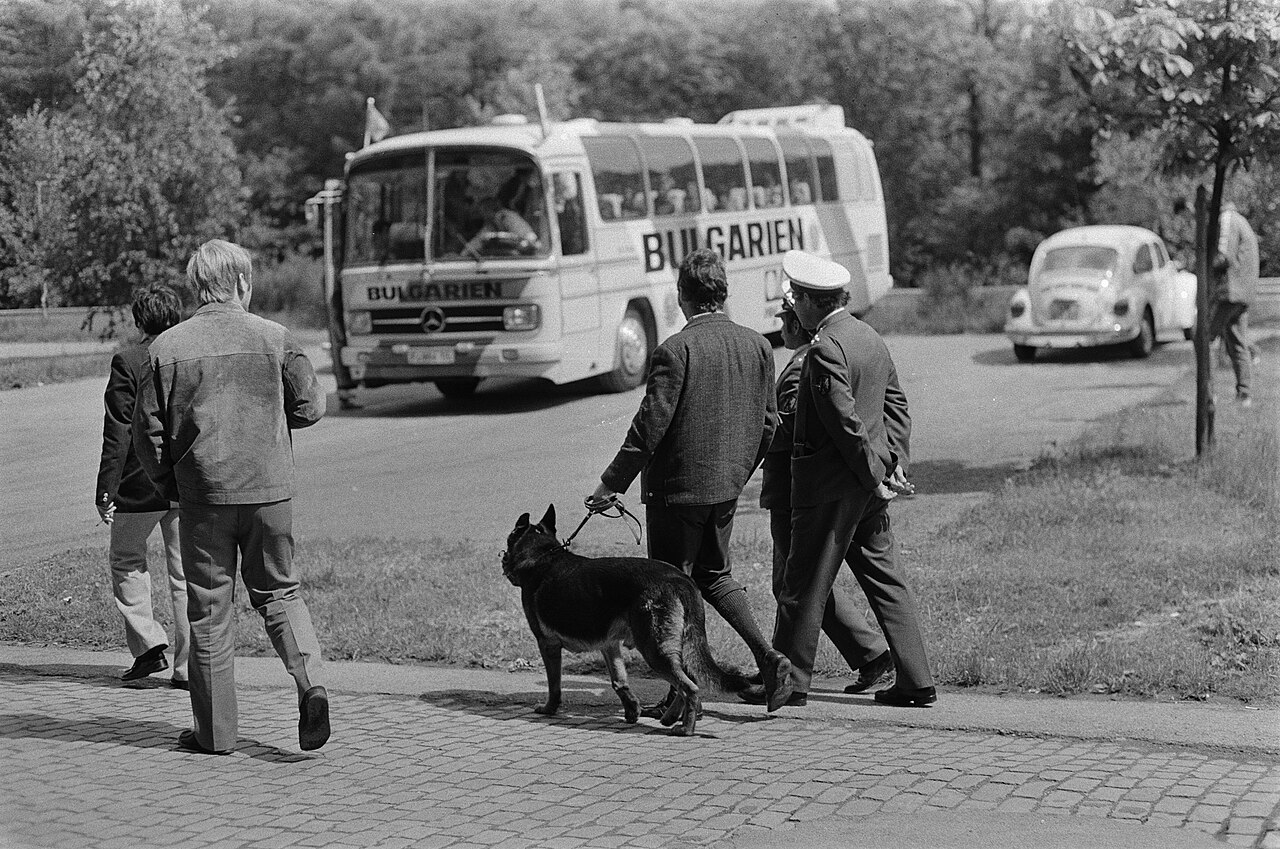
For Bulgaria he won 44 caps and scored 13 goals, the figures the English entry and the Bulgarian one's own career section both give, whatever the summary line at the top of the Bulgarian page says. He played all three matches at the 1974 World Cup in West Germany. His first international goal came in a 2:5 defeat away to Turkey in 1973. His last cap was a 0:3 defeat to England on 6 June 1979. He later coached Levski twice, spent a spell in Nigeria with Iwuanyanwu Nationale, and died suddenly in Sofia on 18 February 2018.
Today's name days
Today is the name day for Lyudmila, Lyudmil and Lyusi. The name is Slavic and fairly transparent once you break it: lyud (people) and mil (dear), so something close to "dear to the people". The saint behind it is Ludmila of Bohemia, who died in 921 and was canonised almost at once, and who was the grandmother of Wenceslas. The carol the British sing every December is about her grandson.
Here is the part that catches British expats out. In the UK you wait to be invited. On a Bulgarian name day the celebrant keeps open house, and friends, neighbours and colleagues simply turn up unannounced. That is correct behaviour, not an imposition. The single rule is that you never arrive empty-handed: cake, banitsa, wine or chocolates all do the job. If you bring flowers, bring an odd number, because even numbers are for funerals. The phrase you want is честит имен ден (ches-TEET ee-MEN den), happy name day, and it is worth learning from the Bulgarian phrasebook before a colleague beats you to it.
Why this matters for British expats
Football from this era is a better way into a conversation here than politics. The Levski and CSKA divide is national rather than local, so the blue shirts turn up in Shumen as readily as in Sofia, and men in their sixties will describe that 1975/76 European run with more precision than they can manage about last season. Panov is a name that buys you credit in that conversation.
There is a small British hook too. His first cap came in an Olympic qualifier against Great Britain in March 1971, and his last was that defeat to England in June 1979. A career that opened and closed against British opposition is a neat accident, and it is exactly the sort of detail worth having ready when someone asks how the Englishman knows who Pavel Panov was.
If this is your kind of context, the Bulgarian name-days guide is the natural next read.
Sources and further reading
The career detail, the goal tallies and the European run come from the Bulgarian Wikipedia entry on Pavel Panov, with the English entry supplying his standing among Bulgarian scorers in Europe. The two disagree on his league goals and on his caps, and where they differ the figure both repeat has been used here.