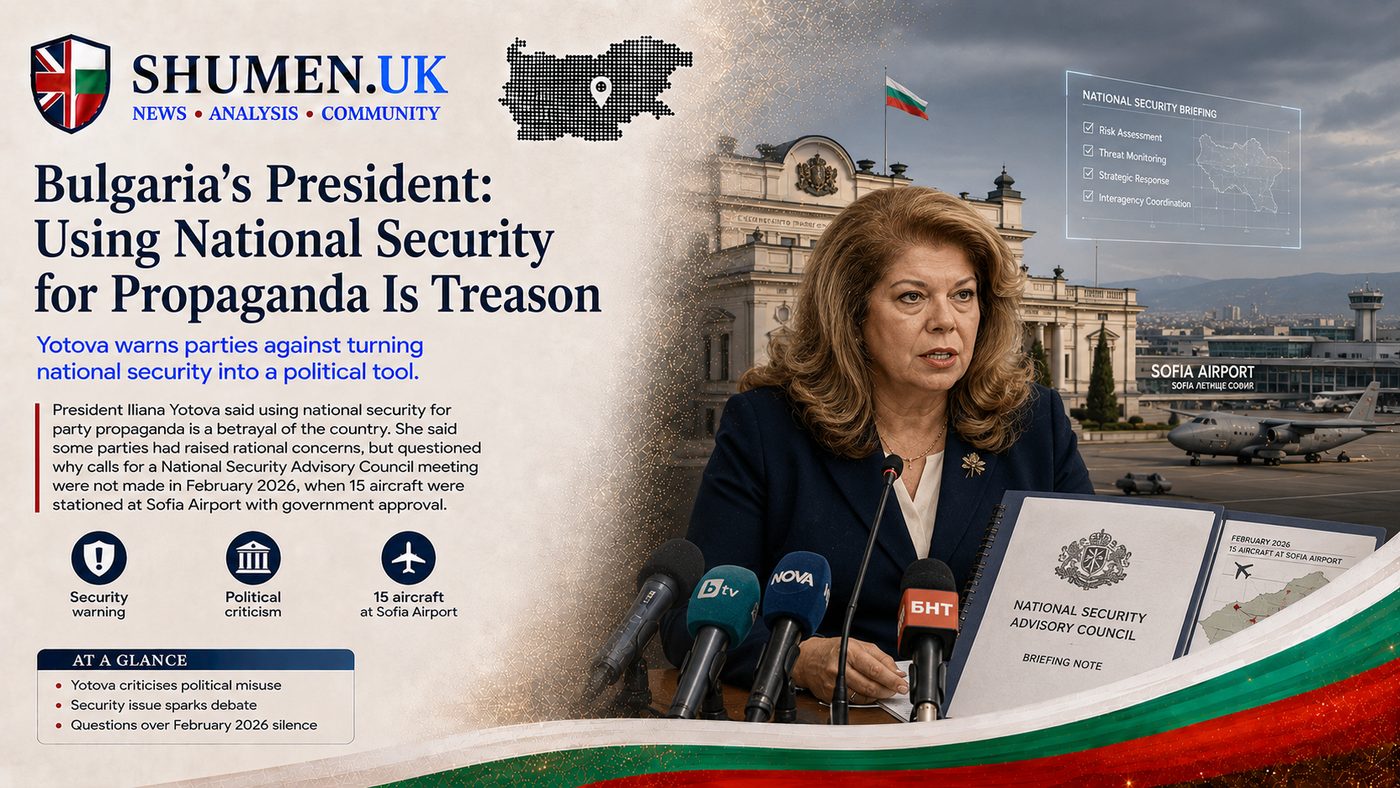
President Iliana Yotova has refused to convene Bulgaria's National Security Advisory Council and accused the parties demanding it of playing politics with the country's security. "I have not yet found any grounds for convening the Advisory Council," she said, and went further on what she thinks the demands are for: "For me, using the national security of the country for propaganda and party purposes, with dubious political dividends, is a betrayal of the country."
She was careful not to tar every party with the same brush, saying she did not regard all the reactions as equivalent and that some parties had raised what she called rational arguments. The sharper point was directed at the timing. With a presidential election set for 25 October, she said she would not let national security become campaign material.
The Row Started at Bezmer
The demands had been building for a month. Novinite reported on 22 July that GERB leader Boyko Borissov was demanding an emergency Security Council meeting over US tanker aircraft stationed at the Bezmer airbase. On 20 August, according to fakti.bg, Democratic Bulgaria's Andrey Gyurov called on Yotova directly to convene the Advisory Council over Bezmer. Novinite reported on 23 August that Defence Minister Dimitar Stoyanov had said the US aircraft and tankers had left Bezmer and departed the country.
Yotova's counter-question is the interesting part of her answer. She asked why nobody called for the Advisory Council in February 2026, when 15 aircraft were stationed at Sofia Airport with the permission of the government led by Prime Minister Zhelyazkov, and said the presidential institution was not informed about that deployment at the time. The presidency, she said, is now in contact and coordination with the government, the Security Council, the security services and international partners.
The Powers Moved, and That Is Her Argument
The second half of her answer is constitutional rather than political, and it is the part worth understanding. Responsibility for the security services has been transferred away from the presidency, a change Yotova said a large majority of lawmakers supported. Her conclusion follows from that: the people now demanding a council meeting already have full access to the security services' reports, in their capacity as leaders of parliamentary parties.
Put plainly, her position is that the meeting would tell those asking for it nothing they cannot already read, which is why she reads the demand as theatre rather than oversight. Whether that is fair is a matter for Bulgarian voters. It does at least explain why a refusal that looks obstructive from the outside is being defended as a procedural point.
What Actually Changes Between Now and 25 October
The election calendar is fixed and it is worth having in your diary, because it shapes the next two months of Bulgarian public life. Parliament approved 25 October as the date. The official campaign runs from 25 September until midnight on 23 October, with 24 October a day of reflection before polling. If no candidate takes 50 per cent in the first round, a second round follows on 1 November.
British expats cannot vote in it unless they also hold Bulgarian citizenship, so the practical content of the next two months is not the ballot. It is that security incidents will now be argued about in campaign terms by everyone involved, which makes it harder, not easier, to work out what actually happened when something lands. That is a reason to go to the authorities directly rather than to the commentary.
The Part That Reaches the Coast
Here the argument in Sofia stops being abstract. On 22 August, according to the Bulgarian News Agency, Navy teams from the Varna base responded to two separate reports of drone debris on the Black Sea coast: one on the shore between the Albena resort and the village of Kranevo in Dobrich district, the other on a beach in the Rakitenika area near Varna. The first object was classified as a decoy drone with no explosive material on board. Police cordoned the area and the Navy removed the parts to the Varna base. It was the third such incident in a fortnight, after a drone breach on 8 August and a report of a suspected rocket booster on 13 August.
The detail worth keeping is how the first find was reported: through 112, to the Dobrich regional administration. That is the number, and it took a member of the public to make the call. If you are on the coast and you come across wreckage, the sequence that worked is straightforward. Do not touch it, do not move it, keep other people back from it, and ring 112. Our guide to emergency services in Bulgaria covers how the 112 system handles English and what to expect when you call.
Anyone who spent August on the Dobrich coast will have noticed the gap between the two conversations: a police cordon on the sand at Kranevo and a Navy team carrying the parts away, and in Sofia an argument about who should be allowed to hold a meeting about it.
The Case Yotova Is Taking to Strasbourg
She also returned to Iva Mihaylova, the 23-year-old Bulgarian woman whom North Macedonian authorities have prevented from travelling to Bulgaria for medical treatment. Yotova said she wrote formally to North Macedonian President Gordana Siljanovska on 11 August, proposing two ways out: a council of Bulgarian doctors to assess how Mihaylova could be treated, or allowing her to come to Bulgaria for treatment.
"To this day, I have received absolutely no response," she said, adding that she had appealed to Siljanovska personally to stop the young woman being left disabled. Yotova plans to raise the case with the Secretary General of the Council of Europe in Strasbourg in mid-September.
For anyone here on a British passport the case is not directly transferable, since Mihaylova's difficulty turns on her Bulgarian citizenship and a North Macedonian court. What it does show is how slow a cross-border medical dispute moves even with a head of state pushing it, which is an argument for understanding your own healthcare position here before you need it rather than after. Our healthcare guide sets out how the state system and cross-border cover work.
On the central question she was blunt: "I call on us to show this time that we can behave like normal politicians." Two months of campaigning will establish whether anyone was listening.