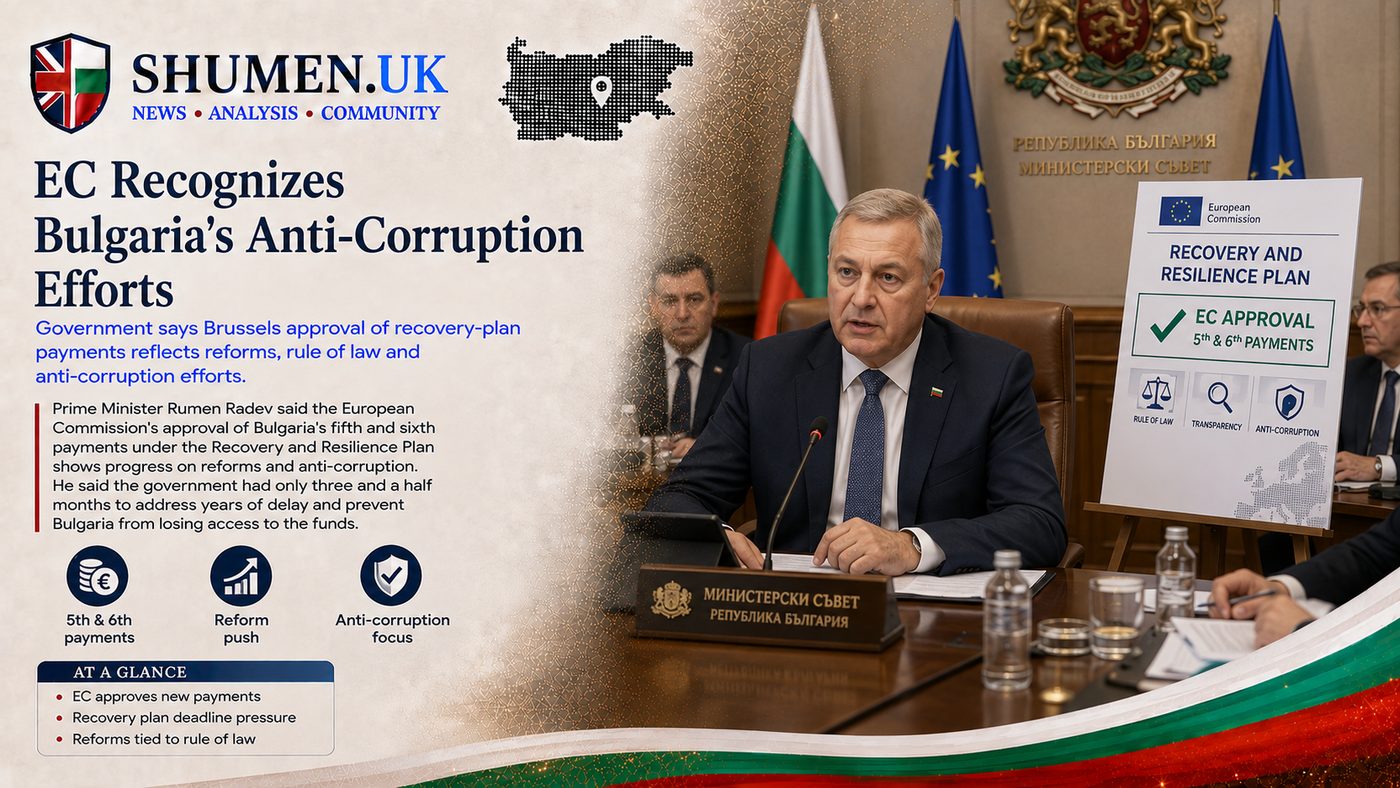
Prime Minister Rumen Radev opened Wednesday's cabinet meeting by telling ministers that the European Commission has signed off Bulgaria's latest payments under the Recovery and Resilience Plan, and that Brussels did so "in recognition of the strong political will and real actions of the government to establish the rule of law and fight corruption". The remarks, reported by Novinite and the Bulgarian Telegraph Agency (BTA), came two days after the EU-wide deadline for finishing recovery-plan reforms passed on Monday 31 August.
In the same breath he announced that the product fee charged on electrical and electronic goods, the recycling levy quietly built into the price of every fridge and washing machine sold here, will fall roughly fourfold. He also named three motorways as an "irrevocable priority": Hemus, Ruse to Veliko Tarnovo, and the Vidin to Montana expressway.
That is three separate stories in one morning briefing. Taken together they say a good deal about where the money is coming from, where it is going, and what a Brit living here will notice first.
Which Payments, Exactly? The Outlets Disagree
Novinite reports Radev as referring to the plan's fifth and sixth payments. BTA, covering the same remarks the same morning, has him talking about the fourth and fifth instalments. Neither outlet gives an amount, and the two versions cannot both be right, so we are showing both pending clarification from the government's press office.
The Commission's own country page for Bulgaria lists four payment requests, the most recent decided on 24 July 2026. Deputy Prime Minister Atanas Pekanov, who runs the EU-funds portfolio, told reporters on 31 August that "the fifth payment remains" and that it amounts to "nearly 1.7 billion euros". Read against that, BTA's numbering looks the more plausible, and Radev's "approval" most likely covers the fourth payment already banked and the fifth now being prepared. The practical facts below are the ones that are documented.
What is on the record:
- Bulgaria received €896 million as its fourth payment on 31 July, according to economic.bg. It had requested €1.1 billion; the Commission found 23 of 26 milestones met and held back the rest, including legislation on public transport and on water supply.
- A further €109 million was released in the first week of August once parliament passed the new Act on Counteracting Corruption and the law on the accountability of the Prosecutor General, Pekanov told BTA on 4 August. Over €400 million had been frozen over anti-corruption concerns under the previous administration.
- With that, Bulgaria had received "just over 70%" of its €6.17 billion grant allocation, Pekanov said. His stated target is 90 to 95%.
The link between the anti-corruption legislation and the money is therefore real, not rhetorical. Those two laws were the specific milestones the Commission had been withholding funds against.
The Deadline Radev Was Talking About
The Recovery and Resilience Facility is the EU's post-pandemic grant scheme, and it closes this year on a fixed timetable. Reforms and investments had to be completed by 31 August 2026. Final payment requests must be submitted by 30 September. The Commission then has until 31 December to pay out whatever it has approved, after which the money is gone. Pekanov put it bluntly in July: "The deadlines are not arbitrary - they are final."
Radev's "three and a half months" line refers to his own government, sworn in on 8 May with a single-party majority for Progressive Bulgaria. He said it "had to make up for years of negligence and lack of courage for reforms in order to prevent the loss of funds for Bulgaria". That is a political claim, but the underlying picture is not disputed: an ING analysis in November 2025 put Bulgaria's absorption rate at 29% against an EU average of 54%, and ranked it among the slowest performers in central and eastern Europe.
Why a British expat should care is the other half of Radev's sentence. He described the treasury as depleted, with advance revenue for 2026 "already spent", which is why he called the payments "extremely important". Bulgaria is already operating under a Brussels spending cap through the excessive deficit procedure, as we reported in June. Recovery-plan money is grant, not loan. Every euro that arrives is a euro the autumn budget does not have to find from taxes, fees or cuts, and the 2026 budget already reached for the vignette once this year.
The Appliance Eco-Fee: What Changes at the Till
The product fee is a levy paid by whoever first places electrical or electronic equipment on the Bulgarian market, and it exists to fund the collection and recycling of that equipment when it dies. You never see it on a price tag, but you pay it. According to the Bulgarian Industrial Association in April, the fee on a 70 kg fridge is €33, on a 65 kg washing machine €18, and on a 5 kg vacuum cleaner €5, and the association estimated the fees had added around 10 to 15% to appliance prices overall.
The Ministry of Environment and Water put a rewrite of the fee methodology out to consultation in the spring. Radev's announcement on Wednesday is the cabinet acting on it: fees will fall "by approximately four times" on average, in his words, as "the first step towards a complete change in the waste management system" that he said would bring Bulgaria closer to average European levels and mean "lower prices for citizens".
The arithmetic, if the whole saving reaches the shelf, is worth having. A €33 fridge fee cut to roughly €8 takes about €25 off the sticker; a washing machine, around €13. Two caveats. Neither Radev nor the reports of the decree give a date from which the lower fees apply, and the fee is paid by importers and manufacturers, not retailers, so whether the saving is passed on in full is a decision the shops will make. Anyone kitting out a village house has no reason to rush a purchase this month, and every reason to ask the retailer in a few weeks whether the new fee is in the price.
The recyclers are not happy. The Bulgarian Association of Recycling wrote to Radev in August calling the cuts "unjustified and economically unviable", warning that fees reduced "four to five times" from early-2026 levels could destabilise collection, push more waste into illegal dumping, and expose Bulgaria to EU penalties it put at €400 million to €600 million if the country fails to collect 130,000 tonnes of electrical waste a year. Radev answered that objection directly on Wednesday: "These actions of ours do not mean a reduction in environmental responsibility, because waste management should be measured not only by the amount of money collected, but above all by the result achieved." Whether the result holds up with a quarter of the funding is the question the association has put and the government has not yet answered with numbers.
Three Motorways, One of Them Past Shumen's Door
Radev's transport list starts with Hemus, the Sofia to Varna motorway that has been under construction, on and off, since 1974. Of its planned 418 km, 206 km were open at the end of 2025, in two pieces: Sofia to Ugarchin in Lovech province, and Varna to Buhovtsi near Targovishte. Anyone who has driven Shumen to Sofia knows the shape of that sentence from the inside. The dual carriageway runs out somewhere past Targovishte and the rest of the trip is a single lane each way behind a lorry, until the motorway reappears near Lovech.
Regional Development Minister Ivan Shishkov said on 1 September, inspecting the works in Pleven province, that he wants Hemus to reach Veliko Tarnovo "within the next two and a half years". He also said the entire motorway is "in the prosecutor's hands", alleging that work carried out in 2021 was paid for in 2026 using documents stating it had been completed in the relevant year. Novinite reported in July that the same minister had accused previous governments of wasting billions on the road.
The Ruse to Veliko Tarnovo motorway matters to a different set of Brits: anyone who drives here from the UK through Romania and crosses the Danube Bridge at Ruse. It is 132.84 km in three sections. Shishkov said on 31 August that the Ruse to Byala section and the Byala bypass, costing €525 million in EU and national money, will now be finished by the end of 2028, a year earlier than the end-2029 date given in May. Procurement for the remaining Byala to Veliko Tarnovo stretch is worth close to €1.5 billion. We covered the ground-breaking at Ruse in May; the driving guide has the practicalities of that border crossing.
The Vidin to Montana expressway, part of the wider Vidin to Botevgrad link in the north-west, was named by Radev without a timeline, and none of the reporting this week gives one.
What to Watch
- 30 September: the last day Bulgaria can submit its final payment request, the one Pekanov values at close to €1.7 billion.
- The product-fee decree: its publication in the State Gazette will carry the effective date and the new per-kilogram rates. Until then, the fourfold figure is an average, not a price list.
- Appliance prices: our cost of living tracker will log whether the cut shows up in the shops.
Radev called transport connectivity an irrevocable priority. Every government since 1974 has said something similar about Hemus. The difference, if there is one, will be measured in kilometres opened, not in adjectives.