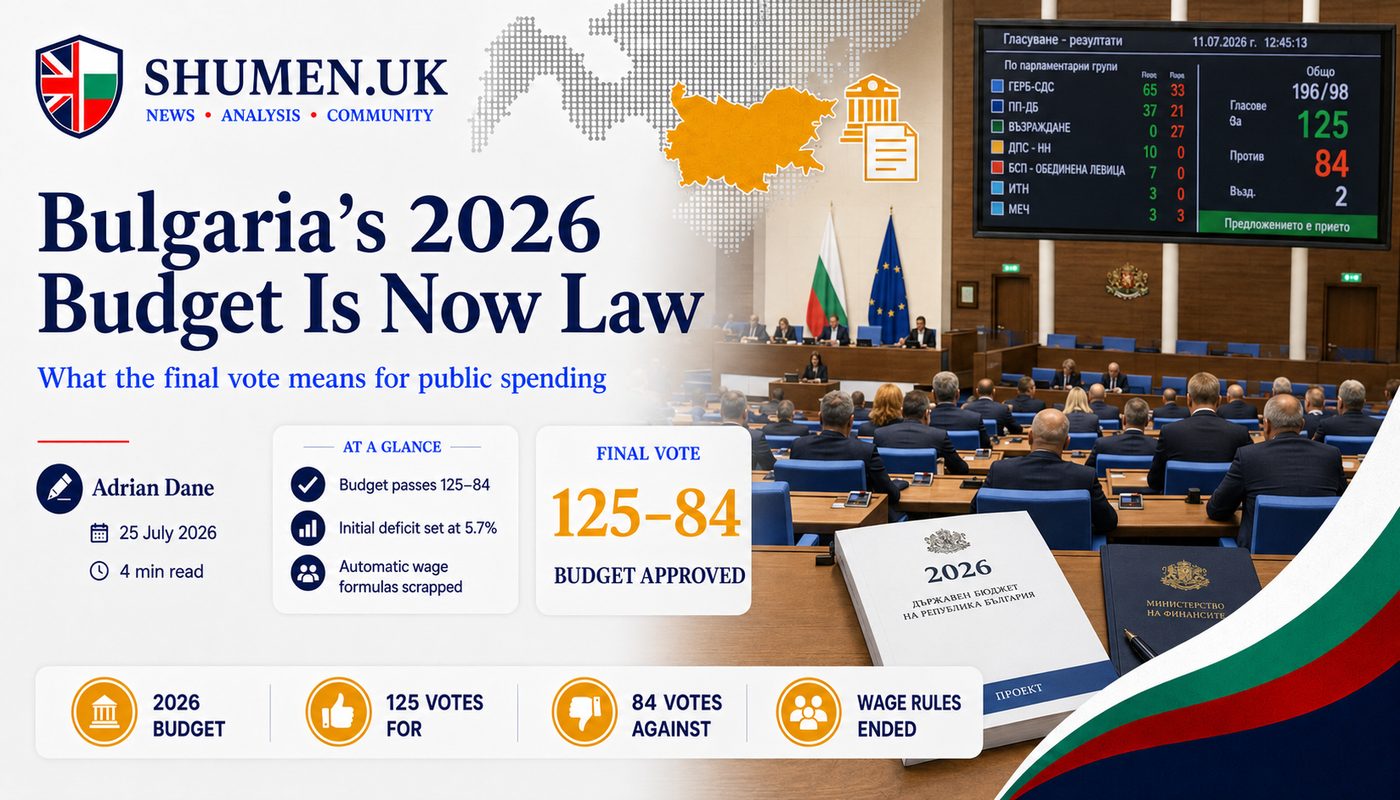
Bulgaria's 2026 state budget cleared its final reading in the National Assembly on 24 July by 125 votes to 84, with no abstentions, and it did so on one party's votes. Progressive Bulgaria, which holds 131 of the chamber's 240 seats, supplied every vote in favour. GERB, DPS, Democratic Bulgaria, We Continue the Change and Revival all voted against, and the DPS switch matters: it had backed the framework at first reading on 15 July before joining the opposition for the second. The debate that preceded the vote ran for roughly thirteen hours.
For anyone living here, the parliamentary arithmetic is the least useful part of this. The useful part is a short list of things that change on 1 August, most of which cost money.
What changes on 1 August
Vignette prices go up 30%. That is the single change most British expats here will meet first, because almost everyone with a car needs one. The increase takes effect on 1 August, so the identical vignette, for the identical roads, costs 30% more if you buy it a week later than if you buy it now. If your renewal is due around then, the date you click matters more than usual. Our driving guide covers how the electronic vignette works and where else the road costs land.
Also from 1 August: the maximum insurable income rises, the minimum social security thresholds go up and are now differentiated by economic activity and position, and the thresholds for pregnancy, birth and child-rearing allowances have been raised. Tobacco excise duties begin a staged climb that runs through to January 2028.
The minimum-threshold change is the one that quietly bites the self-employed. If you are registered here as a freelancer or running a small firm, your monthly social security floor is set by your activity code, not by what you actually earned that month, so a higher floor is a higher bill whether or not the work came in. The tax guide explains how the contribution base sits alongside the flat income tax.
Civil servants and judiciary employees start paying their own social security contributions from the same date, split 80:20 between employer and employee and moving to 60:40 from 1 January 2027. Their take-home pay is protected in law: basic salaries are recalculated so nobody nets less than they did on 31 July 2026.
The minimum wage stops moving
The structurally biggest decision was the abolition of the formula that has set the minimum wage at 50% of the national average salary since 2022. Nothing replaces it yet. A new model is to be negotiated between the state, employers and unions, and until that is agreed the minimum wage is frozen at 620.20 euros.
Atanas Katsarchev, chief economist at the Podkrepa Confederation of Labour, welcomed the fact that a budget passed at all and that the insurance thresholds were finally differentiated, but said freezing the minimum wage during persistent inflation would worsen conditions for the roughly 360,000 working poor, about 12% of the workforce. "How will these people survive, in what way?" he asked. Asen Vassilev of We Continue the Change went after the sequencing, telling deputies parliament had just declined to freeze the pay of state-enterprise directors and boards while freezing the minimum wage: "The fight against the oligarchy of people working on a minimum wage is going according to plan, and those on the boards will receive 18 minimum wages and above."
That freeze sits against an inflation rate that has not frozen. The budget's own arithmetic assumes average annual inflation of 4.3%. June's annual rate came in at 5.2% on Eurostat's harmonised measure and 5.4% on the National Statistical Institute's, both above the planning assumption.
Part-time work will count for less, from 2027
This one is worth reading twice if you work reduced hours here, which a lot of British expats do. From the start of 2027, length of service for part-time employees will be calculated in proportion to hours actually worked rather than credited by calendar day. A four-hour day will accrue service at half the rate of a full-time one, and that feeds into pension eligibility, unemployment benefit and paid leave entitlement. Service already accrued is untouched; the change applies only to future service, and anyone holding more than one employment contract will have each counted separately. Progressive Bulgaria describes it as a tool against the shadow economy. Whatever the intent, the effect on a part-timer's pension timeline is arithmetic, and it starts counting from January. The pensions guide sets out how Bulgarian service years interact with a UK record.
The deficit, and the three versions of it
The headline is a deficit of 5.7% of GDP, a record. The cash figure is less settled: it was reported at 7.2, 7.191 and 7.32 billion euros at different points in the process, differences of rounding and of which reading you are quoting rather than a dispute about the policy. We are showing all three because the process did; treat the 5.7% as the number to hold on to.
Total spending is set at 56.8 billion euros against revenue of nearly 50 billion, on assumed growth of 2.6%. New borrowing of up to 10.1 billion euros was authorised, including up to 3.261 billion under the EU's SAFE defence instrument, taking the debt ceiling to 37.7 billion euros by the end of 2026, with a minimum fiscal reserve floor of 2.6 billion. Official projections still have the deficit back to 3% by the end of 2028, with debt above 50 billion euros by then.
The European Commission is less alarmed than the headline suggests. Its own working estimate is a deficit nearer 4.2% by year end, on the reasoning that not everything budgeted will actually be spent, particularly under the Recovery and Resilience Plan. The Finance Ministry has broadly agreed with that reading, saying it wrote in all potential RRP funding knowing some would not materialise. The adoption still comes weeks after the EU placed Bulgaria under an excessive deficit procedure, which is triggered when a member state goes past the bloc's 3% threshold.
It is passed, but it is not quite finished
One thing the coverage has largely skipped. A bill that has cleared parliament becomes law when the president promulgates it, and the president may instead return it for further debate. Speaking on BNT the following morning, President Iliana Yotova confirmed she has received the opposition's petition urging her to veto this budget, and said she would examine the arguments before deciding.
Before anyone plans around that: a returned act goes back to the National Assembly, which can re-pass it on the votes of more than half of all members, at least 121 of the 240. Progressive Bulgaria has 131 on its own. A veto here would buy a debate and a delay, not a different budget.
Finance Minister Galab Donev called the outcome "an important and first step towards stability, predictability and budget balance". Budget committee chairman Konstantin Prodanov said the government's "real priorities" would be visible within two or three months, which is a reference to the 2027 budget the ruling party keeps promising will carry the actual reform. Martin Dimitrov of Democratic Bulgaria noted Bulgaria has not run a comparable deficit since the Zhan Videnov government of the 1990s. Tsvetan Simeonov of the Bulgarian Chamber of Commerce and Industry gave it a mixed verdict, crediting it for not raising tax rates and for ending the automatic payment mechanisms, while noting it covers less than six months of the year in practice.
For a household here, none of the arguing changes the practical position. The vignette costs 30% more from 1 August, the social security floor is higher from the same day, and part-time years start counting for less from 2027.