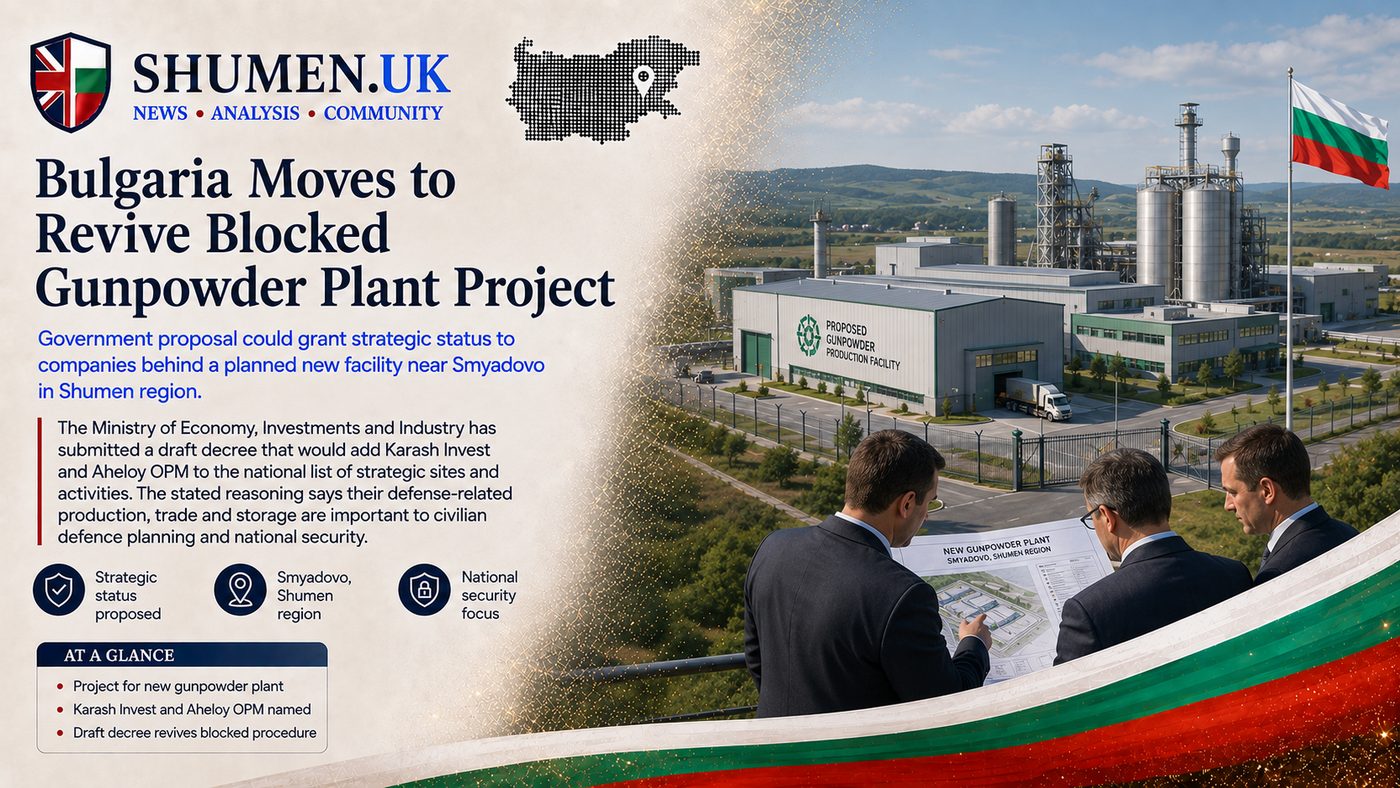
The government has restarted a procedure that would give strategic status to the two companies behind a proposed gunpowder plant near Smyadovo, in the southeast of Shumen province. A draft decree from the Ministry of Economy, Investments and Industry would add Karash Invest and Aheloy OPM to the national list of strategic sites and activities important to national security. Karash Invest is owned by Hristo Emilianov Gebrev, son of the arms manufacturer Emilian Gebrev.
It is worth being precise about what this is, because the shorthand version circulating will not be. The decree does not authorise anyone to build a gunpowder plant. It proposes a change in the legal status of two companies.
If adopted, they would fall under a special security regime: increased monitoring, protection and control by the State Agency for National Security, along with stricter requirements governing security and access. The ministry's stated reasoning is that their production, trade and storage of defence-related products matter to civilian defence planning and national security.
What the Decree Would Change, and What It Would Not
Strategic listing is a supervision measure, not a planning consent. It would formally recognise the companies' activities as bearing on national security, and it would put their sites under the security agency's regime. It would not grant a construction permit, settle a site, or shorten any of the approvals a plant of this kind needs.
A draft decree in Sofia and a working factory in Shumen province are separated by a great deal of paperwork, and anyone who has waited on a Bulgarian permit already has a rough sense of how much.
The Same Procedure Collapsed in 2024
An earlier attempt to give these companies strategic status was abandoned in 2024, after the State Agency for National Security withdrew an opinion it had initially given in support.
What happened around that withdrawal has been publicly contested ever since, and it needs setting out carefully. Bogdan Bogdanov, the former economy minister, has said the government was pressured to stop the procedure, and has since told Radio Free Europe that two phone calls to Delyan Peevski preceded the agency's change of position. Boyko Noev, a former defence minister, has alleged that Peevski was behind the intervention. Bogdanov had raised the matter twice before, first at a committee hearing in parliament in March 2024, and again that October in a Nova TV interview. The issue reached a wider audience in 2025, when Noev returned to it on Studio Bulgaria, a Radio Free Europe programme.
Peevski has not publicly confirmed any of it. The circumstances of the withdrawal have not been established as fact by a final decision of any competent authority, and none of the above should be read as though they have. These are allegations by named former ministers, reported as such.
The consequence of the 2024 collapse was practical rather than symbolic. Without a place on the list, Karash Invest went without the extra state protection that listing brings, and that absence told on the confidence of outside partners.
The State's Own Gunpowder Project Is Not Where It Was Meant to Be
This is the context the announcement does not carry on its own, and it changes how the Smyadovo decree reads.
Bulgaria is usually described as having two routes to more domestic gunpowder. One is this private project near Smyadovo. The second is the state-backed tie-up with the German defence company Rheinmetall, announced in October 2025: an investment approaching one billion euros alongside VMZ-Sopot, making gunpowder, 155-mm artillery shells and modular charge systems, with around 1,000 jobs attached.
The second route has stalled. On 23 July 2026, Alexander Pulev, deputy prime minister and minister of economy, investments and industry, put it plainly: "There is no founding agreement, there is no joint venture between VMZ-Sopot and Rheinmetall." He said the financing had not been provided for in the budget despite what he called the generous promises of the Borissov cabinet, and that the terrain chosen for the project was not optimal. Talks are being restarted.
Pulev's ministry is the same one now proposing strategic status for the Smyadovo companies. Nobody has established a link between those two things, and this article does not assert one. What can be said is that the state's flagship gunpowder project currently has no joint venture behind it, that the shortage of gunpowder and ammunition components in Europe since Russia's invasion of Ukraine in 2022 has not eased, and that gunpowder remains the bottleneck for artillery shells.
The Explosions Near Belitsa
The revival also comes days after explosions at ammunition warehouses belonging to Gebrev's EMCO near the village of Belitsa, close to Tryavna. Prosecutors have opened a case on suspicion of arson. They say they are working through every version, external interference among them, and no finding has been announced.
It is not the first such incident connected to Gebrev's businesses. In previous cases, Russian nationals linked to Russian military intelligence were charged, and the same individuals have been sought over the poisoning of Gebrev, his son and an EMCO employee in April 2015.
If You Live in the Shumen Region
For the British expats spread through the villages of this province, and for anyone still house-hunting in it, the only question that really matters is whether something is about to go up nearby. On the evidence so far: not because of this. No permit has been granted, and a strategic listing is a decision about how two companies are supervised, not a decision about what gets built. Whether a gunpowder plant is constructed near Smyadovo, and on what terms, remains a separate and unanswered question.
The practical point is narrower and worth acting on only if it applies to you. If you are house-hunting anywhere in the Smyadovo municipality, this belongs on the list of things to raise with a seller or an agent, alongside the quarry, the wind farm and the road scheme: ask what is actually permitted on the land nearby, not what the neighbours have heard. Our guide to buying property in Bulgaria sets out the searches worth doing before money changes hands, and the background on the region is worth a read if Smyadovo is a name you have only just learned.
The other honest observation cuts the reassuring way. If the decree is adopted, these sites would be watched more closely than they are now, not less. Tighter monitoring and controlled access is the entire point of the listing.
Smyadovo has now had a draft decree written about it twice, and no gunpowder plant either time. The question of whether anything is actually built there is still open, and this decree does not answer it.