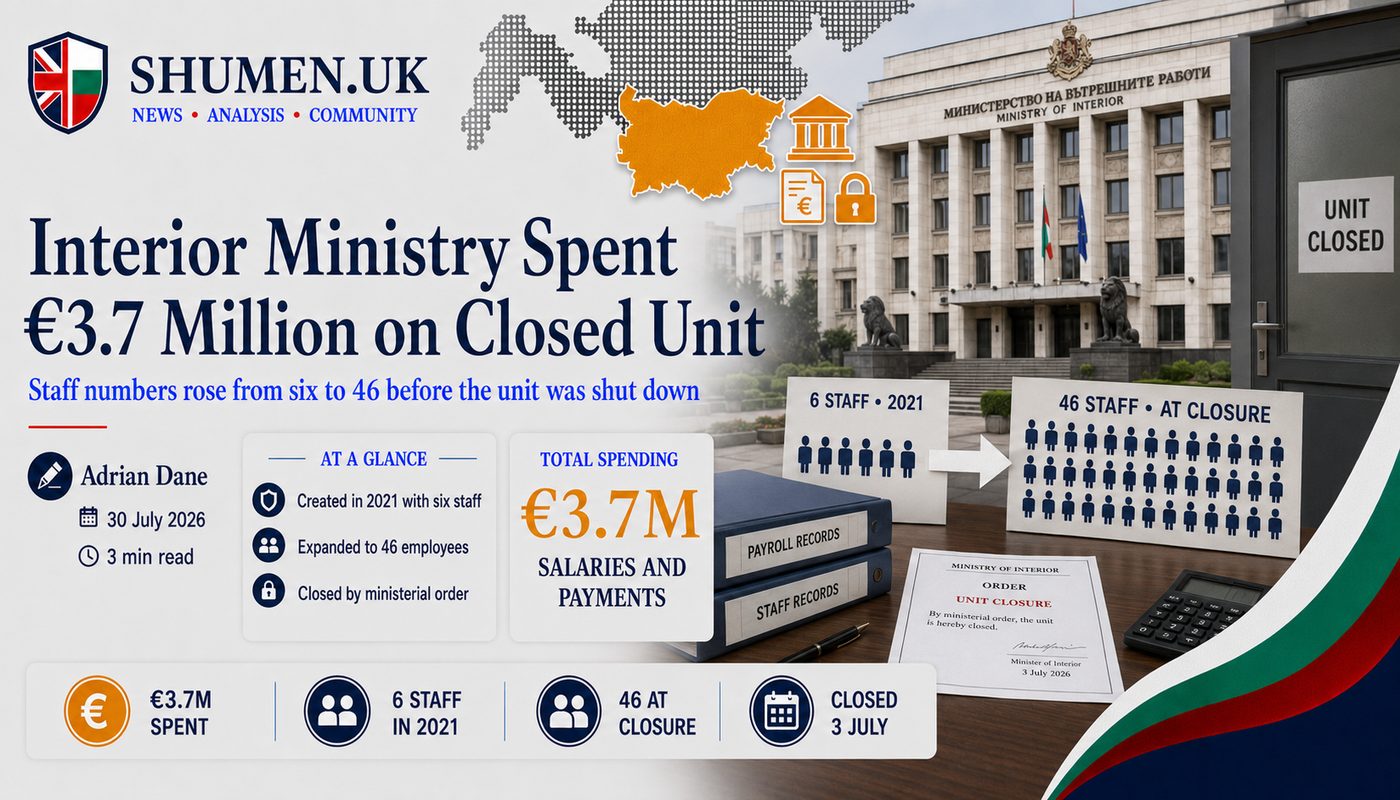
Bulgaria's Ministry of Interior spent more than €3.7 million on salaries and other remuneration for a special internal unit that the minister who shut it down described as "parasitic", according to figures the ministry released under the Access to Public Information Act and reported by Novinite.
The unit, known informally inside the ministry as the "isolator", was closed by an order from then Interior Minister Ivan Demerdzhiev on 3 July. Created in May 2021 with six employees, it had grown to 46 staff by the time the order was signed.
Anyone who has queued at a Migration Directorate desk to register an address knows the ministry is not short of genuine work. The question these figures raise is why so much of its payroll was going to people its own leadership had decided not to use.
What the "Isolator" Was
Announcing the closure, Demerdzhiev said the unit held ministry officials who had lost the confidence of the leadership and were no longer given significant responsibilities. "They are not given responsible tasks and the results of their work are little known," he said. Employees, he added, would be assessed individually and transferred to positions where their experience could be useful, and the ministry would look for other structures with duplicated functions or unclear roles.
The ministry has declined to name the unit's staff or give their positions, citing personal data protection. It is also unclear whether any of them had reached retirement age: employees are not required to tell their employer if they choose to exercise their pension rights.
The Bill, Year by Year
The ministry's own figures put the total cost of the unit, from its creation in May 2021 under former Interior Minister Boyko Rashkov to its closure, at just under €3.77 million in salaries and related payments.
- 2025 was the most expensive year, at about €1.09 million.
- More than €903,000 was spent in the first half of 2026 alone, putting the unit on course for a record year had it survived. A significant share of that went on compensation payments rather than ordinary salaries.
- Spread across the 46 staff, the 2026 spending works out at roughly €3,300 per person per month in total remuneration costs.
Two Explanations That Do Not Match
The ministry's official explanation is that experienced employees were appointed to the unit and assigned tasks by the leadership so that their professional expertise could be used.
That sits awkwardly next to Demerdzhiev's account of a unit for officials who had lost the leadership's confidence, were given no responsible tasks and produced work whose results were little known. Both descriptions come from the ministry itself: one from its formal written response, the other from the minister who ordered the closure. Readers can judge which sounds more like a €3.7 million line item; the two cannot both be the whole story.
Who Ended Up Parked There
Some names have emerged despite the ministry's refusal to publish a staff list. A parliamentary hearing of acting Interior Minister Emil Dechev revealed that several senior police officials connected to what is known as the "Petrohan" case had been assigned to the unit, among them senior figures from the Montana and Sofia regional police directorates and directors from the National Police Directorate. Dechev told parliament the officials were not direct participants in the investigation, had not been dismissed or removed from their positions, and had been temporarily reassigned to assist the Interior Minister. The source report does not detail the case itself.
The unit also held Stefcho Bankov, the former head of the ministry's Internal Security Directorate, who was dismissed during Boyko Rashkov's tenure, challenged the dismissal in court, won, and was assigned to the unit on his return. Vasil Kostadinov, previously head of the Plovdiv regional police directorate, has said he spent about six weeks there after being disciplinarily dismissed while Kalin Stoyanov was interior minister. He later won reinstatement in court. His lawyer in that case was Ivan Demerdzhiev, the same man who, as minister, would eventually close the unit.
What This Means for British Expats
The Ministry of Interior is the arm of the Bulgarian state that British expats deal with most directly. Residence permits and address registration run through its Migration Directorate, which our residency guide walks through in detail, and driving licences, vehicle paperwork and traffic fines sit with the KAT traffic police covered in our driving guide. On the account of its own former minister, this is a ministry that was paying 46 people not to work while those front desks stayed as they are. Where the payroll budget goes is not an abstract question for anyone who has waited at one of them.
There is also a practical lesson in how the story surfaced. The figures exist publicly only because someone filed a request under the Access to Public Information Act, Bulgaria's equivalent of a freedom-of-information law, and the ministry answered it. The route is not reserved for journalists, and this disclosure is a decent demonstration that it works. For expats used to the British FOI system, it is the local counterpart worth knowing exists.
Finally, the follow-through. Demerdzhiev said the ministry would identify other structures with duplicated functions or unclear roles. Whether more "isolators" surface, and what they have been costing, is the thing to watch.