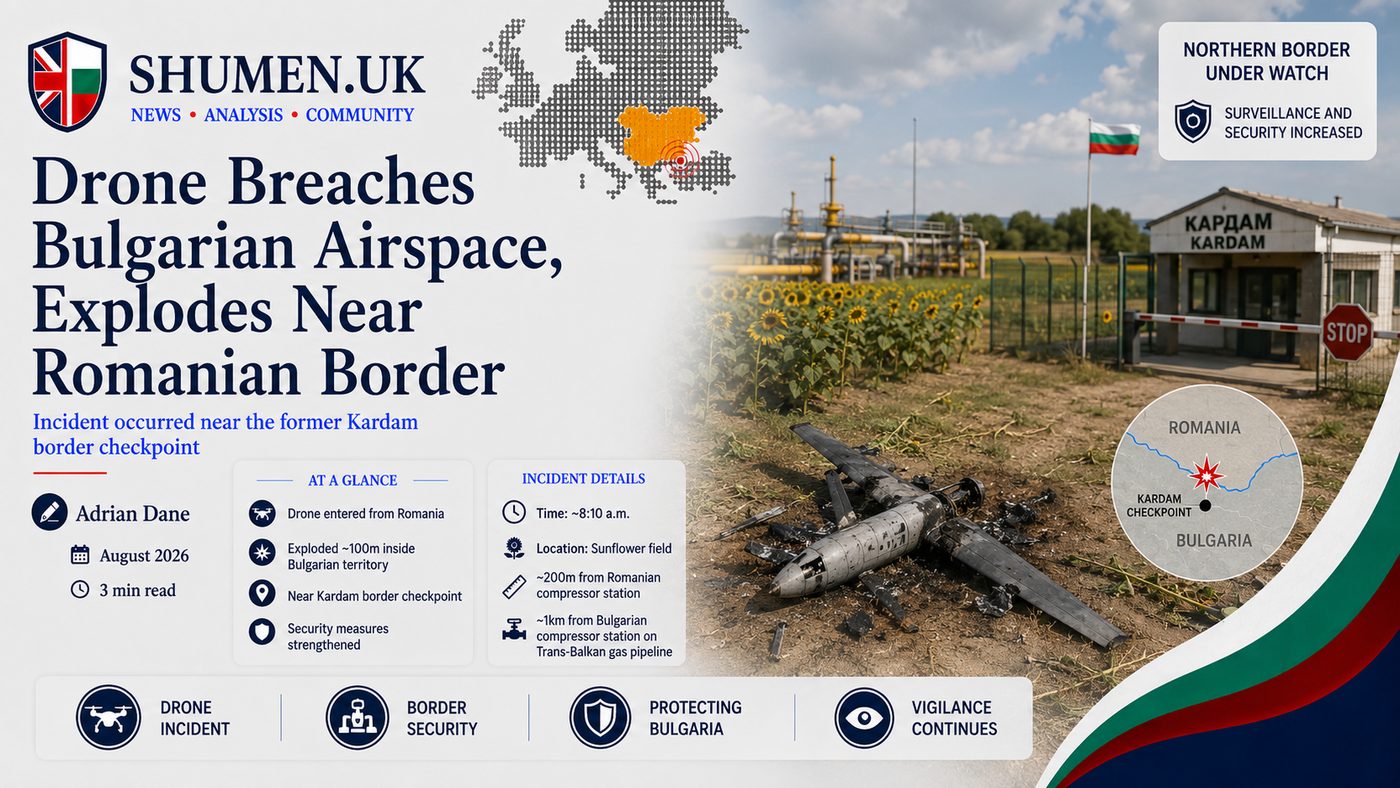
A drone crossed into Bulgarian airspace from the Romanian side shortly after eight on the morning of Saturday 8 August and exploded in a sunflower field near the old Kardam checkpoint in Dobrich province, 1,000 metres from a compressor station on the Trans-Balkan gas pipeline. How far inside the border it came down is reported inconsistently: most accounts, including the Defence Ministry's, put it at roughly 100 metres, while Al Jazeera places the site about a kilometre in. Nobody was hurt. No building, no piece of infrastructure and, as far as the authorities have said, not even the surrounding farmland was damaged.
Prime Minister Rumen Radev said the device was not a hobby drone but a larger machine carrying what appeared to be a significant amount of explosives, judging by what was heard and seen from a distance. The Defence Ministry's preliminary assessment is that the wreckage most likely belongs to a Maya, a cheap decoy drone widely used by the Ukrainian armed forces. The same ministry has been careful to add that, in its words, nothing currently suggests the incident was deliberate.
Bulgaria has still summoned Ukraine's ambassador over it. Foreign Minister Velislava Petrova said Ambassador Olesia Ilashchuk has been called in for a meeting on Monday 10 August, once she is back in the country.
Nobody's Radar Saw It Coming
The detail that has caused the most disquiet in Sofia is not where the drone came down but that it arrived unannounced. Neither Bulgarian nor Romanian radar tracked the aircraft before it detonated, a point Radev confirmed himself, adding that identifying and neutralising drones of this kind poses a major challenge.
According to the Novinite commentary that first laid out the sequence, there was also no alert from NATO's Combined Air Operations Centre at Torrejon, which covers this airspace, and Radev acknowledged that the procurement of modern three-dimensional radar has been stalled for years. Chief of Defence Admiral Emil Eftimov is quoted in the same piece conceding that even specialised anti-drone radar might pick up a target like this only at four or five kilometres, which over a populated border leaves almost no time to react.
Romanian border police did register the drone, in a fashion. They heard it. The explosion was audible on the Bulgarian side near General Toshevo. Heard but not tracked is the distinction that matters, and it is the one Bulgarian officials are now having to answer for.
The sunflower fields run to the horizon in that corner of Dobrich province, which is the only reason this is a story about a crop rather than a roof.
What the Investigation Has Not Settled
Ukraine has denied steering anything towards Bulgaria. Foreign ministry spokesman Georgiy Tykhyi said Kyiv can state with certainty that the Ukrainian armed forces did not intentionally direct any assets toward Bulgaria, and put the incident down to Russia's invasion. Kyiv has offered to help with the investigation.
The most technically credible explanation, and the one Eftimov has pointed to, is electronic interference: a Maya knocked off its programmed course by Russian jamming or spoofing, the same effect analysts blamed when a wandering Ukrainian Maya was intercepted over the Baltic earlier in 2026. That is the mundane answer, and it is also the probable one.
Other readings are circulating, and it is worth being precise about their status. The Novinite piece notes that Poland's and Lithuania's defence ministers had both warned publicly, before Kardam, that Russia had captured intact Ukrainian drones and might use them for false-flag provocations against NATO members, and that the Institute for the Study of War describes this as a deliberate Russian campaign. Ivaylo Mirchev of Democratic Bulgaria has asked whether the proximity to the Vertical Gas Corridor, the route Bulgaria is counting on for non-Russian gas, suggests a hybrid operation probing responses around critical infrastructure.
Those are questions raised in commentary and in politics, not findings. The Defence Ministry's stated position remains that nothing so far indicates deliberate action, and Radev has said the wreckage is badly burned. Until the forensics are done, the honest summary is that the origin is unresolved and the official reading is accident rather than attack.
What It Means in the North East
For anyone living in this part of the country, and that includes a fair number of our readers, the practical consequences are modest but real.
The first is a visible one. Bulgaria has increased surveillance along its borders and redeployed troops for drone detection and anti-drone work, so more military movement around Dobrich province and the northern border is to be expected for a while. If you are in the villages up towards General Toshevo, Kardam or the coast road, that is what you are looking at.
The second is a straightforward safety point that follows from the one fact everybody agrees on. This machine was carrying a significant quantity of explosives. If you come across debris, wreckage or anything that looks like it fell out of the sky, the sensible response is the boring one: do not touch it, do not move it, note where it is and ring 112. That applies to farm workers and dog walkers as much as anyone, and it applies for as long as the searches continue.
The third is energy, and here the honest answer is reassuring. The compressor station was not hit and gas supply has not been affected. The Trans-Balkan line runs from Turkey towards Ukraine and matters to Bulgaria's supply arrangements rather than to your boiler this week; our utilities guide covers how household energy actually reaches you here, and none of it changed on 8 August.
Bulgaria is due to host a NATO counter-drone experiment in October, and there is a SAFE anti-drone project already in train. Whether Kardam turns that from a diary entry into something more urgent is the question worth watching. The north east has spent the war a long way from the front line, and mostly still is. It is simply no longer somewhere that nothing arrives from the sky.