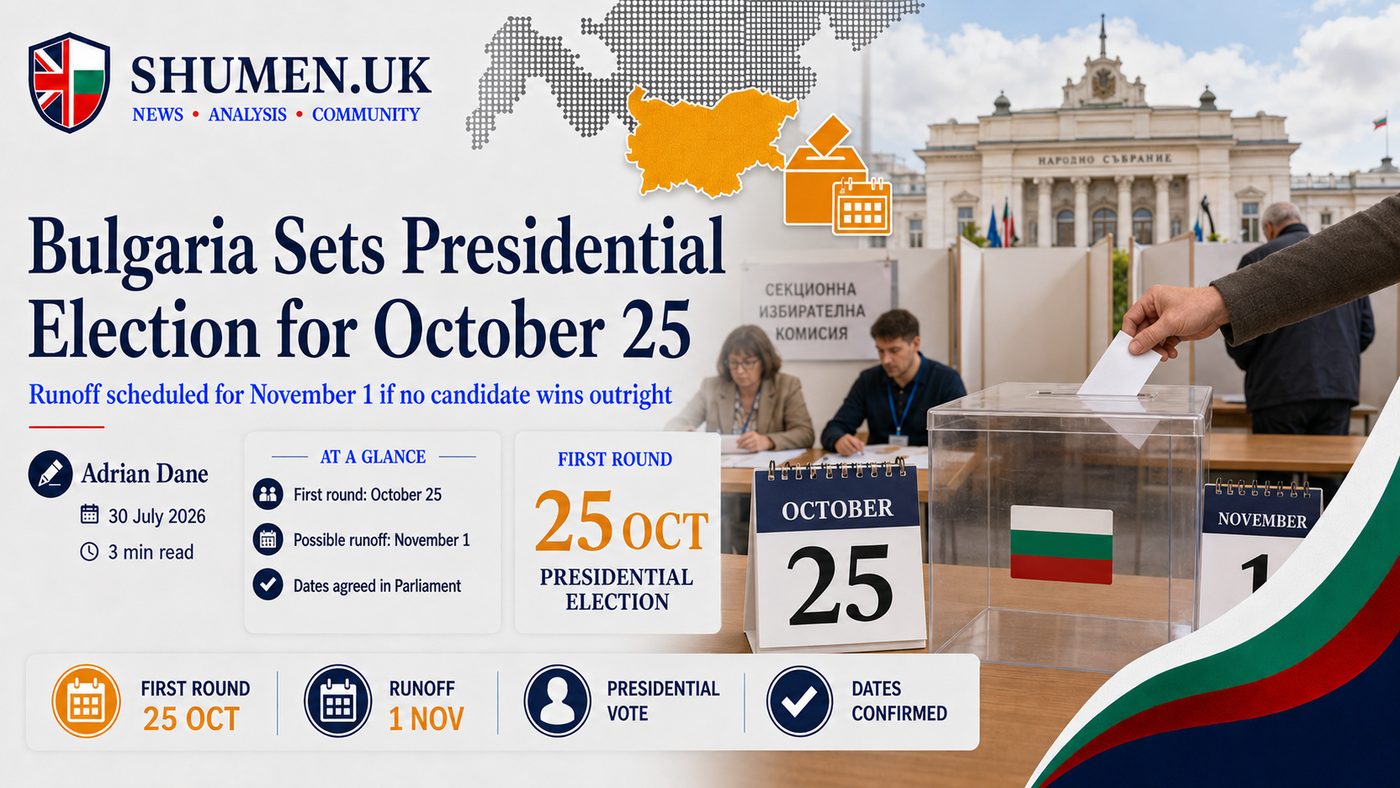
Bulgaria will choose its next president on Sunday 25 October, with a runoff pencilled in for Sunday 1 November if no candidate wins the first round outright. The date was settled at the regular meeting of parliamentary group leaders in the National Assembly, Novinite reports, and in a characteristically Bulgarian touch, none of the political parties has yet bothered to comment publicly on it.
The timing is dictated by the constitution rather than by anyone's preference. Under the basic law, the National Assembly fixes the date of the presidential and vice-presidential elections, and the vote must fall within a window of between two and three months before the current president's term expires. In the kafenes of Shumen the argument about who will stand has been running for weeks; parliament has now supplied the when.
The Runners So Far
Two candidacies are officially confirmed. Incumbent president Iliyana Yotova announced last week that she will seek a full term, with Progressive Bulgaria declaring its support. The leadership of the Bulgarian Socialist Party has also formally endorsed her, a gesture of loyalty more than of arithmetic, since the BSP no longer holds seats in parliament. Novinite reported this week that a survey by polling agency Global Metrics puts Yotova ahead in the early running.
The second confirmed contender is Nikolay Nenchev, a former defence minister and diplomat nominated by the Bulgarian Agrarian National Union (BZNS), with Tsveta Kirilova proposed as his vice-presidential running mate. Wikipedia's election page also lists independent candidate Yolo Denev as declared.
Several heavier names remain in the maybe column:
- Andrey Gyurov, the former central bank deputy governor who led a caretaker government earlier this year, has not confirmed a bid, although local media report an initiative committee stands ready to back him.
- Prof. Daniel Valchev, a former deputy prime minister and education minister, says he would run only if nominated by an initiative committee.
- Wikipedia also notes figures from Vazrazhdane, MECh and other formations as possible or pending entrants, while Boyko Borisov and former presidents Rosen Plevneliev and Petar Stoyanov have publicly ruled themselves out.
How Bulgaria Picks a President
The system is a two-round affair, and the small print explains the 1 November placeholder. To win in the first round a candidate needs a majority of the valid votes and turnout above 50 per cent. Fail either test and the top two meet again a week later, where a simple majority suffices. According to the electoral rules documented by IFES and Wikipedia, no candidate has ever cleared the first-round bar, so seasoned watchers treat the runoff date as the real one. Since 2016 the ballot has also carried a "none of the above" option, which has a loyal following.
Eligibility is tight. A candidate must be a Bulgarian citizen holding no other nationality, at least 40 years old on election day, and resident in the country for the previous five years. The constitution also caps anyone at two elected terms, which is why Georgi Parvanov and Rumen Radev are both out of the frame.
Why a Largely Ceremonial Job Still Matters
Day to day, Bulgaria is run by its government, not its president. But the office carries reserve powers that have mattered enormously through the country's long political crisis: the president is commander-in-chief, can send legislation back to parliament, and, crucially, appoints a caretaker government when the assembly cannot form one. That last power is not theoretical. Gyurov, one of the undeclared candidates, spent part of this year leading exactly such a caretaker cabinet, and the April parliamentary election was Bulgaria's seventh snap vote since April 2021, according to Wikipedia's account of the five-year crisis.
Progressive Bulgaria won that April election decisively, and Yotova's former ticket-mate Rumen Radev now leads the government as prime minister, having swapped offices with his old running mate. Whoever takes the presidency in the autumn inherits the power to decide who governs the next time parliament deadlocks, which, on recent form, is a question of when rather than if.
What This Means for British Expats
The blunt version first: British expats cannot vote in Bulgarian presidential elections unless they also hold Bulgarian citizenship, and the candidacy rules shut the door even tighter, since dual nationals cannot stand at all. For most Brits here this is spectator politics, and anyone curious about the longer road from residence permit to citizenship will find it mapped out in our residency guide.
Spectator does not mean irrelevant. The autumn vote decides who holds the caretaker-appointment power through whatever the next parliament does, and after five years of caretaker cabinets and snap elections, that power has shaped the ministries British expats deal with, from residence permits to the health fund, as much as any elected cabinet has. Expect the campaign to build through September and October, polling stations in schools and chitalishta on both Sundays, and the parties to start commenting on the date they have just set roughly any day now.