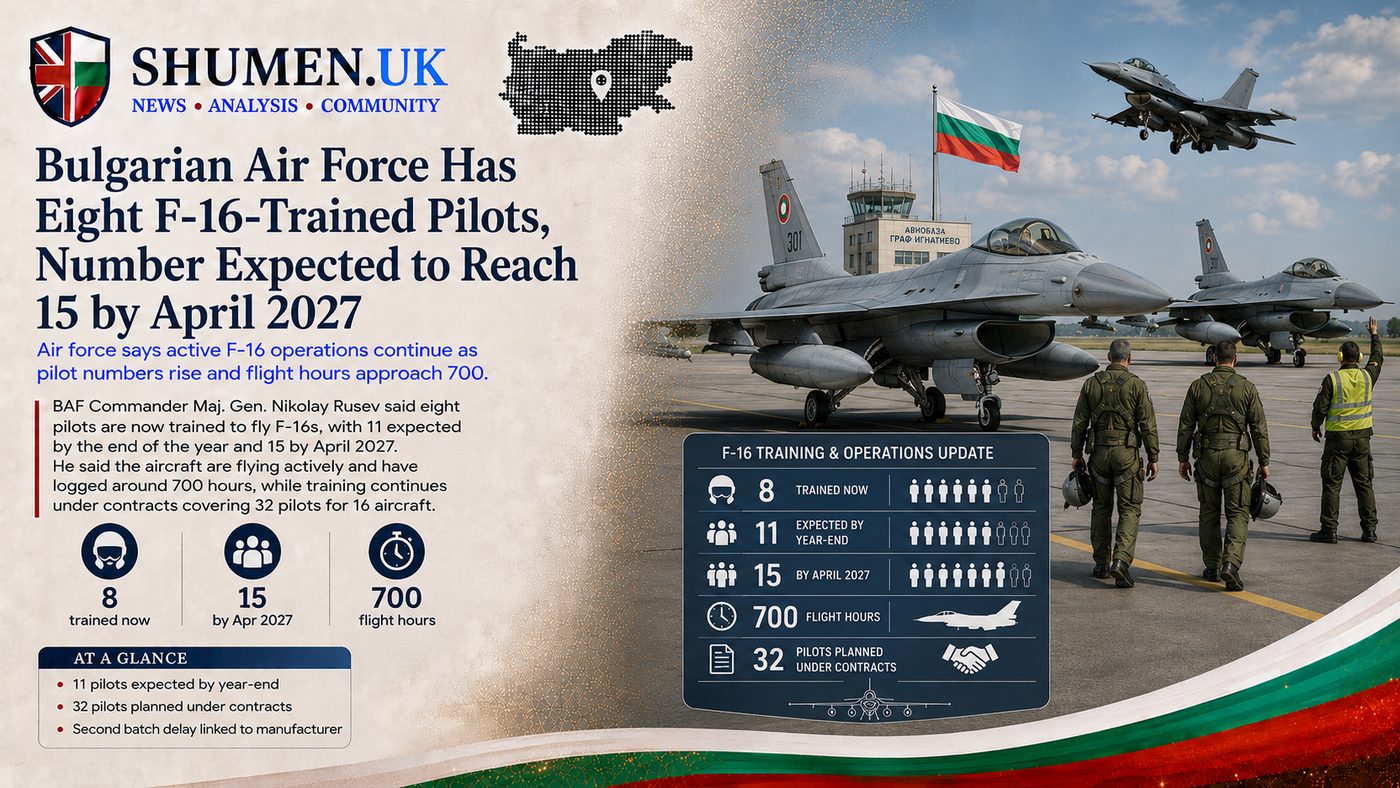
The Bulgarian Air Force now has eight pilots qualified on the F-16, the jets have logged around 700 flying hours between them, and not one of those aircraft can yet fly a combat air patrol. That is the state of the Block 70 programme as set out by Air Force commander Major General Nikolay Rusev speaking to Bulgarian National Television on Thursday 3 September, in an interview reported by BTA.
The pilot count is due to reach 11 by the end of 2026 and 15 by April 2027, Rusev said, and the crews start night flying next year. Those are the tidy numbers. The rest of his answers were less tidy, and they matter more, because the air over the Black Sea coast is the stretch of NATO's eastern flank that British expats in Bulgaria actually live under, and the jets meant to police it are still waiting on a box of kit from America.
Eight Jets on the Ramp, None on Patrol
Rusev's plainest admission was that the jets are not yet kitted out for combat air patrols, because the self-protection and warning suite they need is still missing. "Why it is not there, I cannot answer; we do not manufacture it, but we have assurances that installation of the system may begin within the next year. I expect there to be results by the end of 2027," he told BNT.
Put that beside the two other dates already on the record. Defence Minister Dimitar Stoyanov told Lockheed Martin representatives on 14 August that the goal is to have the first eight jets on combat duty in 2027, according to a ministry statement reported by The Sofia Globe. Six weeks earlier, on 28 July, the same ministry had said the Air Force would not have the F-16s fully operational until 2028. So the reader has three answers to one question: combat duty in 2027, self-protection results by the end of 2027, full operational readiness in 2028. None of the three has been reconciled in public, and we are showing all of them rather than picking the kindest.
Until that is sorted, the alert job stays with the MiG-29s. Former defence minister Todor Tagarev made the awkward point on 27 July, as reported by The Sofia Globe: Bulgaria has eight F-16s and trained pilots, none on duty, and when a passenger jet squawked the hijack code over the region in June only one of the two available MiG-29s got airborne. We covered that 30 June scramble and the spending pledge behind it at the time. The MiG-29 was already the old jet when I arrived in Bulgaria 13 years ago. It is still the one on the alert pad.
The Second Eight Are Now a 2030 Story
Rusev said the slip on the remaining eight airframes is not Bulgaria's doing and sits with the factory building them. The ministry's own account, from that 14 August meeting, is more specific: Lockheed Martin said delivery of the second eight could slip to the second quarter of 2030, while promising to take all steps to accelerate production. Stoyanov's response was about money as much as dates. He called it "of key importance that the delay be minimised and not lead to an additional financial burden for the state" and said Bulgaria expects assurances that the slip will not affect the final contract price.
For scale, the first eight were approved by the US State Department in June 2019 at an estimated $1.67 billion, and the second eight were agreed in November 2022. The Ministry of Defence has planned to retire the MiG-29 around 2028, after the F-16s reach full operational capability. A second batch arriving in 2030 makes that retirement date look less like a plan and more like a hope.
Hence the shopping around. The ministry confirmed on 28 July that it has sent enquiries to Poland and Hungary about available aircraft and spare parts, is looking at used F-16s and Gripens, and has asked the US for second-hand F-16s. Stoyanov repeated on 15 August that the second-hand request "is now gaining even greater importance". No negotiations have started and no decision has been taken. The politics of it are already sharp: opposition MP Ivailo Mirchev called the pursuit of Polish MiG-29s, aircraft Warsaw had been discussing sending to Ukraine, counterproductive, and Tagarev's line was blunter: "Instead of moving towards developing capabilities for new equipment and acquiring other anti-drone defence and missile defence systems, we are relying on the old."
Rusev, for his part, repeated that a single F-16 squadron is not enough. "Even the smallest Western European countries have dozens of fighter jets," he said, and he would like to see a second modern type alongside the Viper. The two contracts fund training for 32 pilots in all, which covers the 16 airframes ordered.
What a Fighter Pilot Is Paid to Fly
The interview also put numbers on something Bulgarian defence coverage rarely mentions: what the people in the cockpits get. A pilot receives an extra €193 a month for flying a supersonic aircraft, €179 for a subsonic one, and €170 for transport, training aircraft and helicopters. "If they do not fly, these amounts are simply not paid," Rusev said, and added that people join the Air Force for love of country rather than the pay. That is €193 a month, on top of salary, for the person who shadows a hijack-alarm airliner over Varna. He also rejected any suggestion that young aircrew are being kept out of the cockpit: "in aviation, young people have never been held back," he said.
The weapons side is moving faster than the aircraft side. The US notified Congress on 1 June 2026 of a proposed $957 million sale to Bulgaria of 125 AIM-120C-8 AMRAAM air-to-air missiles, five guidance sections and four AIM-9X Block II missiles, The Sofia Globe reported. So the missiles are coming; the gap Rusev described is the jet's own defensive kit.
Why This Reaches the Coast
For a British expat here the practical point is not who flies the alert, it is what the alert is for. Drone debris was cleared off the beaches between Albena and Kranevo on 22 August, and Romania's F-16s shot down a drone that crossed into Romanian airspace in July, as The Sofia Globe reported. The Bulgarian ministry itself framed the second-hand jet search as a way to sustain NATO air policing until the F-16s are ready. If you find anything that looks like aircraft or drone wreckage on a beach or in a field, the first find on the coast was reported through 112, and our emergency services guide explains what the operator will ask you.
There is a money angle too. Bulgaria has signed up to lift defence spending gradually to 5% of GDP by 2035, and the deficit that plan lands on is already past the 3% target and has already cost pensioners the supplement cut we reported in July. A second F-16 batch that slips to 2030 without adding to the bill is the best financial outcome on offer; Stoyanov's insistence on price assurances is where that fight will be had.
Rusev closed with one line aimed at last month's row: the only aircraft parked at Bezmer Air Base right now are Bulgarian ones. That is the end, for now, of the US tanker dispute that had party leaders demanding a Security Council meeting before the 25 October presidential election. British expats cannot vote in that election unless they hold Bulgarian citizenship, but they will hear the F-16 timetable argued over in campaign terms for the next seven weeks, and the honest version is the one above.
Fifteen pilots by April 2027 is the one date in this story that depends only on Bulgaria. The other two are set in a factory Bulgaria does not control.