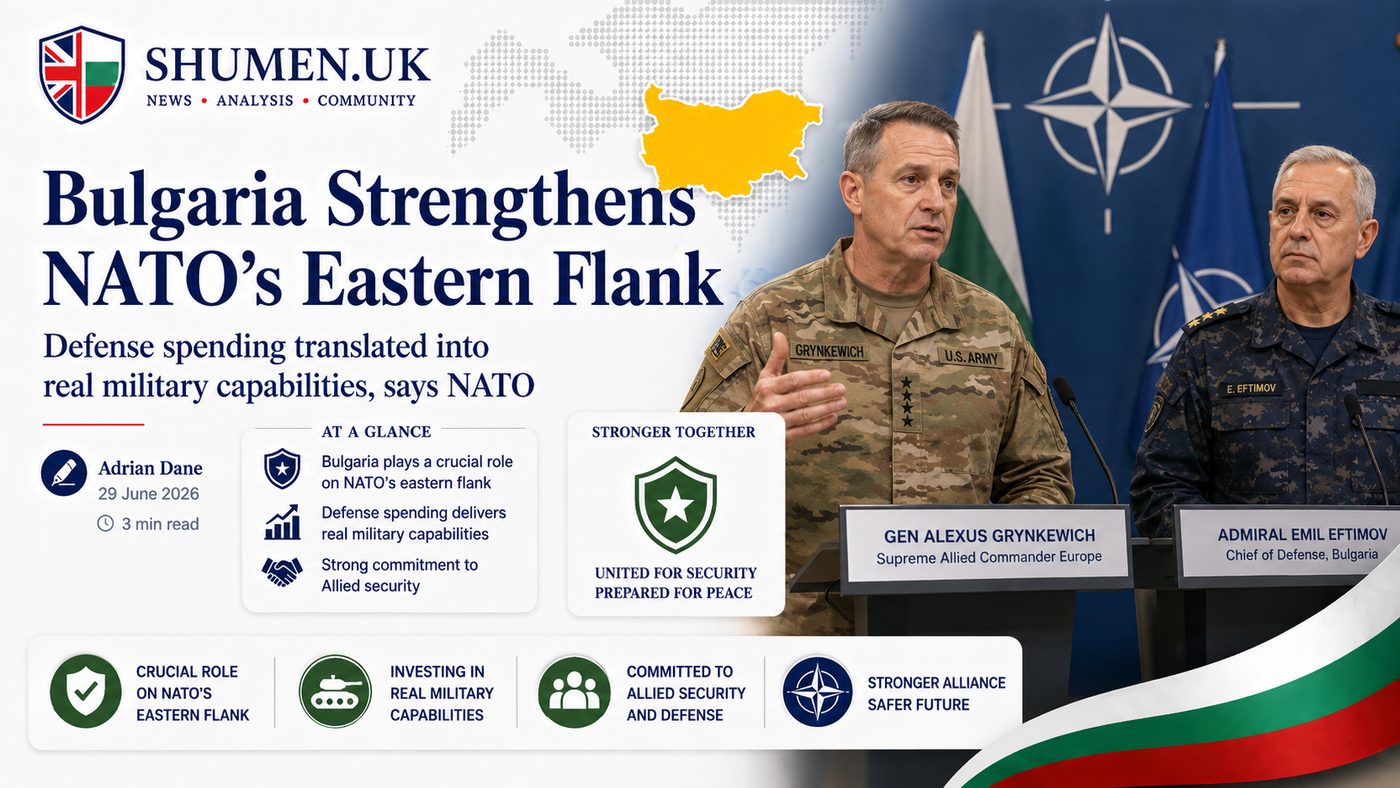
NATO's most senior military commander in Europe was in Sofia on Thursday telling Bulgaria it is doing exactly what the Alliance wants, and paying for it. General Alexus Grynkewich, Supreme Allied Commander Europe, appeared alongside Bulgaria's Chief of Defence, Admiral Emil Eftimov, at the Ministry of Defence and declared that Bulgaria plays a crucial role on NATO's eastern flank and has shown how defence spending translates into real military capability.
The visit came, as Eftimov noted, shortly before the upcoming NATO summit, and the admiral read it as a signal: proof of the attention the Alliance pays to the Black Sea and to Bulgaria's role as what he called a reliable ally on the eastern flank. The compliments in these briefings are standard issue. The numbers underneath them are not.
Five Percent by 2035, and Who Pays for It
Eftimov confirmed that, following the decisions taken at NATO's summit in The Hague (held in June 2025, where allies pledged to lift defence spending to 5% of GDP), Bulgaria has approved a national plan to reach that level gradually by 2035. He was keen to frame it as more than a military bill: "a long-term investment in national security, infrastructure development, the defence industry, and economic growth," in his words, with a message to Bulgarian society that defence spending is "an investment in the future, sustainability, and security of the state."
That framing matters, because the money is real and the budget it comes from is already stretched. When the plan was mapped out, we reported that it amounts to a defence push of roughly €19 billion to 2035, leaning on EU loans to make the arithmetic work. Meanwhile Finance Minister Galab Donev conceded in parliament last month that this year's deficit is heading for 4.1% of GDP, well past the 3% target, and the deficit has already forced economies elsewhere, including a cut to the pension supplement. Grynkewich, for his part, was blunt about the direction: "NATO's collective security is not free and Bulgaria understands this very well," he said.
F-16s on the Ramp, Strykers in the Pipeline
The hardware is arriving. Grynkewich pointed to the first eight F-16 Block 70 fighters now delivered, calling them a huge step towards modernising the air force, and to the first Stryker armoured vehicles from an order of 183, which he described as the most advanced vehicles of their type in the world. Coming from Grynkewich the F-16 praise carries a little extra weight: he is a career fighter pilot who flew the F-16 and F-22 himself before taking NATO's top military job.
He was also careful to put people above kit. "It is not just about equipment. The most important thing is people," he said, adding that as an American serviceman he had always been proud to stand shoulder to shoulder with Bulgarian troops. He singled out the three-decade partnership between Bulgaria and the Tennessee National Guard as a model of the kind, and noted Bulgaria's hosting of allied troops and its contribution to the KFOR peacekeeping mission in Kosovo.
Anyone wanting the practical version of all this air-policing talk got it two days before the briefing: on 30 June a Bulgarian MiG-29 was scrambled to shadow a Warsaw to Tel Aviv passenger flight after it transmitted the international hijack alert code over the region. That is what the briefing-room phrase "eastern flank" looks like from the ground.
The Black Sea Neighbourhood
Much of the substance concerned the sea. Eftimov pointed to the NATO multinational battlegroup led by Italy on Bulgarian soil and the establishment of a multinational divisional headquarters here as proof that national defence planning is aligned with the Alliance's regional plans. He also stressed cooperation with Romania and Turkey, citing the Regional Component Command of Special Forces and the MCM Black Sea mine countermeasures project, designed to keep shipping routes safe and navigation free in a sea that has needed both lately.
What This Means for British Expats
Nothing changes at the till this month, but the direction of travel is worth understanding. The 5% pledge is a decade-long claim on the same national budget that funds the services everyone here uses, and it arrives while the deficit is already overshooting; how Bulgaria squares that circle will show up in future budgets, not just in air shows. Grynkewich's argument that defence investment means "new jobs, economic growth, and a stronger industry" is the optimistic version, and it will be tested in the same economy our cost of living tracker follows month to month. The steadier point for a Brit living here is simpler: the security guarantee underwriting daily life in Bulgaria is the same one that covers the UK, and on Thursday the man who runs it rated this corner of it rather highly.