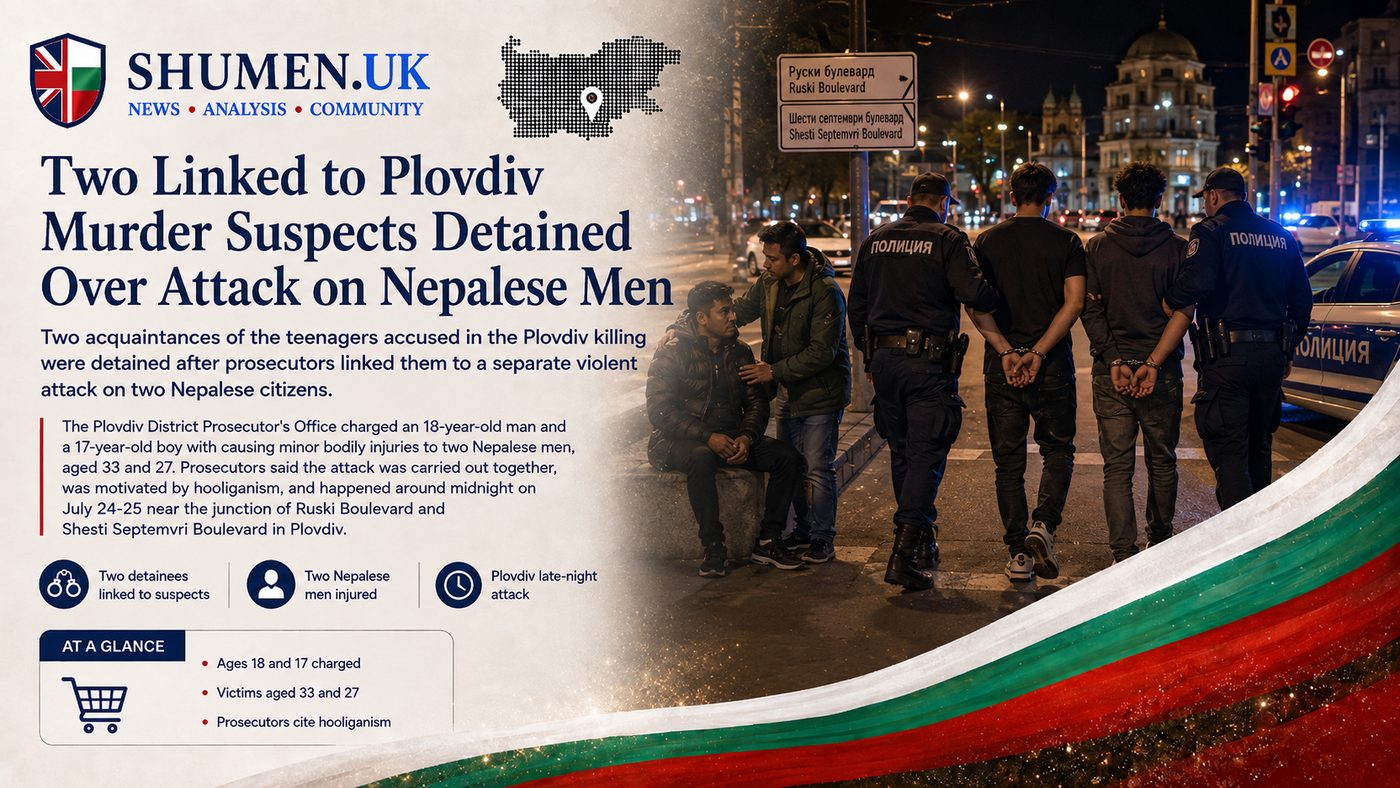
Prosecutors in Plovdiv have charged an 18-year-old man and a 17-year-old boy over an attack on two Nepalese citizens, in a case that surfaced only because investigators were going through phones seized in a murder inquiry.
The Plovdiv District Prosecutor's Office charged them on Tuesday with causing minor bodily injuries to two Nepalese men, aged 33 and 27. Prosecutors said the two acted together and that the attack was motivated by hooliganism. Both victims suffered pain and physical injuries.
The incident happened around midnight on 24 to 25 July, near the junction of Ruski Boulevard and Shesti Septemvri Boulevard. According to the investigation, the accused noticed two men who appeared to be foreigners sitting on or leaning against stairs by the pavement, approached them, and struck them with hands and feet, including blows to the head and body. Drivers passing the scene called 112. Police officers and medical teams attended, and the two injured men were taken to hospital for examination.
The suspects were identified on 10 August, when investigators working on the killing of 37-year-old Georgi Kuzev found video of the attack on one of their phones. The two are also established to have been in contact with the minors accused over Kuzev's death. The 18-year-old was detained for up to 72 hours and the 17-year-old for up to 48 hours, with prosecutors expected to ask the court on 12 August to remand both in custody.
What the Charge Says, and What the Investigation Describes
There is a gap between those two things that is worth setting out plainly, because it is the part of this story with consequences beyond Plovdiv.
The recorded motive is hooliganism. The investigation's own account of what happened is that the accused picked out two men because they appeared to be foreigners.
Bulgarian criminal law does have specific provisions for exactly that. Under Article 131, bodily injury committed with racist or xenophobic motives is treated as a distinct and more serious offence, with penalties running from two to fifteen years across the different degrees of injury, so the bottom of that range is what attaches to the least severe. Article 162 separately covers anyone who uses violence against another because of race, skin colour, origin, nationality, ethnic affiliation, religion, political beliefs or sexual orientation, with one to four years and a fine. Amendments that took effect on 4 August 2023 widened these protections across a series of articles. The tools exist and they are not obscure.
Two fair qualifications belong here. Prosecutors have not set out publicly what evidence they hold on motive, and they may know things the reporting does not. Charges can also be amended as an investigation develops, and this one is days old. Nobody has been convicted of anything, and the accused are entitled to the presumption of innocence.
The reason the distinction is worth flagging anyway is that it is a documented pattern rather than a one-off, though the documentation needs its dates attached. The Council of Europe's anti-racism commission, ECRI, criticised Bulgaria in its sixth report, adopted in June 2022, for not making racist motivation a general aggravating circumstance across all criminal offences, leaving it to sit in specific articles that have to be actively chosen. Amnesty International, researching cases of allegedly discriminatory violence in 2013 and 2014, found that hate was investigated as a motive in only one of the 16 cases it examined.
Both of those predate the 2023 amendments, which is worth saying out loud rather than leaving a reader to assume they describe the law as it stands. The structural criticism does survive them. The OSCE's summary of Bulgarian hate crime law still describes the protection as a set of specific provisions embedded in particular articles, rather than an aggravating circumstance that attaches automatically to every offence, so the motive still has to be picked up and charged deliberately. When it is not, the offence is still prosecuted, but the reason it happened disappears from the record, and so does the state's own count of how often it happens.
Why This Reads Differently If You Are Visibly Not Bulgarian
Most British expats here will never come within a mile of anything like this, and two incidents inside a single investigation do not establish a trend. Nothing in the reporting suggests Brits are being targeted, and it would be dishonest to dress this up as a warning about walking around Bulgaria.
What it does illustrate is a mechanism. Anyone who has been asked "откъде си?" within thirty seconds of opening their mouth in a Bulgarian street knows how quickly you get placed as not from here. For almost everyone that ends in a conversation, occasionally a long one about a cousin in Manchester. The investigation's account here describes the same read being made and used the other way.
If you are ever on the wrong end of something, the practical points are these.
- 112 is the number, and it works. In this case it was passing drivers who called it, and police and an ambulance came. You do not need to be the victim to make the call.
- Say the words, and check they were written down. If anything was said to you about being a foreigner, about your accent, your colour, your religion or who you are, state it explicitly when you give your account and ask that it goes into the statement. Given the pattern ECRI and Amnesty describe, the motive is the thing most likely to fall out of the file, and it is very hard to add back later.
- You are entitled to an interpreter, free, on request. Under the EU Victims' Rights Directive, victims who do not speak the language of the proceedings must be given interpretation at no cost during questioning, including police questioning, and translation of key documents. It applies to all victims regardless of nationality or residence status, so being a third-country national since Brexit changes nothing here.
- Get a lawyer involved earlier than feels necessary. A Bulgarian advokat can see what has actually been entered on the file and press on the classification while it is still open. Our legal guide covers finding one and what to expect on costs.
The Case This Grew Out Of
Kuzev, 37, was found severely injured in the Mladezhki Hill area of Plovdiv on 4 August and later died in hospital. Five teenagers, three boys and two girls, all aged between 14 and 17, face charges over his death. Novinite has reported that police examined whether the attack was motivated by hatred based on sexual orientation, and whether the victim was lured through a dating app. The two girls have appealed against their detention, with the Plovdiv Court of Appeal due to hear them on 13 August.
The same 2023 amendments that cover bodily injury also brought motives related to sexual orientation into the article dealing with murder. What that means in practice for defendants aged 14 to 17 is a different question, since juvenile proceedings work differently, and it is not one to guess at while charges are live.
Interior Minister Ivan Demerdzhiev has announced a tougher state response to online radicalisation, saying authorities will target networks that encourage young people towards violence and present brutality as acceptable.
Who the Two Men Were
The reporting does not say what the two Nepalese men were doing in Bulgaria, and it would be wrong to assume. It is worth knowing, though, that there is now a community here to be part of.
Nepal has gone from sending almost nobody to Bulgaria to being a recognised source of labour migration in the space of a few years. The Kathmandu Post reports 1,677 Nepalis arrived with Bulgarian work permits by 2024, against two in the 2020/21 fiscal year, with 2,993 labour approvals issued for Bulgaria in 2025-26. Balkan Insight reported that National Employment Agency figures showed 18,989 new foreign workers had started work by March 2026, against a 2025 total of 49,179, with Nepal named alongside Uzbekistan, India and Indonesia among the main origins. We looked at what that is doing to the labour market when the foreign worker numbers came out.
That shift has happened faster than most people, Bulgarian or British, have registered. It is the context in which two men sitting on some steps at midnight in Plovdiv were, on the investigation's own account, identified as foreign before anything else was known about them. Whether the charge sheet ends up saying so is now a matter for the prosecutors and, in time, a court.