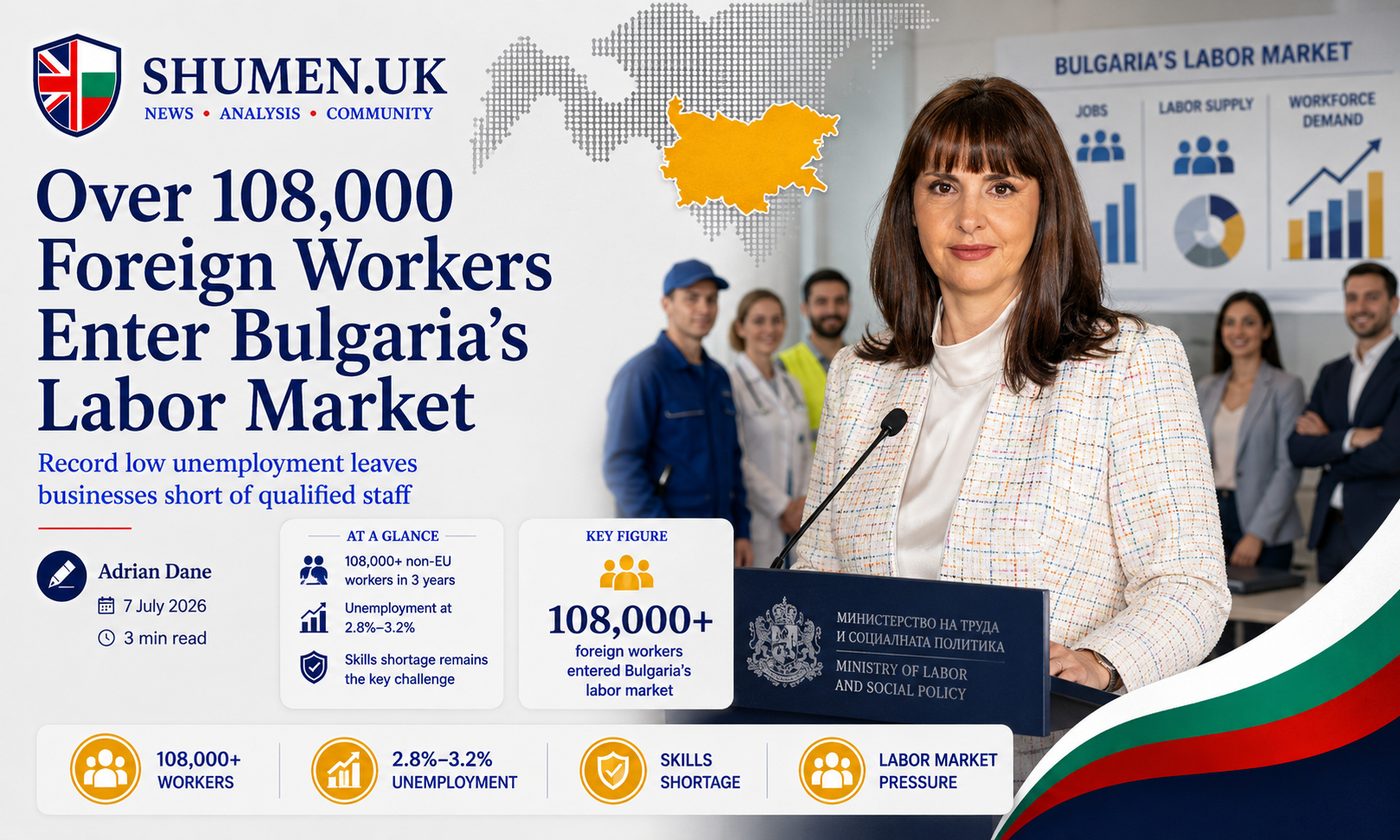
Bulgaria's Labour Minister has confirmed what businesses across the country have been saying for months: the workforce gap can't be filled from home. More than 108,000 non-EU citizens have gained access to Bulgaria's labour market over the past three years, Natalia Efremova said, with over 28,000 of those permits issued since the start of 2026 alone.
The number sits against a backdrop of historically low unemployment, currently between 2.8% and 3.2%. Efremova called the figure "unhealthily low" and said the real problem isn't a shortage of workers, it's a shortage of workers with the right skills. Almost half of those still registered with employment offices have very low qualifications, while employers are chasing candidates with specific technical or trade experience.
Where the Labour Shortage Bites Hardest
Workers from 95 countries have received labour-market access over the three-year period. Uzbekistan supplies the single largest group, with others arriving from Kyrgyzstan, Kazakhstan, Nepal, India, Bangladesh, Sri Lanka and Moldova.
The sectors relying most heavily on this labour are the ones anyone living here will recognise: tourism, construction, agriculture and food processing.
- Black Sea coast hotels increasingly staff restaurants, kitchens and guest services with workers from Uzbekistan, and some spa resorts have hired staff from the Philippines.
- Construction firms often turn to Turkish workers, a sector where Turkey has long-standing expertise.
- Agriculture, despite constant reports of labour shortages, takes only an estimated 3 to 5% of migrant workers. Greenhouse producers say even competitive wages don't attract enough Bulgarian staff, pushing them toward recruitment agencies that source workers from third countries.
Anyone who's had their hotel breakfast served by Central Asian staff on the coast this summer has already met this trend in person; the ministry has simply put a number on it.
Faster Paperwork for Seasonal Hires
The government has also moved to make seasonal recruitment less of an administrative slog. For seasonal jobs of up to 90 days, the registration period has been cut from 10 working days to three, for workers who've already done a season in Bulgaria at some point in the last five years. Employers no longer have to submit copies of foreign workers' identity documents, and employment declarations can now be filed at any labour office rather than only designated ones.
The changes target agriculture, fruit and vegetable production, tourism and food processing, and are meant to bring Bulgarian rules closer to EU seasonal-employment standards. Bulgarian National Radio reported the same package of changes independently of the ministry's own briefing, which is worth noting given how often single-source labour announcements don't hold up.
Employers still carry real obligations regardless of how fast the paperwork moves. By law, anyone hiring foreign seasonal staff must provide suitable accommodation, pay health insurance for the employment period, match the wages a Bulgarian employee would earn for the same work, and cover travel costs to and from Bulgaria, which cannot be deducted from the worker's pay.
What This Means If You're British and Working, or Hiring, Here
This is where the story stops being a Bulgarian labour statistic and starts applying directly to Brits. Since Brexit, British nationals are third-country nationals for Bulgarian employment purposes, in exactly the same legal category as the Uzbek, Indian or Kyrgyz applicants in this story. A British person taking a job with a Bulgarian employer, rather than working through their own company, generally needs the same kind of permission described above: employer sponsorship, a registered position, and matching paperwork. Our residency guide covers the permit routes in detail; a lot of British expats instead register a Bulgarian company and work through it, which the business set-up guide walks through.
If you employ people here, the obligations above apply whether your staff are Bulgarian, Uzbek or, increasingly, British. A British-run guesthouse or restaurant hiring from outside the EU has to meet the same accommodation, insurance and equal-pay rules as any Bulgarian firm.
The View From the Driver's Seat
Plovdiv's public transport operator has started hiring bus drivers from India and Uzbekistan to cover a local shortage. Around 25 Uzbek and 15 Indian drivers are already on city routes, with more expected in the coming months. One of them, Azar, who drove buses in India before moving to Bulgaria, said the pay compares well with home, "the salaries there are low", and that the main adjustment was Bulgarian road discipline: "there are a lot of traffic lights, signs and pedestrian crossings here."
Efremova set out the principles she says will guide labour migration going forward: Bulgarian citizens get first refusal on vacancies, foreign workers get the same labour rights as local staff, and every procedure has to comply with EU law. Bulgaria already has workforce-mobility agreements with Armenia, Georgia and Moldova, and talks with Uzbekistan are close to finished, so this shift looks set to continue rather than reverse.