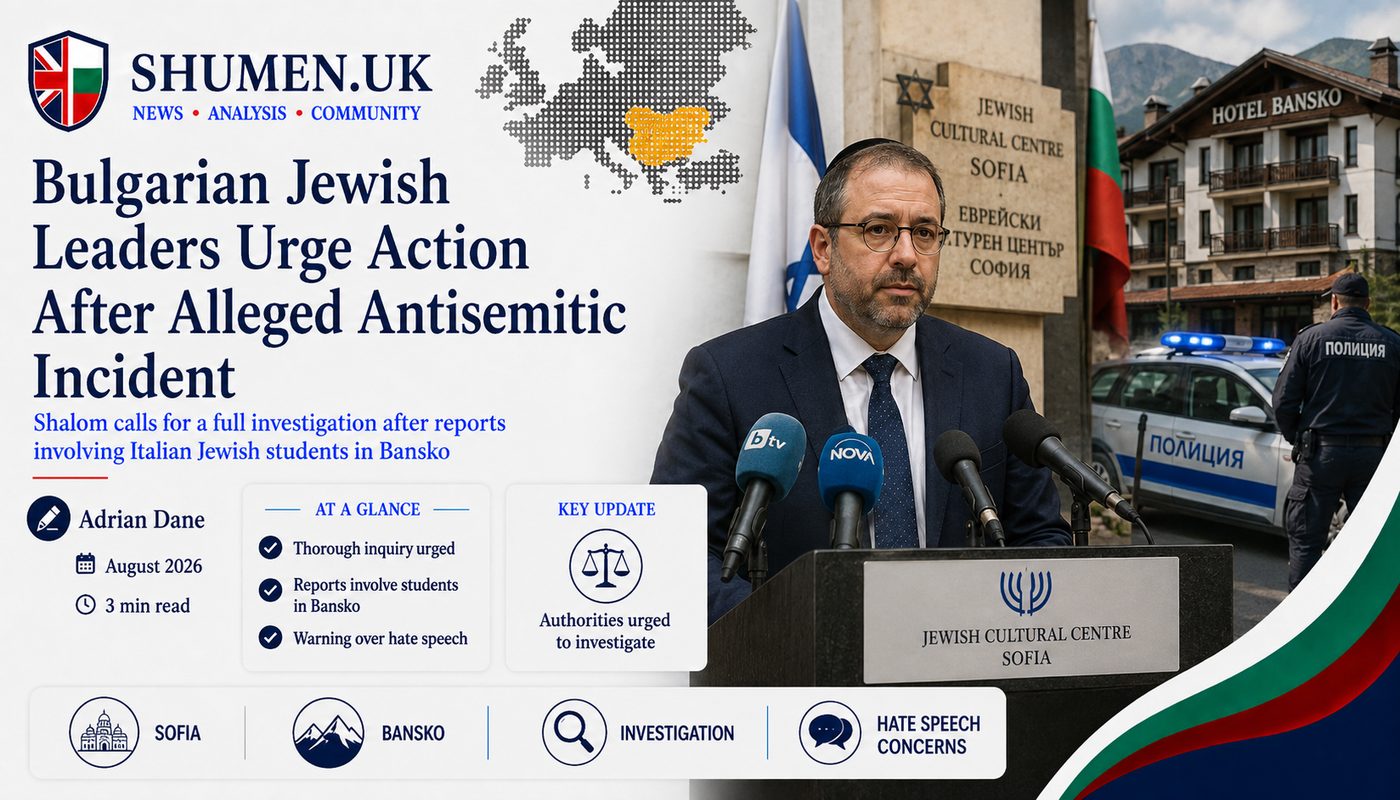
Bulgaria's two leading Jewish organisations have demanded a full investigation after Italian media reported that a group of young men tried to force their way into a Bansko hotel where Italian Jewish teenagers and their teachers were staying on the night of 2 August.
The Interior Ministry has offered a notably milder account, describing a verbal dispute between groups of Bulgarian and Italian citizens with no physical confrontation, and Bansko's mayor has rejected claims of tensions altogether. Caught between those two versions, Alina Levi, president of the Organization of the Jews in Bulgaria Shalom, told journalists at the Jewish Cultural Centre in Sofia on Wednesday that the normalisation of hate speech and antisemitism could have harmful consequences for society.
Bansko in early August is about as far from a flashpoint as Bulgaria gets: a drowsy mountain town of hikers and shuttered ski lifts waiting for the first snow. Which is partly why this story has landed so hard.
Two Accounts of One Night
The version that reached Italy first is the uglier one. Italian media reported that "a group of young neo-Nazis attempted to break into a Bulgarian hotel on August 2 where Italian Jewish teenagers from Rome and Milan and their teachers were staying". According to those reports, the group gathered outside the hotel entrance, attempted to enter the building and blocked access to it, then returned and blocked the entrance again after police intervened. The Israeli outlet Ynetnews went further, reporting that the teenagers were threatened with salutes and "Sieg Heil" chants.
The Interior Ministry's account, given on Tuesday, is considerably calmer. Officers from the Blagoevgrad Regional Directorate responded to what the Ministry called a verbal dispute between groups of Bulgarian and Italian citizens within the jurisdiction of the Bansko police department on 2 August, and no physical confrontation took place. The Ministry's press office later clarified to BTA that the reports concerned a single incident in Bansko.
That clarification matters, because the agency's own dispatch briefly placed the group outside "a hotel in Sofia" before the Ministry confirmed the single incident happened in Bansko. We are flagging both versions rather than tidying them away: what happened outside that hotel on Sunday night is precisely what the investigation now has to establish.
Nikolay Galabov, chair of the Federation of Zionists in Bulgaria, sits somewhere between the two accounts. He stressed there was no information indicating any physical confrontation, but argued that racist and ethnically motivated verbal abuse should not be tolerated. He said he received a phone call from Switzerland on the night between Sunday and Monday, immediately contacted the Bansko police, and, speaking by phone with someone inside the hotel, could hear shouting and provocations in the background. Shortly afterwards, he said, an Italian Jewish organisation contacted him.
The Camp That Chose Bulgaria Because It Felt Safe
The detail that gives this story its sting is why the children were in Bansko at all. Galabov said the decision to organise the camp was taken more than a month and a half earlier, because Bulgaria was regarded as one of the safest destinations given the security situation involving Israel, Iran and the ongoing conflict in the region.
Nor was the visit a surprise to the authorities. Levi said Shalom had written to the Blagoevgrad Regional Directorate of the Interior Ministry on 2 July, a full month before the incident, to warn of a forthcoming event hosting first 70 and later 200 children of Jewish origin, and to request assistance given the security concerns affecting Jewish communities internationally.
Galabov was also candid about the children themselves. They had been standing on the hotel balconies, shouting and making noise, he said; if their behaviour had caused concern, there were appropriate ways to warn them. His sharper point was that children's inappropriate behaviour should never be conflated with their ethnic background.
Levi said Bulgaria had traditionally been a preferred destination for Jewish tourists, and that the incident had unfairly tarnished the country's reputation.
Officials Condemn, Officials Downplay
The official response so far splits in two directions. The Foreign Ministry said on Wednesday that Bulgaria unequivocally condemns all forms of antisemitism, and Italy has condemned the incident as well, according to reporting carried by Novinite. GERB-UDF's Georg Georgiev, in comments carried by BTA, said the incident raises questions about Bulgaria's reputation as a safe country.
Bansko's mayor, meanwhile, has rejected claims of tensions after the incident, according to a separate BTA report on Wednesday. That is quite a gap: the Foreign Ministry condemning antisemitism in Sofia while the town hall downplays tensions in Bansko.
Galabov said Prime Minister Rumen Radev had been informed, and that representatives of the two organisations are scheduled to meet the Interior Ministry's Chief Secretary on Thursday morning, 6 August, for an update on the investigation. He argued that future camps and similar events will require closer coordination with the Ministry, and warned that because tourism is a national priority, incidents like this could damage the sector. Serious measures should be taken, he said, and ethnic tolerance must remain a priority.
A Reputation with Deep Roots
Jews have lived in Bulgarian lands for almost 2,000 years, a continuous presence since before the 2nd century CE. The wartime record is more complicated than the fond modern memory suggests: Bulgaria's Nazi-allied government passed anti-Jewish legislation in 1941, and in March 1943 the authorities deported 11,343 Jews from Bulgarian-occupied regions of Northern Greece, Yugoslav Macedonia and Pirot, sending them ultimately to extermination camps in Nazi-occupied Poland.
None of that history excuses a crowd outside a hotel in 2026. It does explain why Bulgaria's modern reputation for tolerance matters so much to the people now defending it, and why Jewish leaders are framing one bad night in Bansko as a test of it.
What This Means for British Expats
Bansko is probably the Bulgarian town most Brits know best, the anchor of many a first ski trip and increasingly a year-round base for remote workers; our Bulgarian ski resorts compared guide covers what draws people there. The Jewish leaders at the centre of this story are themselves arguing that Bulgaria is fundamentally a safe and welcoming country, which is precisely why they want this investigation handled properly rather than brushed aside.
The practical takeaway is small but worth knowing. The EU-wide emergency number 112 works in Bulgaria with English-speaking operators, and anything short of an emergency can be reported to the regional directorate of the Interior Ministry covering your area, which is exactly the route Shalom used when it wrote to Blagoevgrad in July. If you witness targeted abuse, reporting it is how places stay the way Bulgaria likes to describe itself.