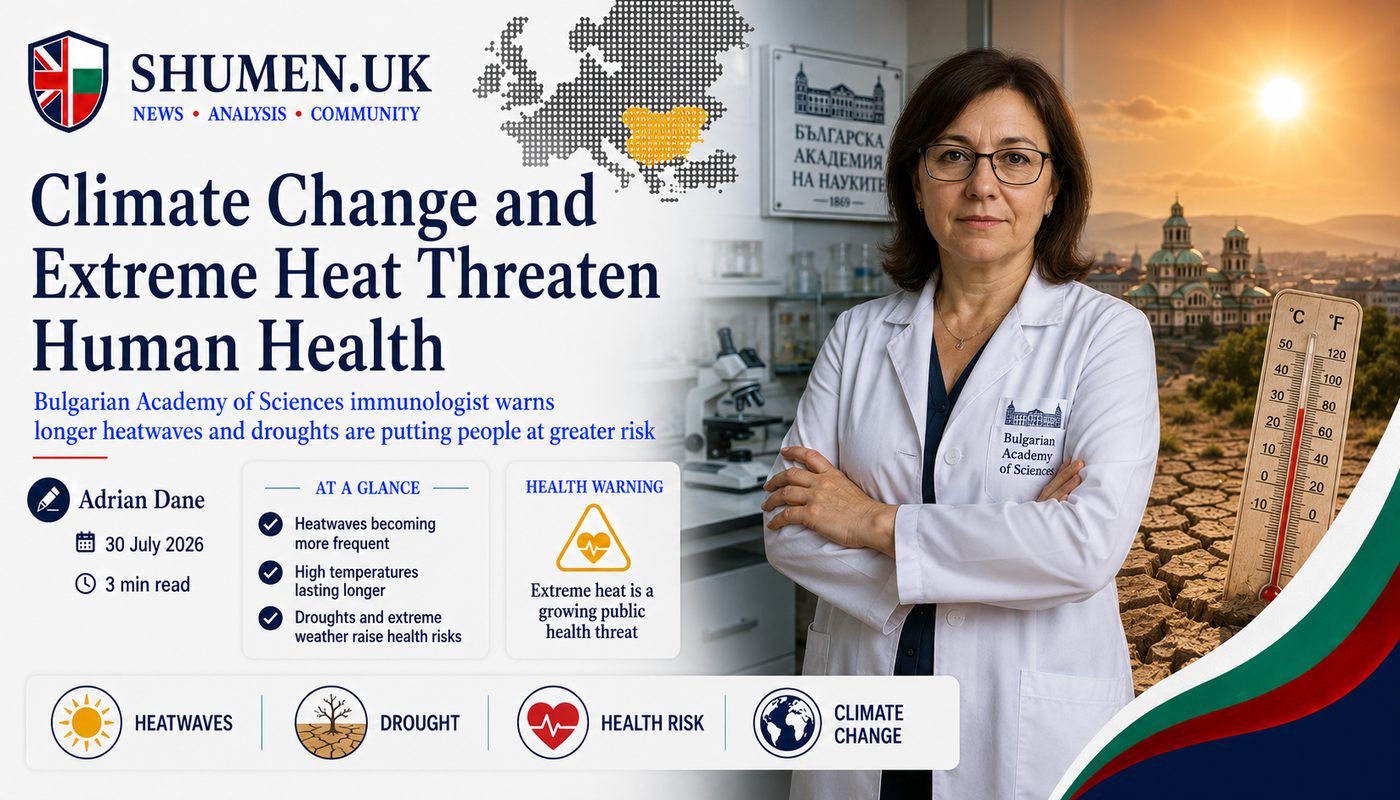
A heat alert covered most of Bulgaria on Wednesday 5 August as an immunologist at the Bulgarian Academy of Sciences warned that the country's longer, more frequent heatwaves now pose a direct threat to human health, with the heart, the lungs and the immune system all under strain.
Associate Professor Petya Dimitrova, of the Laboratory of Experimental Immunotherapy at the Academy's Stephan Angeloff Institute of Microbiology, told BTA in an interview in Vratsa that heatwaves and droughts are becoming more common and that spells of high temperature are growing longer, in Bulgaria as much as anywhere else.
What Prolonged Heat Does to the Body
The human body is good at keeping its cool, but it is not infinitely good at it. Dimitrova explained that although we have mechanisms for thermoregulation and adaptation, prolonged heat and abrupt temperature changes place the body under severe physiological stress, adversely affecting both temperature control and the immune system. Those mechanisms, she noted, underpin the normal function of every organ system, the cardiovascular and respiratory systems included.
The disruption runs deeper than sweating and discomfort. Extreme heat also disturbs the body's circadian rhythm, which can trigger inflammation and, in some people, chronic inflammation. That, Dimitrova said, helps explain something GPs across the Balkans see every August: the health of people with chronic conditions such as cardiovascular disease, diabetes or obesity often worsens during the summer months. Among cardiovascular patients, she added, there is a direct correlation between high temperatures and mortality.
Nor does the sunshine buy you a break from infection. Despite the bright weather and generally robust immune function in summer, the incidence of infectious disease does not decline, she said, because high temperatures and sharp fluctuations adversely affect innate immunity.
The kafene terraces emptying at noon have been teaching the same lesson for years; the Academy has now supplied the laboratory version.
A Hot Week, and a Pattern Behind It
The timing of the warning is not abstract. Novinite reported on Monday that Bulgaria was bracing for peak heat with temperatures of up to 43°C, and a heat alert covered most of the country on Wednesday. The World Health Organization's European office warned at the end of June that the current European heatwaves are, in its words, a dress rehearsal for what is coming, and the New York Times reported in July that heat waves in Europe have been linked to thousands of excess deaths.
Dimitrova placed the trend squarely on climate change, saying extreme weather events, particularly heatwaves and droughts, are becoming more common and the hot periods longer. The BTA interview did not analyse the causes beyond that attribution.
The Advice, Such As It Is
Her prescription is pleasingly unfashionable. During hot periods, Dimitrova urged people, particularly those with chronic conditions, to take care, rest regularly, drink enough fluids and keep physical activity moderate. Regular sleeping, waking and mealtimes matter for everyone, she added, whatever the weather is doing outside.
What This Means for British Expats
Brits who grew up treating 28°C as a national event should recalibrate: a Bulgarian August is a different proposition, and the body notices. A few practical points are worth sorting before the heat finds the weak spot.
- If you are visiting, the UK GHIC covers medically necessary state-provided treatment in Bulgaria, but it is not travel insurance and it is not meant for people living here.
- If you live in Bulgaria, make sure you are properly registered with the state health system and have a GP before you need one in a heatwave. Our healthcare guide walks through NHIF registration and finding an English-speaking doctor.
- If you take regular medication for blood pressure, diabetes or a heart condition, Dimitrova's point lands directly on you: these are precisely the conditions she says worsen in prolonged heat, so keep prescriptions current and do not skip check-ups until September.
- Follow the local rhythm. Errands in the morning, the heavy work before noon or after six, and a proper lunch-hour slowdown. And check on older neighbours and relatives during an alert; they are the group the mortality statistics are about.
For British expats in Bulgaria the takeaway is simple enough. The heat here is not background colour for a pleasant summer, it is a genuine health variable, and the people telling you to take it seriously now include the Bulgarian Academy of Sciences.