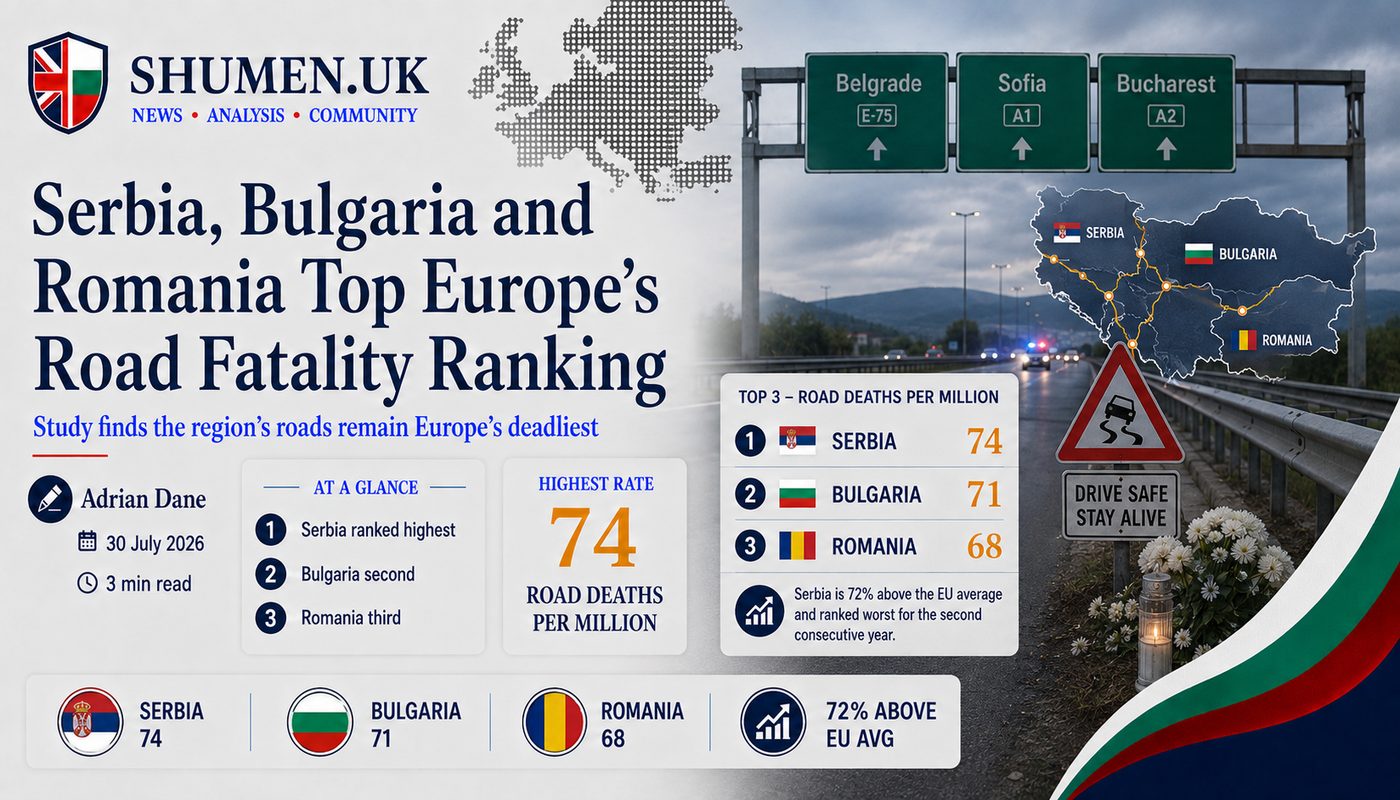
Bulgaria has the second-deadliest roads in Europe, with 71 road deaths per million inhabitants, behind only Serbia on 74 and just ahead of Romania on 68, according to a new ranking released as the summer driving season gets properly under way.
Anyone who has driven the old Shumen to Varna road on a Friday evening this August will not need much convincing; the study has merely put a European number on the overtake you watched through your fingers.
The ranking comes from Vignette Switzerland, an online provider of Swiss electronic vignettes, which compared road fatality rates across the continent as millions of drivers prepare for long summer road trips. Serbia sits top for the second consecutive year, with a rate 72% higher than the European Union average, although its latest figures show a slight improvement on the year before. On those numbers, the EU average works out at roughly 43 deaths per million, which puts Bulgaria's 71 in stark relief.
The Wrong End of the Table Is Crowded
The safest roads in the study are Norwegian and Swedish: 19 deaths per million inhabitants each, barely a quarter of Serbia's figure. More uncomfortable reading for holiday planners is the company Bulgaria keeps further down the top ten, because Portugal, Greece, Italy and France all appear there too. These are the countries British drivers cross, or aim for, every August.
The researchers' parting advice is the sensible, unglamorous sort: look up the traffic rules of the countries you will cross, plan the route properly, and slow down on roads you do not know.
The Bulgaria Figure the Headline Skips
Buried under the grim placing is a number that deserves more air. Bulgaria has cut its road deaths by 36% over the past decade, one of the strongest improvements in the study. Only Lithuania (down 43%) and Latvia (down 37%) have done better, while Greece managed 35% and Hungary 30%.
The contrast elsewhere is striking. Portugal has reduced road deaths by just 1% since 2015, and France by only 6% over the same period. So two things are true at once: Bulgarian roads remain among the most lethal in Europe, and they are considerably less lethal than they were ten years ago. The second fact rarely makes the headline.
Who Produced the Ranking
It is worth knowing whose table you are reading. Vignette Switzerland is a commercial business that sells Swiss e-vignettes online, and a study that nudges drivers to think about European road rules in the first week of August is, among other things, very good marketing for a vignette company. That does not make the numbers wrong, and the broad pattern matches what Bulgaria's own statisticians and broadcasters have been reporting. But the provenance is part of the story, and the source coverage does not mention it.
Bulgaria's Own Statistics Landed the Same Week
The timing is pointed. Bulgaria's National Statistical Institute published its 2025 road accident figures on 31 July, two days before this ranking surfaced in the Bulgarian press. Bulgarian National Radio, meanwhile, has taken to describing the situation as the war on Bulgarian roads, reporting fresh public outrage after another fatal crash in recent days. Road safety here is a live political argument, not an abstract league table.
What British Drivers Should Actually Do
For British expats, the practical translation matters more than the placing. A few things are worth doing before the next long drive:
- Buy the e-vignette before you touch a motorway. Bulgaria's motorways and main national roads require an electronic vignette, the KAT traffic police run roadside checks, and an unpaid vignette is an easy fine to collect. The driving in Bulgaria guide covers vignettes, licence exchange and KAT basics in detail.
- Lights on, always. Dipped headlights or daytime running lights are required at all times in Bulgaria, even in August sunshine.
- Know what your GHIC does not do. A GHIC gets you state hospital treatment on the same terms as a Bulgarian after a crash, but it does not cover repatriation or private care, which is why proper travel insurance still matters. The healthcare guide explains the split.
- Think ahead to November. Winter tyres become compulsory from 15 November to 1 March, and the winter driving guide is worth reading before the first proper snow rather than after it.
British roads routinely rank among Europe's safest, so the adjustment for a newly arrived Brit is real: the journey you would do on autopilot at home wants more margin here, particularly at night, on two-lane roads, and around lorries on the trans-Balkan routes. And if you are one of the Brits who drives the Calais to Bulgaria run each summer, note which country tops the table for the second year running. The Serbia leg is the one to do rested, in daylight, and without a schedule breathing down your neck.
One ranking from a vignette seller is not the final word, and deaths per million is a blunt instrument that says nothing about who was driving or where. But it lands in the same week as Bulgaria's own accident statistics and it points the same way. The trend is improving. The level is not good. In August, with the roads full, the second of those is the one to drive on.