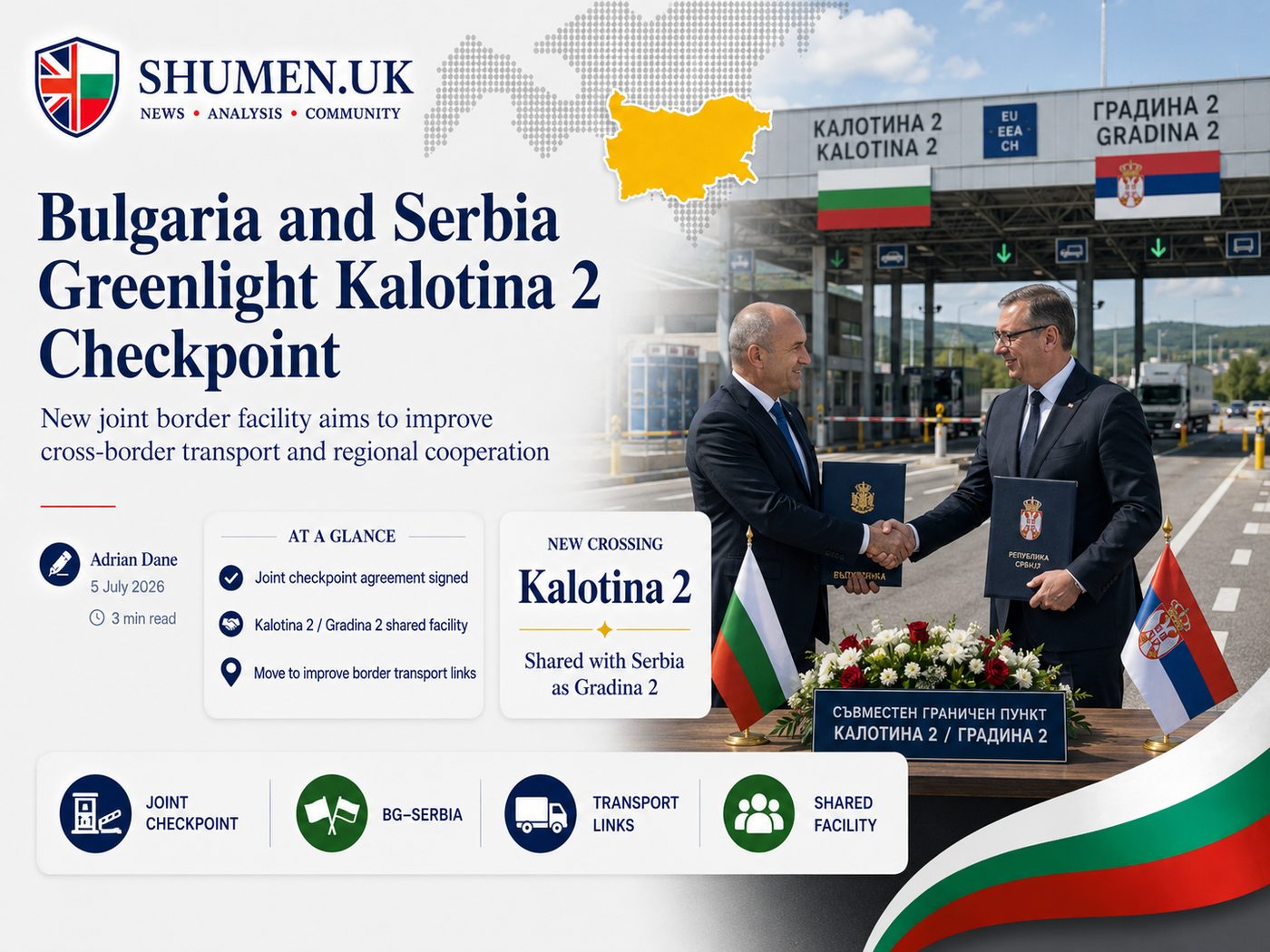
Bulgaria and Serbia have agreed to build a second border crossing at Kalotina, the notorious bottleneck on the main road between Sofia and Serbia, in an attempt to break the summer queues that anyone driving to or from Western Europe already knows too well.
The two countries' interior ministers, Bulgaria's Ivan Demerdzhiev and Serbia's Ivica Dacic, signed an intergovernmental agreement at the Kalotina crossing on Thursday 9 July to set up a shared facility that Bulgaria will call Kalotina 2 and Serbia will call Gradina 2. It is the political green light the project needed. Detailed design, financing and construction come next, and the two governments have not yet set a completion date.
If you have ever crawled back from the UK in August, that last sentence is the one that matters.
What Is Actually Being Built
The plan is a shared crossing running a "one-stop control" system, where Bulgarian and Serbian border and customs officers carry out joint inspections in one pass instead of each side checking you separately. That, the two governments say, is what should cut the waiting and the paperwork for travellers and hauliers alike.
Earlier this year Serbian Prime Minister Djuro Macut set out the shape of it: a facility near the existing checkpoint, aimed primarily at passenger vehicles and private travellers, operating seasonally during set hours. The logic running through years of expert talks in Sofia and Belgrade has been to pull cars out of the same queue as the lorries, so a family estate is no longer stuck behind a line of freight.
The groundwork is further along than a single signing ceremony suggests. Bulgaria's Interdepartmental Council on Border Control approved the build back in November 2025, picking a site on Bulgarian territory next to the current crossing, and the proposal was put to the European Commission in preliminary consultations, where it drew a positive assessment. Thursday's agreement is the political approval that lets the project move into its next phase.
Why Kalotina Jams Every Summer
The existing Kalotina-Gradina crossing sits on Pan-European Transport Corridor X, one of the main overland routes tying Western Europe to the Middle East and Asia, and it is among the busiest land crossings in Southeastern Europe. Steadily rising freight volumes and the seasonal surge of summer holiday traffic have, for years, produced the miles-long tailbacks the crossing is known for. The checkpoint was modernised fairly recently, but officials concede its capacity still runs out at peak, and the surrounding geography leaves little room to expand it further.
There is a detail the wire copy skips that explains a lot of the wait. Since Bulgaria completed its Schengen accession, with land borders joining on 1 January 2025, the Serbian frontier is now a Schengen external border. Serbia is outside both the EU and Schengen, so this is a full external check on the way in and out, not the wave-through you get between EU neighbours. More thorough checks, on a route that was already heaving, is a large part of why the queue forms.
What It Means if You Drive To or From Bulgaria
For British expats who make the long drive between the UK and Bulgaria, Kalotina is not an abstraction. It is the crossing where you meet the EU's external border, and since Brexit you cross it as a third-country national, with the passport stamps and questions that come with that. Our Brexit guide covers what that status means at the border and elsewhere.
The new crossing is aimed squarely at the traffic Brits generate: a car full of people and belongings, travelling in the school holidays, sitting in the passenger queue behind the freight. On paper it is exactly the fix that traffic needs.
The catch is the timeline, or rather the absence of one. Thursday's agreement opens the design-and-financing phase; it does not put a booth on the ground. Serbian officials have said publicly they want a solution to the Kalotina jams by the end of this tourist season, according to the state agency BTA, but a signed intergovernmental agreement and an open lane are not the same thing. Plan this summer's trips as if nothing has changed, because at the border, nothing has yet.
Practically, that means the usual defences. Check the live wait times before you set off, cross overnight or midweek rather than on a peak weekend, and build the delay into your schedule rather than your blood pressure. Our driving guide runs through the route, the vignette and the KAT rules you will meet on the Bulgarian side.
The Honest Reading
This is a real step, not a ribbon-cutting. A second crossing has been talked about at expert level for years, approved on the Bulgarian side in late 2025 and blessed by Brussels, and it now has the political signature it was waiting for. But the diggers are not there yet, and until they are, the Kalotina queue remains what it has always been in July: a slow, hot rite of passage. The agreement is the promise. The relief is still a couple of phases away.