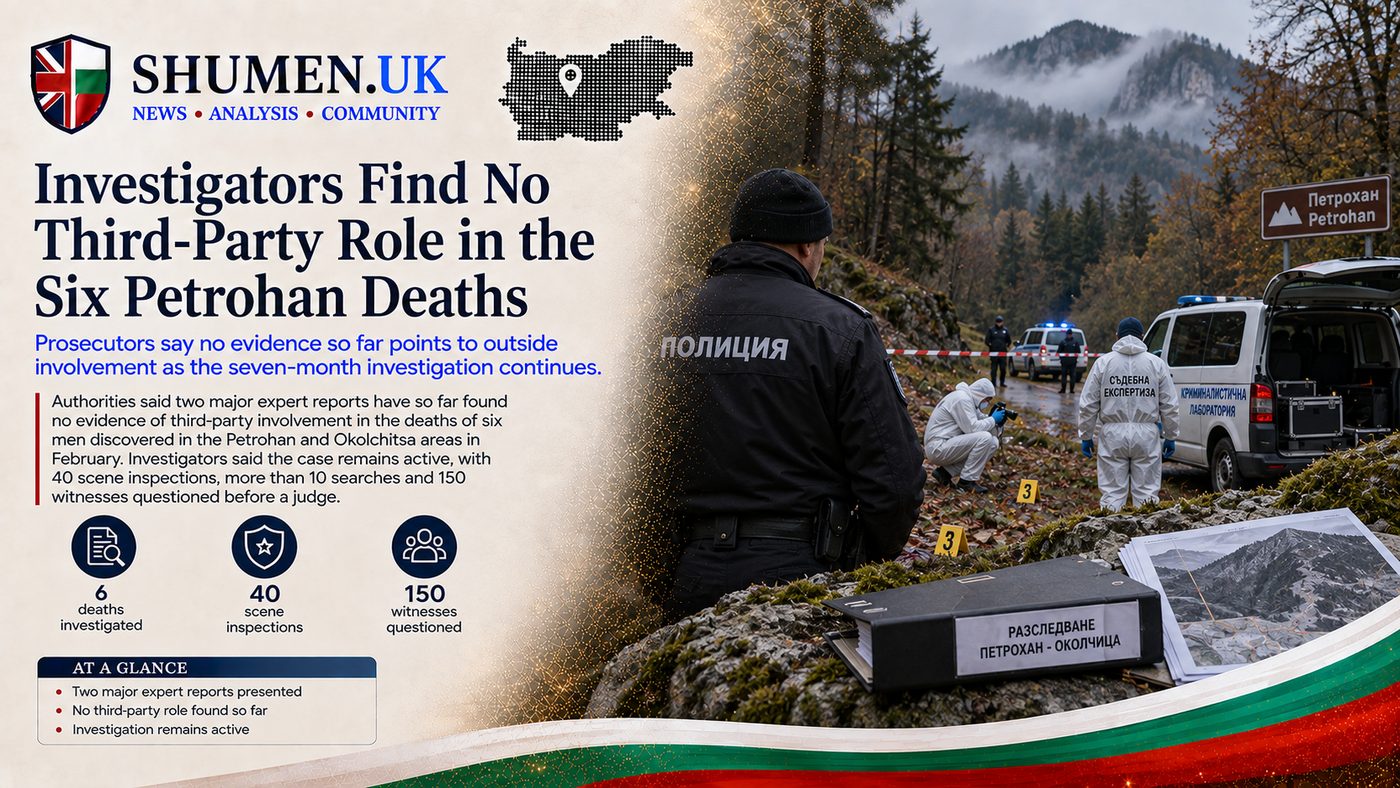
Bulgarian investigators say the evidence gathered so far does not indicate involvement by anyone outside the group in the six deaths linked to Petrohan and Okolchitsa, prosecutors and forensic specialists said at a briefing on 14 September 2026. Their investigation remains open, with around 12 expert examinations still awaiting conclusions.
That qualification matters. The briefing set out the authorities' current account of the deaths, while leaving further forensic work and separate inquiries into connected institutions unfinished. For British expats raising children in Bulgaria, the questions about oversight also make it useful to know where a safeguarding concern can actually be reported.
No outside involvement found, but the case remains open
The deaths came to light in February. Three bodies were discovered at the former Petrohan lodge on 2 February; another three were subsequently located inside a camper in the Vratsa Balkan mountains, close to Okolchitsa Peak. Investigators linked all six to a closed community whose leader, Ivaylo Kalushev, was himself one of the deceased.
The working explanation presented by investigators is that the lodge deaths were suicides, while the camper deaths involved two killings and a suicide. Those remain attributed investigative conclusions. A statement that no evidence of outside involvement has emerged does not turn an unfinished investigation into a completed account of everything that happened.
Prosecutors described substantial work already undertaken: 150 witnesses questioned before a judge, alongside 40 inspections of scenes and more than 10 searches. They said witness interviews and investigative activity were continuing. These figures describe the work carried out; they do not supply a date when the case will be finished.
Two major expert assessments formed the centre of the briefing. One examined the deceased and the community's psychological and social dynamics. The other brought together medical, ballistic and technical expertise concerning the camper. The final reconstruction of events inside the vehicle was still being completed.
The questions extend beyond the two death scenes
Prosecutors also described financial inquiries involving connected organisations, including tax checks and preliminary measures to secure assets. Those inquiries run alongside the effort to establish how the six people died. They concern a wider set of activities and relationships.
A separate investigation concerns the private Kosmos school in Osoitsa, in Gorna Malina municipality. Deputy appellate prosecutor Natalia Nikolova said the allegations involve school officials and education authorities, with admissions, documents and compliance with education requirements under examination. The period being investigated runs from 2022 to 2026.
These are allegations under investigation. The announcement does not establish that the school or any named category of official committed an offence.
The community's links to youth camps, and questions about the response to earlier warnings, explain why the institutional inquiries matter. Establishing what happened at the lodge and camper does not, by itself, answer whether adults or institutions elsewhere failed children. That is a separate question of accountability, and one the continuing inquiries have yet to settle.
A child-protection concern has a route beyond the school gate
For British parents following this from a school-gate conversation or a Bulgarian parents' chat, the useful distinction is between discussing a disturbing case and reporting a concern about an identifiable child. A forwarded screenshot is no substitute for giving someone the details needed to act.
Bulgaria's 116 111 child helpline accepts calls from children and from adults concerned about them, including parents, relatives, neighbours and teachers. It offers advice as well as a route for reporting risk. Calls are free and the service operates around the clock, according to its official guidance on who can call.
The helpline's reporting guidance says you can call when you know or suspect that a child is at risk. You do not have to represent a school or another institution. It also identifies the details that help social workers locate the child:
- The child's name and current address.
- The parents' names, where known.
- The school the child attends.
The same guidance allows concerns to be raised directly with the local child-protection department, by telephone or in person. For someone living in a village, it explains that the responsible department is in the nearby city or municipal centre. Ask which office covers the child's location.
If there is an immediate emergency requiring police, an ambulance or firefighters, call 112, the number confirmed in the UK government's Bulgaria advice. Our guide to emergency services in Bulgaria explains the wider emergency contacts and practical steps.
Those contacts serve a different purpose from commentary about the Petrohan investigation. A family seeking advice about a child's welfare need not resolve the competing interpretations of a national case before asking for help. Give the service the concern and the identifying details you know; assessing it belongs with the people responsible for child protection.