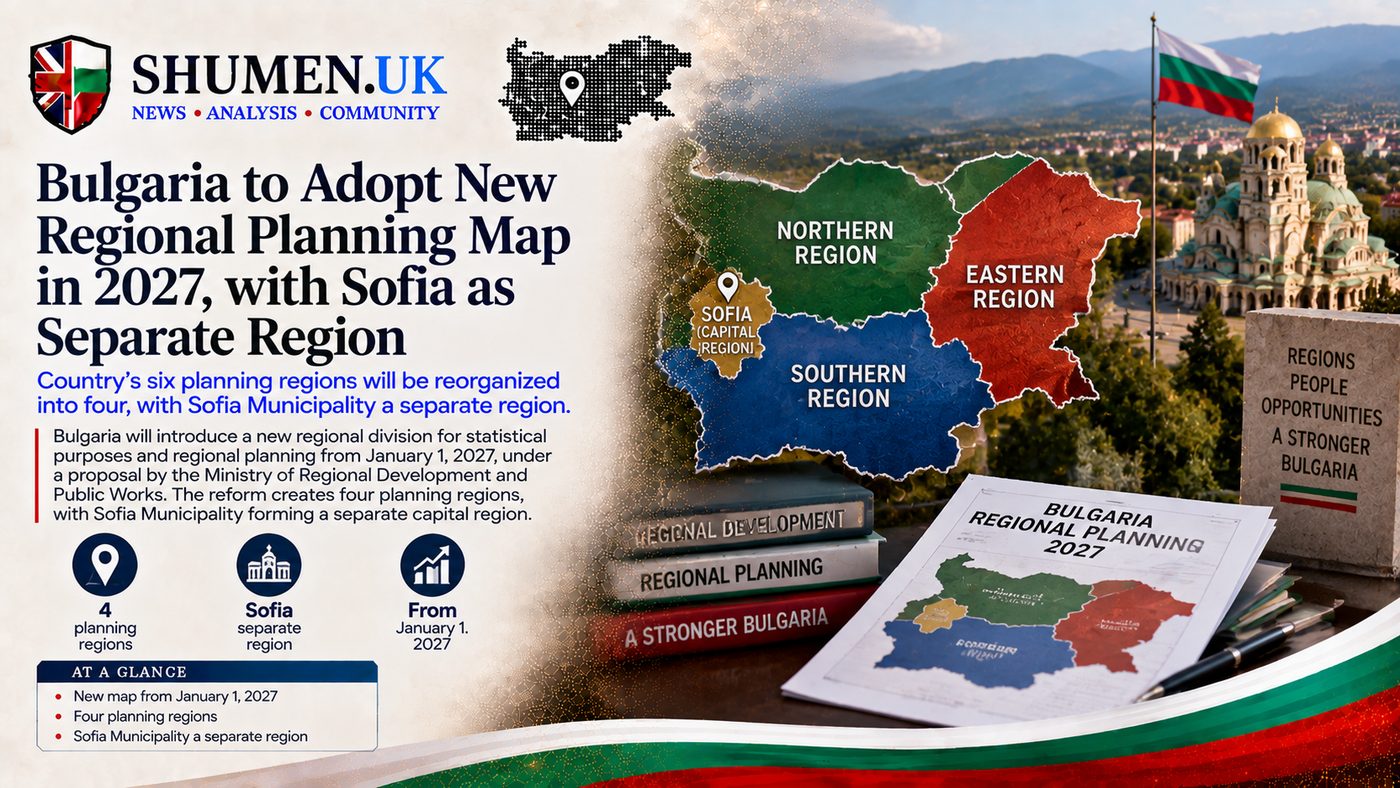
Bulgaria's Regional Development Ministry has proposed trimming the planning map from six regions to four, starting on 1 January 2027, with Sofia city carved out as a region of its own. The proposal, put forward on Tuesday 29 September, changes the statistical map and not the real one: all 28 provinces and their municipalities stay exactly where they are, and what moves is the way they are grouped for statistics and regional planning. Shumen province ends up with a different set of regional neighbours.
The trigger is European, not domestic. The ministry wants to amend the Regional Development Act so that domestic law matches the new NUTS classification, the EU's Nomenclature of Territorial Units for Statistics. BTA reports that the classification arrives under Delegated Regulation (EU) 2026/195, which is binding and applies directly in every member state from 1 January 2027. Fakti.bg reports the ministry's goal as aligning the regional development system with the new classification while making strategic planning for the territory work better.
What Changes for Shumen and Its Neighbours
Shumen province currently sits in the Northeastern region with Varna, Dobrich and Targovishte. Under the proposal it joins an Eastern region of six provinces: its old companions Varna and Dobrich, plus Burgas, Sliven and Yambol. Targovishte, the fourth member of the old grouping, goes north into a Northern region of eleven provinces that stretches from Vidin in the northwest to Silistra in the far northeast. Burgas, Sliven and Yambol arrive from the current Southeastern region, whose fourth member, Stara Zagora, is reassigned to the Southern region.
Put plainly, the new Eastern region has Dobrich, Varna and Burgas on the Black Sea, with Shumen, Sliven and Yambol inland behind them. It is a change for the spreadsheet, not the signpost: Shumen still sits on the main route between Varna and Sofia, and the bus timetable will not notice. Nothing our Shumen guide covers, from the Tombul Mosque to the early capitals at Pliska and Veliki Preslav, has been reclassified.
What Stays Exactly as It Is
BTA is explicit that statistical boundaries would change while the boundaries of all 28 provinces and their municipalities would not, and Novinite and Fakti.bg both stress that nothing is added to or removed from the map of provinces and municipalities. For British expats, that answers the first question: the municipality where you register your address and pay your local taxes is the same on 2 January 2027 as it was on 31 December 2026. Nothing in the reported proposal touches residency, health insurance or banking either, which is unsurprising in an amendment to a regional development law.
Where You Might Actually Notice It
Planning regions are what Eurostat calls NUTS 2, which it describes as the basic regions for regional policies. Eurostat also says the regions eligible for EU cohesion support have been defined at that level, and that the cohesion report has so far mainly been prepared at it. Regrouping provinces at NUTS 2 is therefore not purely cosmetic. Neither the ministry's summary as reported nor the coverage says what the new map means for funding, though, so anyone announcing winners and losers is guessing.
The planning machinery is reshaped too. Each region other than the capital will get an integrated territorial strategy, which for Shumen means a document written for the whole Eastern region, and the regional development councils fall from six to four.
Then there is the data. Any figure quoted for the Eastern region from 2027 will be calculated over a different set of provinces than the old Northeastern one, with Burgas, Sliven and Yambol in and Targovishte out. Expect a break in the series rather than a trend, and check which map a table uses before drawing conclusions about how this corner of the country is faring. Regional price, pay and property comparisons are the obvious place to be caught out.
Sofia Gets a Region to Itself
The fourth region, the Capital Region, covers Sofia Municipality and nothing else. Sofia Province, the administrative region around the city, joins the Southern region alongside Plovdiv, Pazardzhik, Haskovo and others. Instead of a territorial strategy, the capital will get an integrated development plan that does the same job. None of the coverage explains why Sofia is split out, so we will not guess.
Not a New Idea
Bulgaria has been here before. According to Wikipedia's entry on the country's NUTS regions, a 2013 study commissioned by the ministry examined the state of the existing regions, the redrawing process was restarted in 2017, and in October 2018 the Council of Ministers released a Regional Development (Amendment) Bill built on a four-region option for public consultation. Bulgaria still has six regions, which is worth remembering before treating any proposal as a done deal. This time there is a fixed external date, but BTA describes the amendments as proposed, and no parliamentary timetable has been reported.
What to Do About It
Nothing, for now. Watch the draft amendments as they move through the legislative process, and if you lean on regional statistics to decide where to buy or rent, note from January 2027 which version of the map a table uses. Our where to live guide compares Varna, Burgas and Shumen among other places on what matters to expats, and none of it depends on how Eurostat files them.