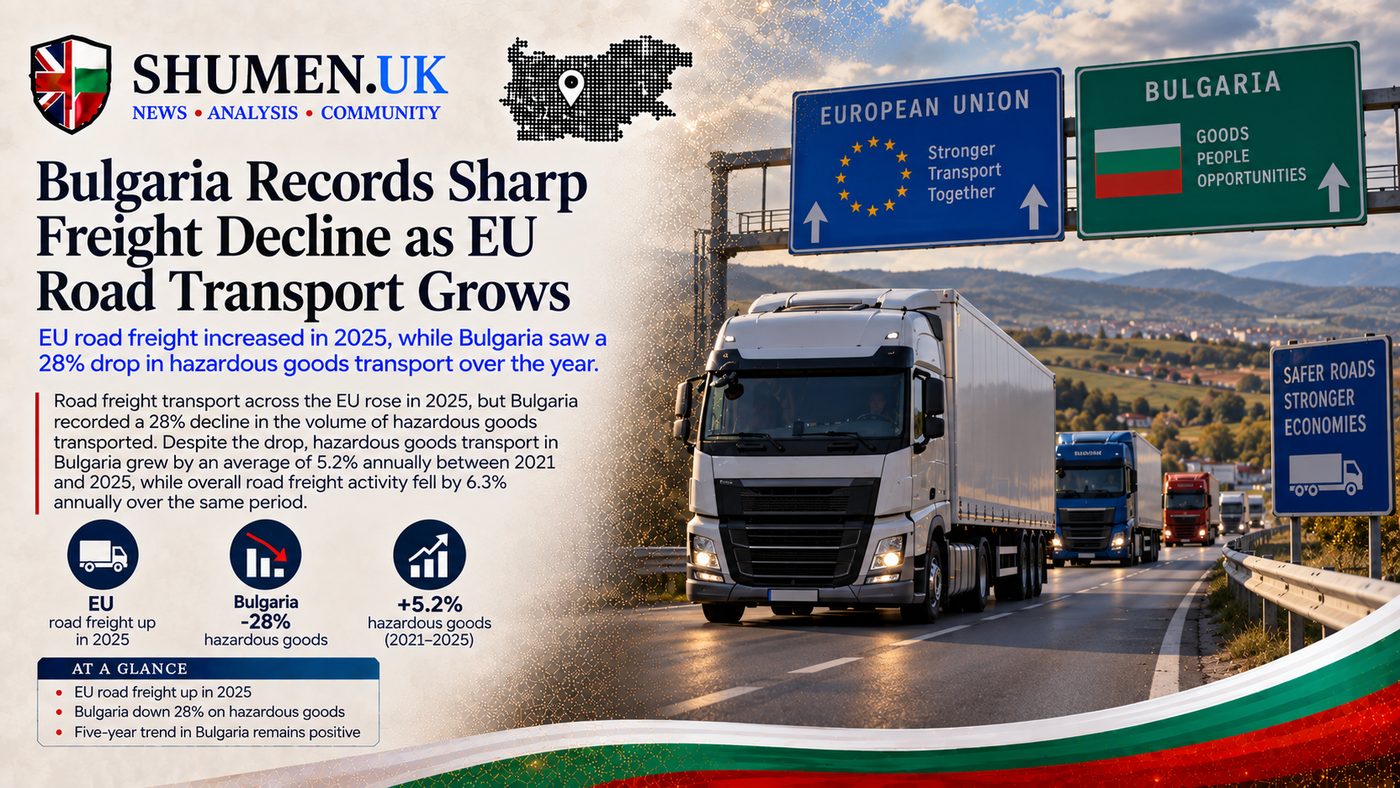
Bulgarian hauliers moved less freight in the five years to 2025 than hauliers in any other EU country for which Eurostat has figures. Measured in tonne-kilometres, their work shrank by an average of 6.3% a year between 2021 and 2025, against an EU average decline of 0.5% a year. Novinite reported the figures on 26 September 2026, alongside a second Bulgarian number that points the other way.
That second number is dangerous goods. Bulgaria's hauliers carried 28.0% less hazardous cargo in 2025 than in 2024, the steepest fall Eurostat recorded, ahead of Lithuania (26.0%) and Denmark (18.5%). Yet over the same 2021 to 2025 period, this category grew by an average of 5.2% a year. So a bad 2025 came after several strong years.
What the Numbers Actually Count
The headline is easy to misread, and it matters for anyone who drives here. Eurostat's road freight figures come from sample surveys that record "the road goods transport undertaken by vehicles registered in these countries". In plain terms: this measures how much work Bulgarian-registered lorries did, wherever in Europe they drove. It does not measure how many lorries used Bulgarian roads.
A Turkish or Romanian truck crossing the Danube bridge at Ruse is not in Bulgaria's total. A Bulgarian truck running loads between Germany and France is. Anyone who has sat behind a queue of articulated lorries on the road out of Shumen will not be surprised that this is not a statistic about empty roads.
A tonne-kilometre, Eurostat's measure of transport performance, is one tonne of goods carried one kilometre. The measure rewards distance. A haulier who gives up long international runs for short domestic ones can carry the same weight and still post a sharp fall.
2025 Was Flat, Not a Collapse
The five-year average hides the shape of the decline. Bulgaria's National Statistical Institute (NSI) published its own 2025 figures in March 2026. They show a sector that stopped shrinking last year rather than one still falling:
- Goods carried by Bulgarian hauliers reached 165.7 million tonnes, up 11.8% on 2024.
- Domestic tonnage rose 15.0%, while international tonnage fell 8.2%.
- Transport performance was 26,977 million tonne-kilometres, up just 0.1% year on year.
- Domestic tonne-kilometres rose 5.2%, international tonne-kilometres fell 3.3%.
Eurostat's own summary agrees that total road freight in Bulgaria "remained stable" between 2024 and 2025. So the 6.3% average annual fall came from earlier in the period, not from last year. The NSI split also shows the pattern the tonne-kilometre measure punishes: more weight moved over shorter domestic distances, and less on long international hauls.
Neither Eurostat nor Novinite explained why Bulgarian haulage shrank over the five years, and we will not guess.
Europe Is Moving More
Across the EU as a whole, 2025 was a modest year of growth. Eurostat puts the weight of goods moved by road 1.8% higher than in 2024, with tonne-kilometres up 0.8%. Mining and quarrying products were the largest category by weight, at 3,040.6 million tonnes, or 22.9% of the total. Food, drink and tobacco came second by weight (1,610.5 million tonnes) and first by tonne-kilometres (311.1 billion, or 16.6%). That is because groceries travel further than gravel.
Why the Dangerous Goods Figure Needs a Health Warning
Dangerous goods are the cargo carried under the international ADR rules: fuels, gases, chemicals and similar loads. The Bulgarian 28% fall looks dramatic. However, Eurostat warns that because the data come from a sample survey and hazardous loads are only a small share of the total, the results for this category carry "a higher degree of statistical uncertainty" than the rest.
That caution matters for Brits here. The figure does not mean less fuel or heating gas is reaching Bulgaria. It measures how much of that cargo Bulgarian-registered lorries carried, and it comes from a small sample. Novinite reported separately on 23 September that Bulgaria topped the EU for fuel price rises. Nothing in the Eurostat release links the two, and a fall in hazardous haulage by Bulgarian firms is not evidence of a supply problem at the pump.
What It Means for British Expats in Bulgaria
For most readers, this is background rather than a call to action, but three points are worth taking away.
- Moving goods from the UK. These figures measure the work of Bulgarian-registered hauliers only, so they tell you nothing about what your next removal quote will be. Our shipping guide covers how to compare removal firms and what the customs paperwork involves.
- Prices in the shops. Haulage is one input into what things cost here. These figures do not show freight costs rising or falling, and Eurostat makes no such claim. Our cost of living tracker is the better guide to what has actually changed on the shelf.
- Working in the sector. Brits who work in logistics here, or run firms that depend on Bulgarian carriers, should note the split. Domestic work is growing, while long international runs are losing ground.
The broad picture is a Bulgarian haulage sector that shrank hard for four years and then levelled off, doing more short work at home and less long work abroad. That is a less dramatic story than "sharp freight decline", and, on the official numbers, a more accurate one.