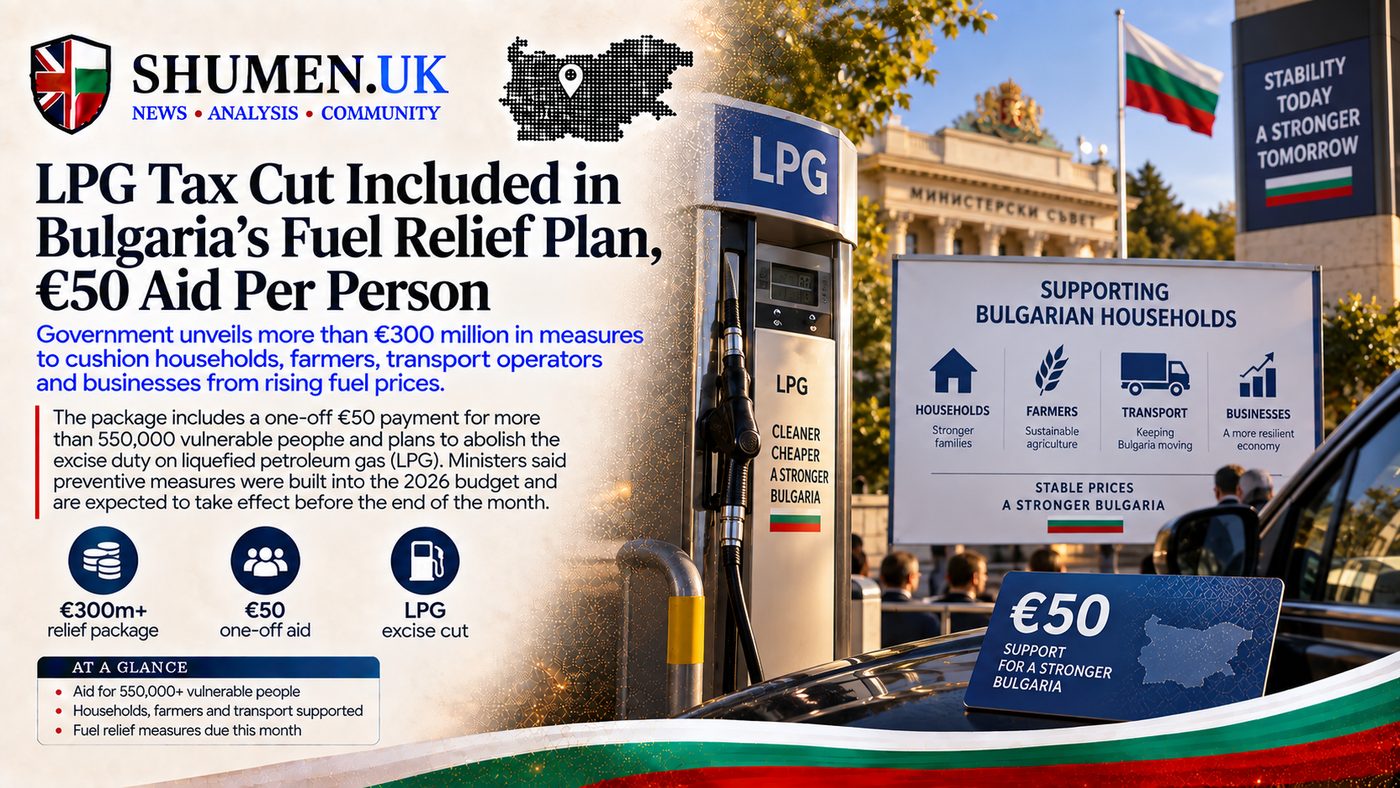
The Bulgarian government has put a figure on the fuel relief Prime Minister Rumen Radev promised on 16 September: more than €300 million, presented on Friday 18 September by Deputy Prime Minister and Economy Minister Alexander Pulev, Social Policy Minister Natalia Efremova and Agriculture Minister Plamen Abrovski, according to Novinite. The three headline items are a one-off €50 "inflation cheque" for more than 550,000 people already on social assistance, the scrapping of excise duty on LPG until the end of 2026, and €170 million for farmers.
What the package leaves out matters as much as what it contains. There is no excise cut on petrol or diesel, and the government says none is planned. With Fuelo putting diesel at €1.94 a litre and A95 petrol at €1.67 on Friday, anyone running an ordinary diesel hatchback gets precisely what they had on Thursday, which is a larger bill.
Pulev's line was that the state "stands firmly by the people" and is "finding local solutions to global problems". In Novinite's report from Thursday he described the philosophy as an end to "helicopter money": help aimed at the people and sectors most exposed, rather than a discount for every motorist.
Who Gets the €50, and Who Does Not
The payment goes to people and families whose income sits below the poverty line and who already receive social assistance. Efremova called it an inflation cheque, meant to absorb dearer fuel and the food and service prices that follow it. Novinite says eight groups qualify, and names these among them:
- kids growing up without parental care
- households on targeted heating assistance
- families bringing up a child with a permanent disability
- children living with relatives or in foster care
- families on child allowances
- war-disabled veterans and people hurt on military service
Two things separate this from the spring round. First, it is automatic. Nobody applies. The Social Assistance Agency pays in October, to a bank card or through the post office, whichever route the existing benefit already takes. Second, you do not need a car. The spring scheme paid €20 to people with a 2025 gross income of no more than €652.41 a month who owned or leased a vehicle, which excluded anyone who takes the bus. The government's reasoning this time is that fuel feeds into everything on the till receipt, not just the forecourt. The budget is €30 million, and Novinite's Thursday report says payments may run into November before everyone is covered.
One arithmetic note. Novinite puts the spring programme at €25 million and the new one at €30 million, then reports that the two together bring this year's support for vulnerable families to €50 million. Those figures do not add up to that total. We are showing them as reported rather than tidying the ministry's sums for it. The Sofia Globe, meanwhile, counts the eligible group at more than 560,000 against Novinite's 550,000; the gap is probably rounding, but no outlet has published the underlying list.
For British expats the position is blunt. If you are not on Bulgarian social assistance, this payment is not for you, and there is no form that changes that. If you are, for example a family receiving Bulgarian child allowances or targeted heating help, expect €50 to land in October by the same route as the benefit itself, with nothing to file. Whether a residence-permit holder on Bulgarian benefits is treated identically to a citizen is not stated in any of the reports we have read, and it was not stated in the spring either. The place to ask is your local directorate of the Social Assistance Agency (Agentsia za sotsialno podpomagane), not the municipality.
The LPG Cut Is Real, but Parliament Votes First
Abolishing excise on LPG is the one measure that reaches a pump. The government expects it to lower forecourt prices for gas-powered cars and for hauliers, and it puts the cost to the budget at about €15 million through to the end of the year, roughly €5 million a month on Novinite's Thursday figures. It may be extended, the ministers said, depending on "developments around the Strait of Hormuz".
There are two catches. It needs a change in the law, which the government says it will take to parliament, and a notification has gone to the European Commission. Asen Vasilev of We Continue the Change called the LPG cut "perhaps the most sensible proposal" in the whole package while warning that the Commission step could delay it. And nobody has said what it is worth per litre. Autogas was €0.68 a litre on Friday, per the Sofia Globe's figures, and the government has not published a cents-per-litre saving, so we are not going to invent one.
The autogas pump on the Shumen ring road already has the queue this month. The diesel side of the same forecourt is where the attendant stands about with nothing to do.
If you run an LPG-converted car here, watch the parliamentary timetable rather than the forecourt board. Nothing moves at the pump until the amendment passes. The running-cost side of the gas-versus-diesel question is set out in our car ownership guide.
Farmers, Lorries and the Village Bus
The largest single line is agriculture. Of the €170 million, €100 million makes up the gap between what farmers paid for fuel last year and what they are paying this year, which Abrovski said works out at nearly 44 euro cents per litre. He set that against 15 cents in France and 20 cents in Spain, and said Greece and Romania have planned nothing comparable; those are his comparisons as Novinite reported them, not ours. Vasilev's objection is that the €100 million mostly reaches large grain producers. If you are registered as an agricultural producer here, even on a modest holding, the 44-cent figure is the one to raise with your regional agriculture directorate.
Pulev said €55 million has already gone in direct support to heavy-goods hauliers, who compete on European routes. And there are subsidies coming for public, school and medical transport, with a stated emphasis on villages and remote areas, so that dearer diesel does not become dearer tickets or bankrupt bus operators. No amount was given. If you live in a village and rely on the bus into town, that is the line in the package to watch, because the mechanism and the money have not yet been published.
The Price-Rise Rules Now Run to August 2027
The part of Friday's announcement with the longest reach has nothing to do with fuel directly. Abrovski said prices began climbing sharply in 2024 as the eurozone debate intensified, and that Bulgaria had lacked a legal tool to restrain increases. A restriction introduced on 1 August 2025 has now been extended to 1 August 2027 under the Euro Adoption Act: prices may rise only where there is an economic justification, and the National Revenue Agency, the Commission for Protection of Competition and the Commission for Consumer Protection will step in where they judge the public interest needs it. His words: "If there is no economic justification, there is no reason for prices to be raised."
This is the same mechanism that sat behind the "basket" scheme we covered in August, and it has just gained two years of life. The practical consequence for anyone shopping here: if a price jumps at your local shop with no obvious input cost behind it, the body that takes the complaint is the Commission for Consumer Protection (KZP), and our money guide explains how to file one and what the KZP can actually do. Keep the receipt. How a regulator will tell a justified fuel pass-through from an opportunistic one at a village shop's till is something the minister did not address.
The Opposition Reads the Calendar
The reaction from the opposition benches was quick and, on the €50 in particular, pointed. GERB's Temenuzhka Petkova said the measures "are not well-targeted", that there is no guarantee the cheque reaches those most in need, and that it lands days before the presidential election campaign opens. She called the package "a strange mix" of measures already proposed, already in the 2026 budget, or already implemented by the Zhelyazkov cabinet. Her colleague Aleksandar Ivanov said GERB does not believe the payment will lower inflation, "quite the opposite", and Vladislav Goranov argued that "the symptoms are being treated rather than the root cause", noting that diesel is far dearer than in previous years despite similar crude prices.
Vasilev, for We Continue the Change, wanted the 2022 approach repeated, a discount on all fuels for everyone who drives, and called the €50 "absolutely insufficient and a complete mockery". Vazrazhdane's Kostadin Kostadinov described the whole thing as taking money out of people's pockets only to hand it back as aid. The fuel traders' association, whose deputy chairman Dimitar Hadzhidimitrov has spent the week predicting €2 diesel, was more forgiving: "A start had to be made somewhere, given these high prices."
The backdrop is the one we set out when we reported diesel at €1.93 on Thursday: Brent above $90 a barrel, Saudi Arabia cutting supplies to Europe, and shipping through the Strait of Hormuz still disrupted, all per Novinite. The National Statistical Institute's August figures, reported by the Sofia Globe on 15 September, put annual inflation at 5.1% with transport costs 13.8% higher than a year earlier. Novinite also notes that drivers are increasingly leaving the car at home and taking public transport, which is precisely the bus service the package proposes to subsidise without yet saying by how much.
So the ledger for a Brit living here reads: nothing at the pump this month, €50 if and only if you are already on Bulgarian social assistance, LPG relief once parliament votes, and a price-complaint route that now runs to the summer of 2027. The date to watch is not the next cent on the diesel board. It is the day the excise amendment is tabled.