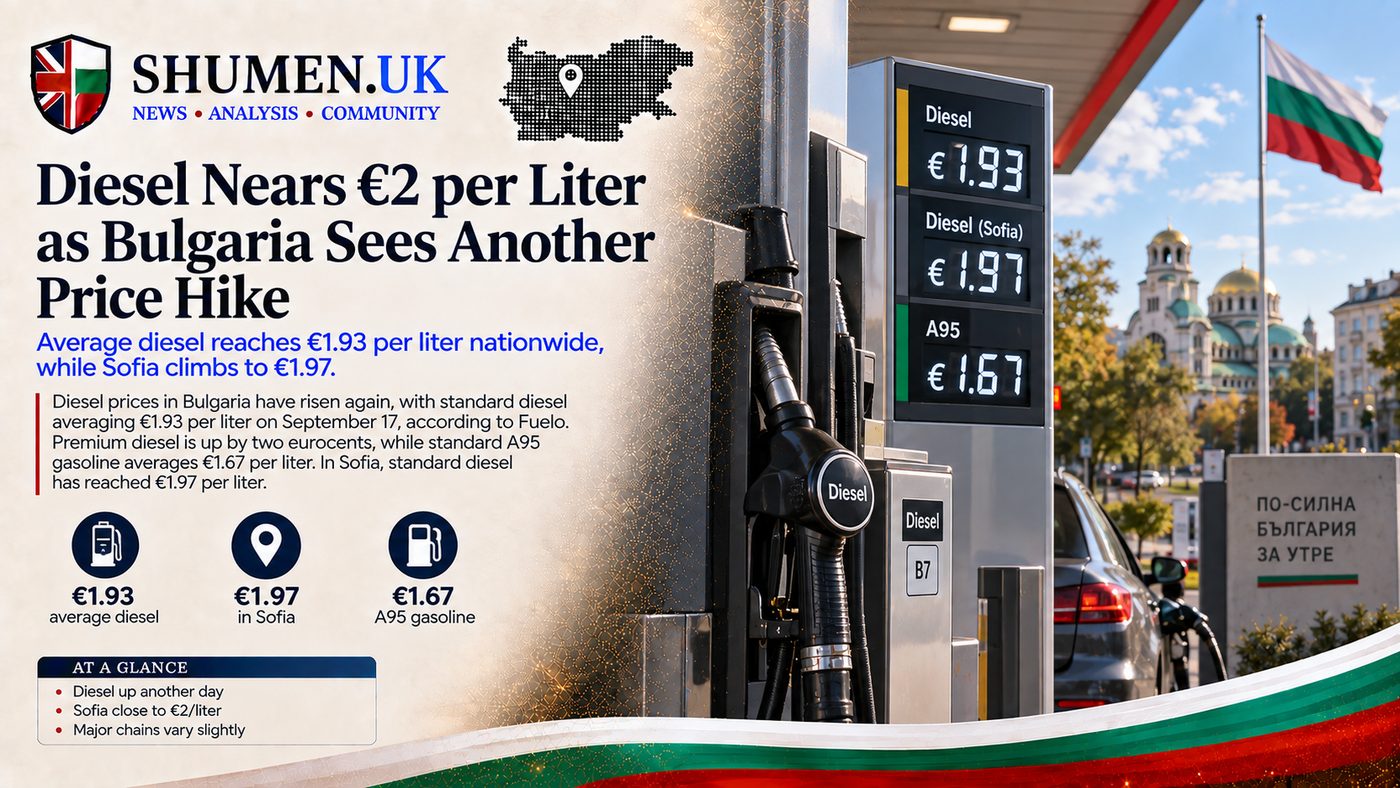
Standard diesel averaged €1.93 a litre across Bulgaria on 17 September, according to the price tracker Fuelo, and in Sofia the forecourt boards already read €1.97. The national figure moved by a single cent on the day. The direction has not changed in three weeks.
Dimitar Hadzhidimitrov, deputy chairman of the Association of Bulgarian Fuel Traders, Producers and Importers, told Novinite that the €2 mark now looks like an October event. Twenty-four hours earlier the same outlet had quoted him predicting it by the end of September, with the national average put at around €1.95. Novinite's own figures do not reconcile: its 17 September report has the average one cent up on the previous day, which puts 16 September at €1.92, not €1.95. We are showing both rather than picking one. The practical reading is the same either way: the second euro is weeks away, not months.
Anyone who has filled up on the Shumen ring road twice this week has already watched the board tick over between visits. Fuelo has simply put a national number on it.
Three Weeks From €1.86 to €1.93
Novinite's own run of price reports charts the climb. On 8 September the national diesel average was €1.86. On 15 September it touched €1.90, which Fuelo recorded as a first for the Bulgarian market. Novinite reported a three-cent jump to roughly €1.95 on the morning of 16 September, and on 17 September Fuelo's figure stood at €1.93 (see the reconciliation note above). Over the month to 15 September diesel rose 6.74%, and against a year earlier it was up 54.84%.
Petrol has been quieter but not quiet. A95 went from €1.55 to €1.65 over the same month, and Fuelo had it at €1.67 on 17 September. Autogas moved from €0.65 to €0.68 a litre, and methane from €1.30 to €1.39 a kilogram. If you switched to LPG to dodge the diesel bill, the gap is still there, but it is narrowing.
One detail worth knowing before you drive across town for a bargain: Novinite reports that the big chains (OMV, Shell, Lukoil, EKO and Petrol) are within about a cent of each other. There is no cheap forecourt to find. There is only the one nearest to you.
Why the Pump Says What It Says
Novinite's report carries an analysis of the causes from energy expert Martin Vladimirov, and it is worth reading closely because it points at something more local than the Middle East.
The global backdrop first. The Strait of Hormuz was closed on 4 March 2026, in what the International Energy Agency has called the largest supply disruption in the history of the oil market, according to Wikipedia's account of the war's economic impact. Vladimirov told Novinite the market is now in a worst-case scenario that nobody was pricing in back in early summer, with stocks already run down, and that a one-day dip in Brent this week should not be read as stabilisation. Hadzhidimitrov, separately, pointed to around ten European refineries closed in recent years and six or seven Russian ones hit in recent months, and estimated a daily shortfall of some four million barrels of refined product.
Now the Bulgarian layer. Vladimirov says the country is importing substantial volumes of crude from Iraq via Turkey at about 10% above Brent, on routes that are dearer and carry their own political risk, when other regional suppliers could be considered. He also argues that Bulgarian fuel duty is among the lightest in Europe while the pump price sits near the top of the EU table, which means the gap is opening somewhere between the tanker and the nozzle. Refined diesel imported from Turkey is, on his estimate, around 20% cheaper than the relevant market price, and in his view much of that saving is not reaching drivers. His words: "The big profit goes to diesel resellers in Bulgaria."
He adds that the Burgas refinery's own margin is also large, and that the special administrator has the power to trim part of it. That administrator is Evgeni Simeonov, who has run Lukoil's Bulgarian companies for the state since the sanctions arrangements of last year. As we reported in August, the refinery is operating on a UK licence that runs to 29 October, with crude supply secured only through September. Vladimirov's suggestion that the state could squeeze the refinery margin lands on a company that is already being run week to week.
The Same Digits as Britain, in a Dearer Currency
British diesel is not a refuge. The RAC's figures for 15 September put the UK average at 192.86p a litre for diesel, the highest since July 2022, and 170.54p for petrol, the highest since August 2022. A full diesel tank in Britain now costs around £106, up almost £5 since the start of the month.
So the Bulgarian number and the British number share the same digits. They do not share a currency, and a pound buys more than a euro, so British drivers are still paying more per litre in absolute terms. What has closed is the old assumption that fuel here is materially cheaper than at home. Vladimirov's point about low tax and high prices is the reason. If you are pricing a drive from the UK to Bulgaria this autumn, budget the Bulgarian leg at British rates and treat anything less as a bonus.
What the Government Has Said, and What It Has Not
Prime Minister Rumen Radev said on 16 September that the government is preparing a package to support public transport, emergency medical services, school transport and the citizens most exposed to fuel prices, and that it would be announced and implemented soon, according to BTA. No amount, no eligibility rule and no date came with it.
Four days earlier Konstantin Prodanov, who chairs parliament's budget committee, had said targeted aid would come if prices became unaffordable, and that this point had not yet been reached. His line to BTA is worth keeping: "USD 100 a barrel in 2026 is somewhat different from USD 100 a barrel in 2022 because of changes in purchasing power and inflation."
The unions are pushing from the other side. At the tripartite council on 14 September, KNSB president Plamen Dimitrov said the need for additional compensation had been discussed, and cited Social Policy Minister Nataliya Efremova's figure of around 230,000 people helped by the spring scheme. He expects clearer parameters by 15 October, when next year's budget takes shape.
The opposition wants more than targeting. Democratic Bulgaria's Ivaylo Mirchev has proposed a flat €0.20 a litre off petrol, diesel and LPG for every consumer, arguing the extra VAT the state collects on dearer fuel already covers it. We Continue the Change's Asen Vasilev warned of an inflationary shock and pointed back to the 2022 subsidy. Vazrazhdane wants VAT on fuel cut. Hadzhidimitrov, for the traders, did his own sum: around 10 million litres of daily consumption means roughly €20 million a month in extra VAT, which he would hand back as a targeted €50 payment.
Financier Nikola Yankov, quoted in the same Novinite piece, is the dissenting voice: he rejects talk of a harsh financial winter, calls Bulgaria relatively wealthy by global standards, and argues incomes have risen faster than prices. Readers on a Bulgarian salary can judge that one for themselves at the till.
The Spring Scheme Is the Template, So Check It Now
Whatever the new package contains, the spring round is the model everyone in the room is working from, and its rules tell you who is likely to be in and who is out.
That scheme paid a one-off €20. According to Novinite's April report, 182,856 people received it automatically because they were already on social assistance in January and February, and close to 45,000 more applied in March. The income test was an average monthly gross income for 2025 of no more than €652.41, twice the previous year's poverty line, and applicants had to own a vehicle or be paying one off on a lease. The Social Assistance Agency paid, and the National Revenue Agency checked the income against its records.
Two practical points for British expats follow from that:
- Eligibility ran off the income NAP holds for you. If you are tax-resident here on a modest Bulgarian salary or a small pension declared here, that declaration is what decides it, not what you feel you earn. Our tax guide covers what NAP should already have on file.
- Neither the April report nor this week's statements say whether non-Bulgarian nationals were included. We could not confirm it either way. If a new round opens, the office to ask is the local branch of the Social Assistance Agency (Agentsia za sotsialno podpomagane), and the question to ask is whether a residence permit holder with a Bulgarian income record qualifies.
If You Live North of the Balkan Range
There is a supply wrinkle that matters more in Shumen than in Sofia. Novinite reported on 15 September that Bulgaria faces no fuel shortage, with the Burgas refinery supplying around 95% to 96% of the market, but that depots in northern Bulgaria rely on rail deliveries, and a shortage of tank wagons has caused temporary gaps in diesel supply. Southern depots are fed by pipeline and have not had the problem.
Shumen, Varna, Ruse and Veliko Tarnovo all sit on the northern side of that line. If a forecourt near you has a bag over the diesel nozzle this month, the reporting suggests it is a wagon problem rather than a national one, and the next station along is the fix. Anyone still deciding whether to keep a diesel car here will find the running-cost side of that question in our car ownership guide.
Sofia's Answer Is Cheaper Buses
The one measure in the source that costs a driver nothing is Vladimirov's. He says an analysis by his organisation found fuel burned on Sofia's roads has grown by roughly a fifth in ten years, with nothing to suggest the curve is flattening, and he floats capped ticket prices or a spell of free fares to pull cars off the road. Radev's package explicitly names public transport, so the two may yet meet. For anyone in the capital who has been driving because the bus felt like the dearer option, it is worth rechecking that sum against our getting around guide once the fares are published.
The number to watch is not €2. It is 15 October, when the unions expect to see the shape of the budget, and 29 October, when the licence that keeps Burgas refining runs out. Both land before the heating season does.