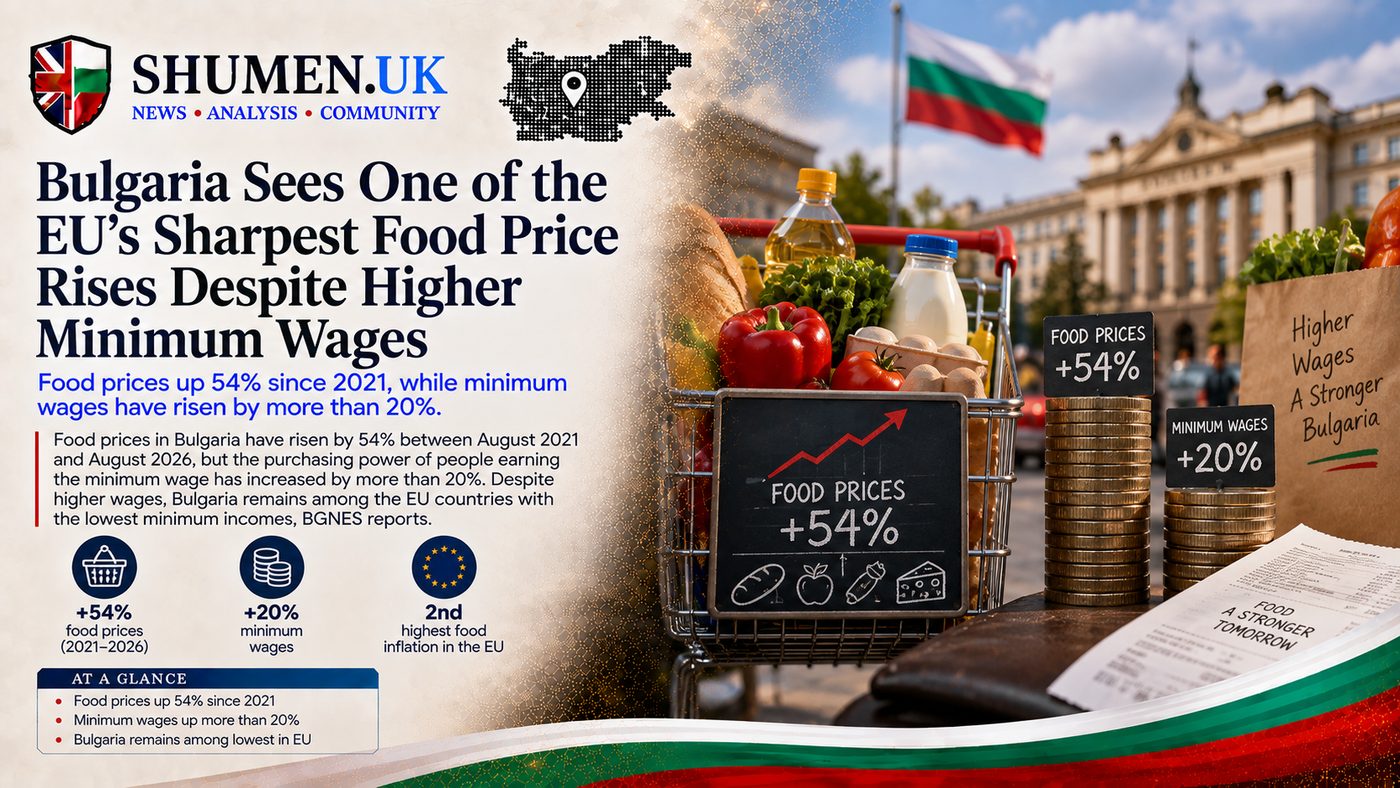
Food in Bulgaria costs 54% more than it did five years ago, the second-steepest rise in the European Union behind Hungary, according to figures reported by BGNES and carried by Novinite on 28 September. They match a Eurostat-based comparison Euronews Business published a day earlier. Over the same stretch, from August 2021 to August 2026, the average across the EU was 34%.
The headline is less grim than it looks, and more awkward than the "wages have caught up" spin suggests. Bulgaria's gross minimum wage has risen faster than food prices, so a minimum-wage earner can now buy more than 20% more food with their pay than in August 2021. But that is a comparison of two percentages, and one of them started from among the lowest floors in the EU.
Bulgaria Sits Beside Hungary and Romania, Not France or Germany
The five-year food rise, per the figures reported by Novinite:
- Hungary: 57%
- Bulgaria: 54%
- Romania: 53%
- Spain: 35%, Germany: 34%, Italy: 30%, France: 25%
- EU average: 34%
Croatia and Greece recorded considerably lower growth, though no exact figures were given. The pattern is plain enough: three eastern members sit at the top of the table, well clear of the big western economies.
On purchasing power, the story flips. In Germany the minimum wage now buys 9% more food than in 2021, in Ireland 10%, in Greece 7%. France and Spain went backwards, by 4% and 5% respectively, and Euronews found Malta fared worst of the 26 countries it compared, at minus 6%. Bulgaria, at more than 20%, sits alongside Croatia, Albania, Romania, Hungary and Lithuania. Serbia and Montenegro did better still, with their minimum wages roughly doubling (up 103% and 102%) and food purchasing power up 37%.
Turkey is the cautionary tale in the dataset: a minimum wage up 823%, food up 752%, and a real gain of just 8%. Big nominal numbers, in other words, are not the same as a fuller trolley.
What the Index Does Not Measure
The comparison uses the gross monthly minimum wage and food prices only. Euronews says so plainly: it does not show what is left for groceries after tax, rent, electricity and transport. That caveat matters more in Bulgaria than almost anywhere else on the list, because the latest official inflation data shows the pressure has moved elsewhere in the household budget.
Anyone who has watched the price of a restaurant shopska salad over the last two summers will not need the statistics to confirm it, but here they are. The National Statistical Institute put annual consumer price inflation at 5.1% in August 2026, up from 4.5% in July, as reported by the Sofia Globe. Food, by contrast, was up just 0.9% on a year earlier and flat on the month. Transport was 13.8% higher year on year, and housing and utilities 5%. The NSI's deputy head, Svilen Kolev, was quoted by BTA as saying that hotel, restaurant and accommodation prices had risen by 20-30% over two years.
The Missed Angle: the Damage Is in the Level, Not the Rate
Put those two data sets together and the real picture emerges. With annual food inflation now below 1%, almost all of that 54% rise landed in the earlier years of the five-year window. Food prices are no longer climbing sharply, but they are not coming back down either. The shock is baked into the shelf price.
That is why the "purchasing power is up" line and the "food is unaffordable" line can both be true at once. Bulgaria's minimum wage now stands at €620.20 a month. Deputy Prime Minister and Finance Minister Galab Donev said on 15 September that the 2027 figure will be set between €620.20 and €672.80, and that the government wants it as close to the top as possible, according to BTA. Even the upper end would be a rise of about 8.5%. BTA reported on 25 September that parliament had approved the new minimum-wage formula at second reading; the exact 2027 amount still needs a Council of Ministers decision.
Novinite's source did not analyse why Bulgarian food prices rose further than most, and we won't guess.
What This Means for British Expats
For Brits in Bulgaria, the practical point splits two ways.
If you earn locally, as many British expats do, often on pay well below UK levels, the minimum wage is a useful yardstick even if you earn above it. It anchors what employers offer at the bottom of the scale, and a 2027 rise of up to 8.5% against food inflation below 1% is, for once, a gap running in the worker's favour. Watch for the Council of Ministers decision that fixes the 2027 figure.
If you live on UK income, such as a pension or remote salary, the minimum-wage index tells you nothing about your own position. What matters is that the grocery bill has broadly stopped rising while eating out, travel and bills have not. Budgeting on 2021 assumptions, or on a relocation video filmed before the euro changeover, will undercount by a wide margin. Our cost of living guide carries the underlying numbers.
Two practical levers remain on the food side. The government's Care Basket scheme offers discounts of at least 15% on a list of essential foods at participating retailers, BTA reported, with Kaufland among those taking part. And the gap between chains, and between chains and the local pazar, is wide enough that shopping around still pays; our supermarkets guide walks through the main chains and the markets.
The UK was not part of the 26-country comparison, so there is no like-for-like British figure to set against Bulgaria's 54%. What the data does settle is that Bulgaria is no longer a place where the weekly shop is an afterthought.