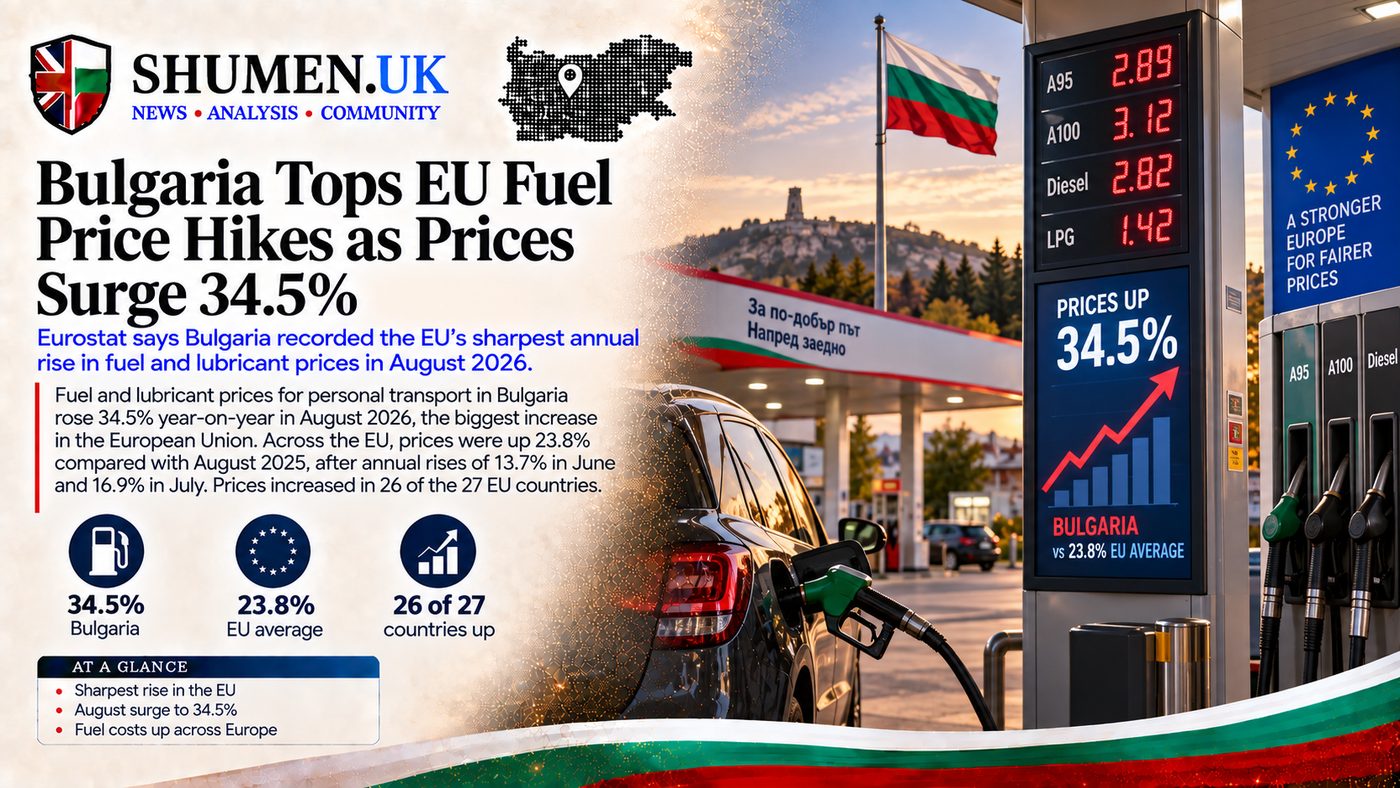
Bulgaria posted the steepest annual rise in fuel prices anywhere in the European Union in August, with the cost of fuels and lubricants for personal transport up 34.5% on August 2025, according to Eurostat figures published on 22 September. The EU average was 23.8%.
That is not a one-off. Bulgaria also topped the table in June, at 26% against an EU average of 13.7%, eased to 22.2% in July, and has now gone past its previous peak of 33.9%, set in May. Anyone who has watched the digits roll on a diesel pump in Shumen this month will not need Eurostat to tell them; it has simply put an official number on the receipt.
Diesel Is Doing the Damage
The monthly figures show where the pain is concentrated. Across the EU, diesel rose 8.3% between July and August while petrol went up 3.3%. Bulgaria's diesel jump was the second largest in the bloc at 13.5%, behind only Czechia (14.3%).
The pump prices have followed. The price tracker Fuelo put standard diesel at an average of €1.93 a litre on 17 September, with Sofia already at €1.97. By Monday 21 September some stations were charging €2 a litre, with the national average at €1.96, while A95 petrol averaged €1.69, Novinite reported. That gap of roughly 27 cents a litre between diesel and petrol is worth knowing if you are choosing a car here.
To put the headline figure in household terms: if the fuel you bought last August cost €100, the same fuel cost around €134.50 this August. For a car doing 6 litres per 100 km, a weekly 200 km round trip (a Shumen-to-coast run and back, say) uses 12 litres, which at €1.96 comes to about €23.50 a week in diesel alone. Our cost of living guide carries the wider household figures and is worth revisiting if you budgeted for this year on spring prices.
Where Bulgaria Sits in Europe
Eighteen member states saw annual rises above 20% in August. After Bulgaria came Lithuania (28.8%), Finland (27.6%), Germany (27.5%) and France (27.4%). At the other end, Hungary recorded just 1.3%, Sweden 6.1% and Ireland 11.7%. Prices rose year on year in 26 of the 27 member states.
Eurostat itself does not analyse why Bulgaria sits at the top. Novinite attributes the Europe-wide surge to the economic fallout of conflicts in the Middle East and Ukraine, and noted that Bulgaria's August rise was its largest since the US-Iran conflict began in late February. Brent crude has stayed above $100 a barrel, according to the same outlet.
What the €300 Million Package Does, and Does Not, Cover
The Radev government announced a relief package worth more than €300 million last week. Read the small print and most drivers of petrol and diesel cars, which includes most British expats with a car, will find very little in it for them. There is no excise cut and no direct subsidy on petrol or diesel.
What it does contain:
- LPG excise removed until the end of 2026, possibly longer depending on events in the Middle East. It needs a change in the law, so it does not apply until Parliament passes it. The cost to the budget is put at around €15 million.
- A one-off €50 payment to more than 550,000 people in eight vulnerable groups (recipients of targeted heating assistance, families raising children with permanent disabilities, military invalids and others), paid automatically in October through the existing benefit channel, with no application.
- €170 million for farmers, worth nearly 44 euro cents per litre of fuel.
- €55 million already paid to heavy goods hauliers.
- Support for public, school and medical transport, with particular attention to small and remote settlements where some routes do not pay their way.
Two practical points for Brits follow. First, the €50 goes only to people already inside the Bulgarian social support system; if you do not currently receive one of those benefits, there is nothing to claim and no form to file. Second, the transport support is the part most likely to matter to anyone living in a village and relying on the bus into the nearest city. Whether it keeps marginal rural routes running is not yet clear, and no route-level figures have been published. Our getting around guide covers how the bus and marshrutka network works outside the big cities.
The opposition has not been kind. GERB-SDS figures and We Continue the Change leader Asen Vassilev argued the €50 would not reach those who need it and that the farm money would mostly benefit large grain producers rather than shoppers. Novinite summarised the charge as the biggest windfall going to grain producers driving Maybachs rather than ordinary people.
Checking You Are Not Being Overcharged
The Commission for Consumer Protection (KZP), now chaired by Maya Manolova, began inspecting petrol stations on 21 September to establish whether recent increases are justified, with sanctions promised where they are not. The inspections cover chains and independents, in cities and outside them, and the commission says it will also watch whether the LPG excise cut actually reaches the pump once it is law.
In practice that gives you two tools. Fuelo publishes daily average prices, so you can see at a glance whether your local forecourt is running well above the national figure. And if it is, the KZP takes consumer complaints; our money guide explains how the commission works. If you run an LPG conversion, keep an eye on the price once the excise change passes: if it does not move, that is exactly what the inspections are meant to catch.
What nobody has offered yet is a forecast of when prices might ease. The government's own package runs to the end of the year, which says something about how long it expects this to last.