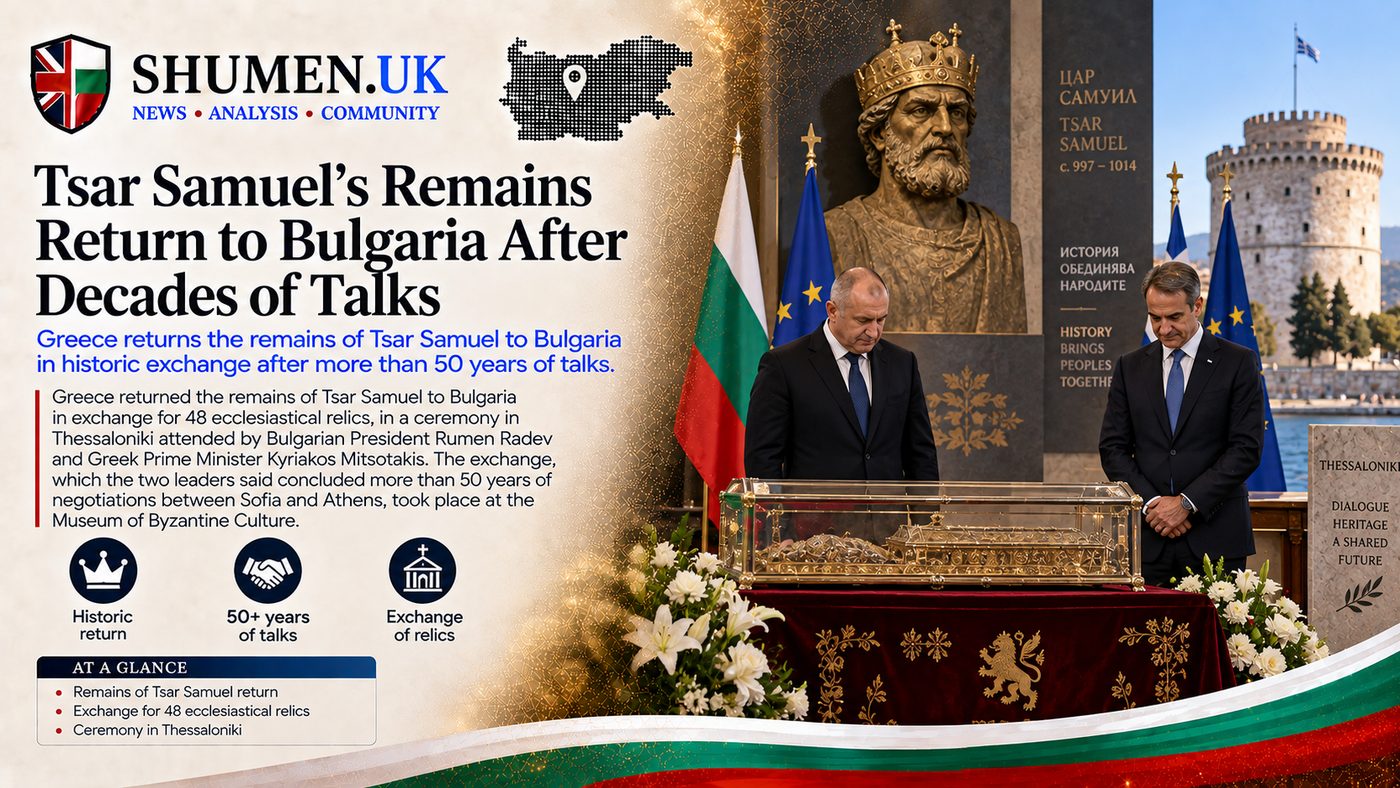
Greece handed over the remains identified as Tsar Samuel's at a ceremony in Thessaloniki on Saturday 3 October, and Bulgaria sent 48 church relics the other way. Prime Minister Rumen Radev and his Greek counterpart Kyriakos Mitsotakis attended at the Museum of Byzantine Culture, where Lina Mendoni for Greece and Evtim Miloshev for Bulgaria, the two culture ministers, signed the handover protocols. Some English-language coverage still styles Radev "President". He left that office in January and has been prime minister since 8 May; Iliana Iotova now holds the presidency and is seeking a full term in the vote on 25 October.
The remains were due to fly to Sofia on a Spartan military transport, with a state ceremony and burial at St Sophia Church planned for the same day. Both leaders said the deal closed a negotiation that had run for around half a century.
What Changed Hands
Bulgaria received:
- the remains identified as Samuel's
- anthropological material from other sarcophagi in the same basilica of St Achillios on Small Prespa Lake. Novinite reported ten further people, eight of them children, with two believed to be Samuel's son, Gavril Radomir, and a nephew, Ivan Vladislav.
Greece received:
- 48 church relics: icons, crosses, church vessels and an episcopal throne, according to BTA
- items from the Metropolis of Serres and Nigrita and from two monasteries, St John the Baptist and Panagia Eikosifinissa, acquired during the First World War
Mitsotakis said the relics would be shown in Thessaloniki before going back to the places they came from. He also hoped the exchange would open the way for other relics to be returned, and put the spirit of the deal in one line: "A good neighbour is closer than a brother."
Whose Bones Are These?
The Greek archaeologist Nikolaos Moutsopoulos found the tomb in the 1960s, in a church on Agios Achilleios, an island in Small Prespa Lake, built while Samuel reigned (997 to 1014). Even the year of discovery depends on where you read it: Novinite gives 1964, Wikipedia says 1965, and BTA's reports of the handover give 1969. Treat "the 1960s" as the safe version until someone reconciles them.
The identification is the part the ceremony does not settle. Prof. Ilia Iliev, a medieval historian at the Institute of Historical Research of the Bulgarian Academy of Sciences, said in comments carried by BTA that evidence tying remains to a particular ruler is generally circumstantial, "as is the case with Samuel". The case rests largely on place. Iliev notes that Samuel built a palace and a royal basilica on Agios Achillios, that the apse bore the names of the sees of the Bulgarian Church, and that members of the royal family were buried in its narthex, where, in his words, "ordinary people could not have been buried". After his death the king was probably taken to that church, he adds.
Science may help, but only so far. Iliev says the remains are being studied by modern methods, and that the only thing that can be established with certainty is whether the bones from the two graves belonged to blood relatives. That would strengthen the likelihood that they are the ruler and his son. Novinite, by contrast, reports that genetic and anthropological examinations are still to be conducted, so the two accounts differ on whether the work has begun, and neither gives a result or a timetable.
The skeleton itself carries a small disagreement too. Prof. Georgi Nikolov of Sofia University puts Samuel's stature at around 1.55 metres, while a separate BTA historical piece cites an anthropological analysis indicating a man of about 1.60 metres and roughly 70 years old. Bulgaria is, in effect, giving a tsar a state funeral on evidence that one of its leading medievalists calls circumstantial, with no genetic result yet reported.
The Man, Briefly
Samuel spent decades resisting the Byzantine Emperor Basil II. On 29 July 1014, at Kleidion, Byzantine troops outflanked the Bulgarian defences, and on Basil's orders roughly 14,000 captured soldiers were blinded. Samuel died on 6 October 1014, reportedly of a heart attack at the sight of them. The remains are therefore arriving three days before the 1,012th anniversary of his death.
Radev framed Samuel as a figure who once set the two peoples against each other and now draws them together, and credited shared EU membership with helping the two governments understand each other. BTA reported that the Bulgarian government and opposition both welcomed the agreement when it was announced, and so did President Iotova.
If You Are in Sofia on Saturday
The programme set out for Saturday 3 October puts the state ceremony on Knyaz Alexander I Square, with Radev's address "Bulgaria Welcomes Tsar Samuel", 21 artillery salutes during the anthem and a fighter-jet flypast at about 12:30 p.m. The Bulgarian Armed Forces carry the remains from Vasil Levski Airport. A procession then goes to St Sophia Church, where the public can pay their respects and a trisagion, the short Orthodox memorial service, will be held.
About 750 Interior Ministry staff are on duty, and police have set up security zones around both venues. If you live or are staying near the centre, expect cordons, crowds and a good deal of noise around midday. BTA's report of the programme did not list road closures or the church's viewing hours, so check the Sofia municipality and Interior Ministry notices before heading in.
BDZ is offering free round-trip tickets to the ceremony (Novinite credits the government with the free travel), but with conditions. The tickets are valid only on the designated special trains and only with a reserved seat, and the reservation is the one thing you pay for, at €0.51 each way. Special trains run from Burgas, Plovdiv, Gorna Oryahovitsa, Petrich and Vidin. The Burgas train leaves at 5:25 and reaches Sofia at 11:25, with the return at 16:45. Online sales for these trains are suspended from 1 to 3 October, so tickets and reservations have to be bought at a station counter. A BDZ round trip to the capital for €1.02, seat included, is for regular passengers the second most surprising development of the weekend. Our getting around guide explains how fares and reservations work the rest of the year.
The next thing to watch is a genetic result. Iliev is careful about what it could show: kinship between the two graves would strengthen the case, not close it.