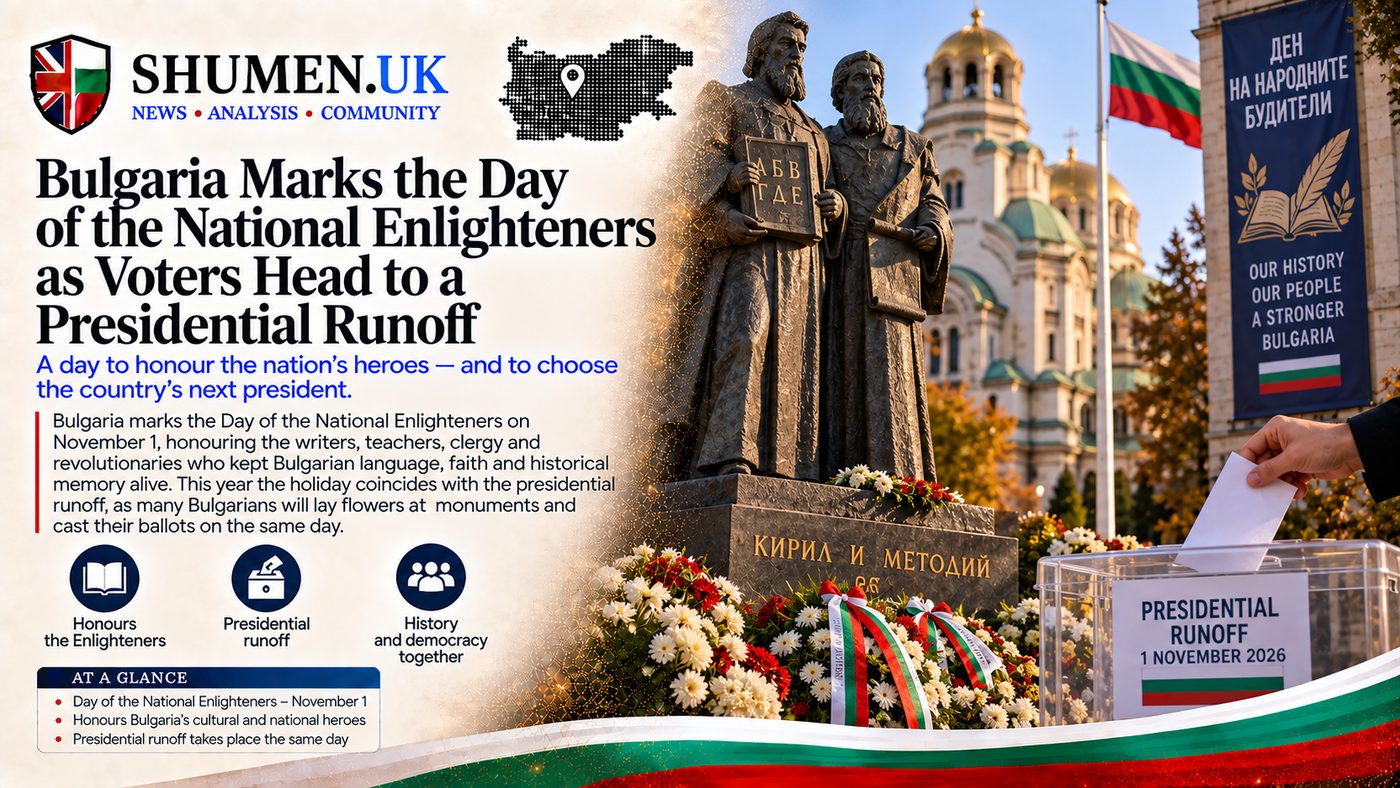
Bulgaria is honouring its national awakeners today, Sunday 1 November, and this year the holiday has company: the same Sunday decides the presidential runoff in which President Iliana Yotova faces Andrey Gyurov. Plenty of Bulgarians will lay carnations at a revival-era monument in the morning and queue at a polling station in the afternoon.
The Day of the National Enlighteners (Den na narodnite buditeli) is a holiday with no direct British equivalent, which is why it tends to pass most expats by. It is worth knowing, partly because it shuts every school and university in the country when it lands on a weekday, and partly because it explains a great deal about why Bulgarians care so fiercely about their language.
What an "Awakener" Actually Is
A buditel is, literally, someone who wakes other people up. English-language sources cannot agree on a translation, so Enlighteners' Day, Awakeners' Day and National Revival Leaders' Day all turn up for the same date. The people being woken were Bulgarians living under Ottoman rule, with no state of their own and a church and school system dominated by Greek.
The name usually placed first is Paisius of Hilendar, a monk based at Hilendar on Mount Athos, who completed his Slavo-Bulgarian History in 1762. Mainstream historiography treats that book as the starting gun of the whole Bulgarian National Revival, a period that ran until the creation of the Principality of Bulgaria in 1878. For decades it travelled as hand-made copies between monasteries and villages.
After Paisius come Sophronius of Vratsa, who made fresh copies of the book and carried it further, and Neofit Rilski, whom Bulgarians often credit as the father figure of their modern schooling. The list then broadens into the 19th-century revolutionaries, including Vasil Levski and Hristo Botev, who are honoured on the same day.
There is a church thread too. St Ivan of Rila, Bulgaria's patron saint and the founder of the Rila Monastery, was commemorated on 19 October under the old Julian calendar. On the Gregorian calendar that date becomes 1 November, so the saint and the awakeners share a day.
In most Bulgarian towns the Paisius or Levski monument gathers a fresh layer of flowers on 1 November; this year the voters walking past it on the way to cast a ballot will add to the pile.
Shumen Has a Better Claim Than Most
The holiday is national, but the city this site is named after sits close to the heart of it.
- The chitalishte started here. The first chitalishta, the community "reading rooms" that combine library, theatre and evening classes, appeared in 1856 in three places: Shumen, Lom and Svishtov. UNESCO added the chitalishte model to its Register of Good Safeguarding Practices in 2017.
- The father of Bulgarian theatre was a Shumen man. Dobri Voynikov, born in Shumen in 1833, taught in the city until 1864 and was active in its fight for secular Bulgarian schooling. In exile in Romania he founded a Bulgarian amateur theatre company in Brăila in 1865, the first to put women on the Bulgarian stage, and later staged work in Shumen itself.
- An early Cyril and Methodius celebration. Shumen hosted the first celebration of the two saints in the Bulgarian lands on 11 May 1813.
None of that is trivia for its own sake. When a Shumen school or chitalishte puts on a 1 November programme, it is marking local history, not just a national date.
Banned in 1945, Restored in 1992
The day has had a rocky century. The timeline below comes from BTA, the state news agency, via Novinite:
- 1909: the first celebration, held in Plovdiv.
- 1922: Stoyan Omarchevski, then minister of education, pushed for a national day of tribute; MPs of the 19th National Assembly added it to the Holidays Act on 13 December.
- 3 February 1923: a decree from Tsar Boris III settled on 1 November.
- 1945: the communist regime scrapped it.
- 28 October 1992: the 36th National Assembly brought it back, using a change to the Labour Code.
That 47-year gap matters for understanding the people around you. Bulgarians now in their sixties grew up without the holiday; their grandchildren grew up with it.
The Practical Bit for British Parents
Since 1992 the date has carried official holiday status. Every school and university closes for it, yet for most other employees it is an ordinary working day. That combination is the one that catches out working parents.
This year it costs nothing, because 1 November is a Sunday. Next year it will not be so kind: 1 November 2027 falls on a Monday, so pupils will be at home while most offices, shops and factories are open. If you work and your children attend a Bulgarian school, put it in the diary now and arrange cover. Our education guide covers how the Bulgarian school year is organised more broadly.
The week around the holiday is also one of the easier moments to step into local life. Schools, universities and chitalishta run concerts, readings and award ceremonies, and many institutions hand out prizes to teachers, scientists and cultural workers around this date. Turning up at a chitalishte event, even if you follow one word in ten, is the route our integration guide recommends for moving from foreigner to neighbour.
The Runoff Running Alongside
By custom the head of state starts 1 November by raising the flag in front of the Presidency building in Sofia and greeting the honour guard. Today that ceremony falls to a head of state who is also a candidate.
Yotova has been president since 23 January 2026, when she moved up from the vice presidency after Rumen Radev resigned; she is the first woman to hold the office. Radev is now prime minister. In the first round on 25 October she took 34.76% of the vote to Gyurov's 31.95%, according to the Central Election Commission's final count, with only 22.98% of voters taking part, which Novinite calls a historic low for a presidential vote. Because nobody cleared 50% of the vote on a turnout above 50%, the top two go head to head today.
For British expats the runoff is something to watch rather than take part in. Presidential votes are for Bulgarian citizens, so unless you hold a Bulgarian passport through the routes in our citizenship guide, you will not be on the register.
The awakeners spent their lives coaxing a reluctant population into taking an interest in its own country. Whether today's turnout climbs above the first round's 22.98% will be the measure of how far that message still carries.