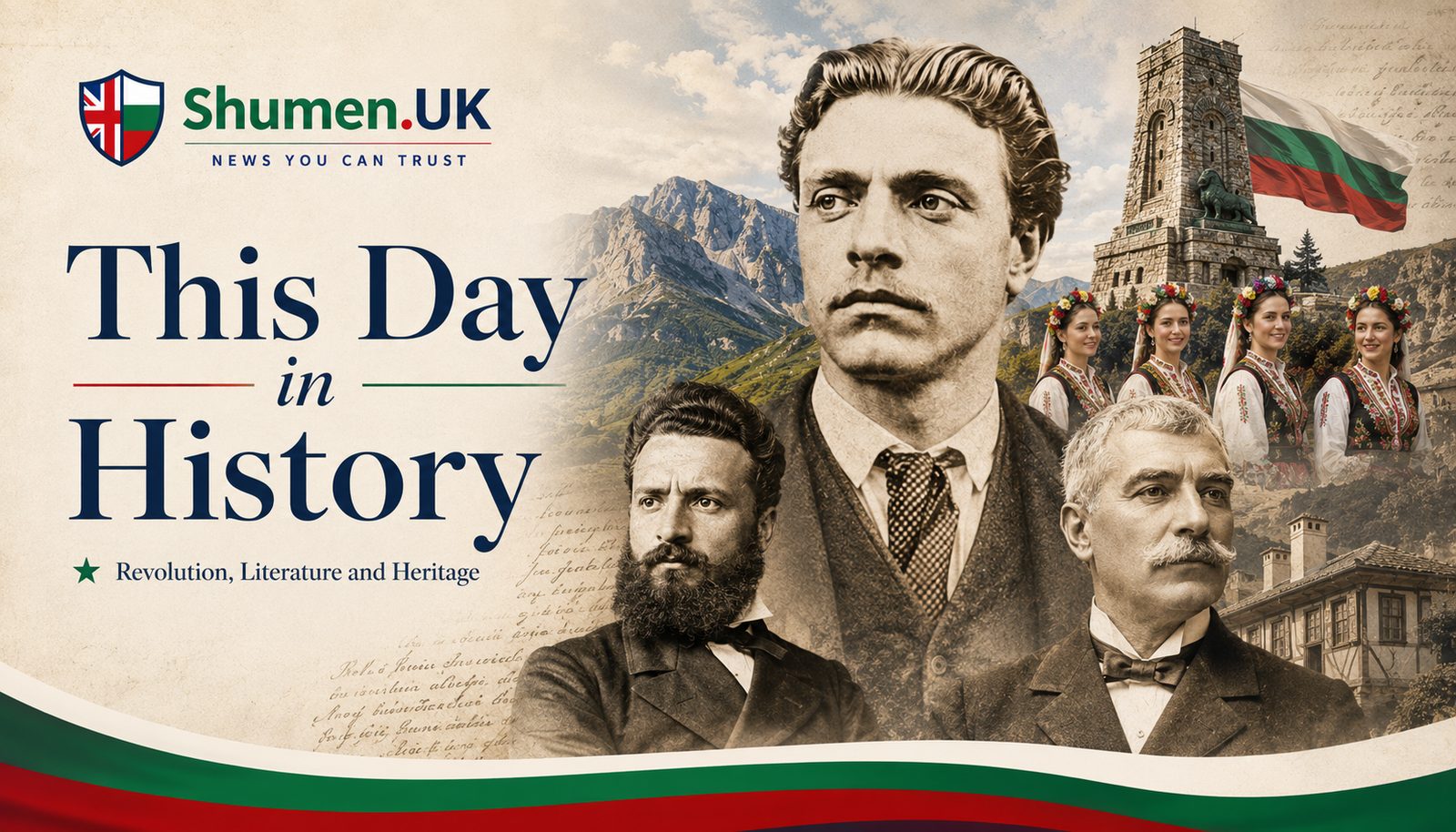
📅 ON THIS DAY IN BULGARIA, Monday 9 November
I rather like a holiday destination with a literary backstory. Albena takes its name from the fiction of Yordan Yovkov, so a familiar seaside name gives us a way into his writing. The original story has rather more trouble in it than a misplaced beach towel.
What happened on this day
Yovkov was born on 9 November 1880 in Zheravna. His literature teacher, the poet Ivan Grozev, spotted a future writer in him, according to the Bulgarian Wikipedia biography. After 13 years in Bulgaria, I still find that sort of classroom detail easier to remember than a list of literary honours. Someone saw the writer before the reputation existed.
He studied at First Sofia Men's High School and later taught in the villages of Dobrudzha. War interrupted the classroom: he was wounded in the leg near Doyran in 1913, during the Second Balkan War. The books that made his name came later, the story collections Legends of Stara Planina (1927) and the tales of the inn at Antimovo, and in 1929 the Bulgarian Academy of Sciences awarded him its Cyril and Methodius Prize.
The story behind the seaside name
The resort's own website explains its connection to Albena, Yovkov's short story; he also wrote a play with that title. This is where the familiar place name becomes more interesting. A character has travelled out of a work of fiction and onto the holiday map. You can recognise the destination for years without knowing what its name carries.
In the short story Albena, a village gathers around a woman implicated in her husband's murder. The crowd's hostility softens as people look at her beauty, then turns against her again as the scene unfolds. My reading is that the villagers' changing judgement matters as much as the crime. Watch how quickly sympathy arrives, and how quickly it can disappear. That is quite a lot of human behaviour packed into one seaside name.
Put the writer on your map
Dobrich has a Yovkov memorial museum, the Dom-pametnik, whose displays include his study. The museum's website also offers a virtual tour. Dobrich is no random choice: he married Despina Koleva there, in her home city, on 15 December 1918, and was still in Dobrich when Dobrudzha was handed back to Romania, after which he crossed the border illegally to Varna. It is a useful next step if the name has finally acquired a person behind it.
There is a separate Yovkov house museum, too. If you want to visit the house, start by contacting the memorial museum: the museum's own visitor instructions direct people there to arrange access.
Why this matters for British expats
For British expats building a life in Shumen, this is a manageable bit of cultural homework: follow a name you recognise into one actual story. Yovkov's trail here leads towards Zheravna and Dobrudzha; Shumen will have to share the literary honours on this occasion. Read Albena with a Bulgarian friend and ask which change in the crowd's attitude troubles them most. You have something specific to discuss, with room to disagree. If your Bulgarian is not there yet, John Burnip's English translation, The Inn at Antimovo and Legends of Stara Planina (1990), lets you start on your own terms.
Sources and further reading
The Bulgarian Wikipedia biography, checked alongside its English counterpart, supplies the birthday and teaching background. Albena's own account explains the resort connection, Yovkov's story supplies the village scene, and the Dobrich museum's exhibition and visitor pages provide the places to explore next.