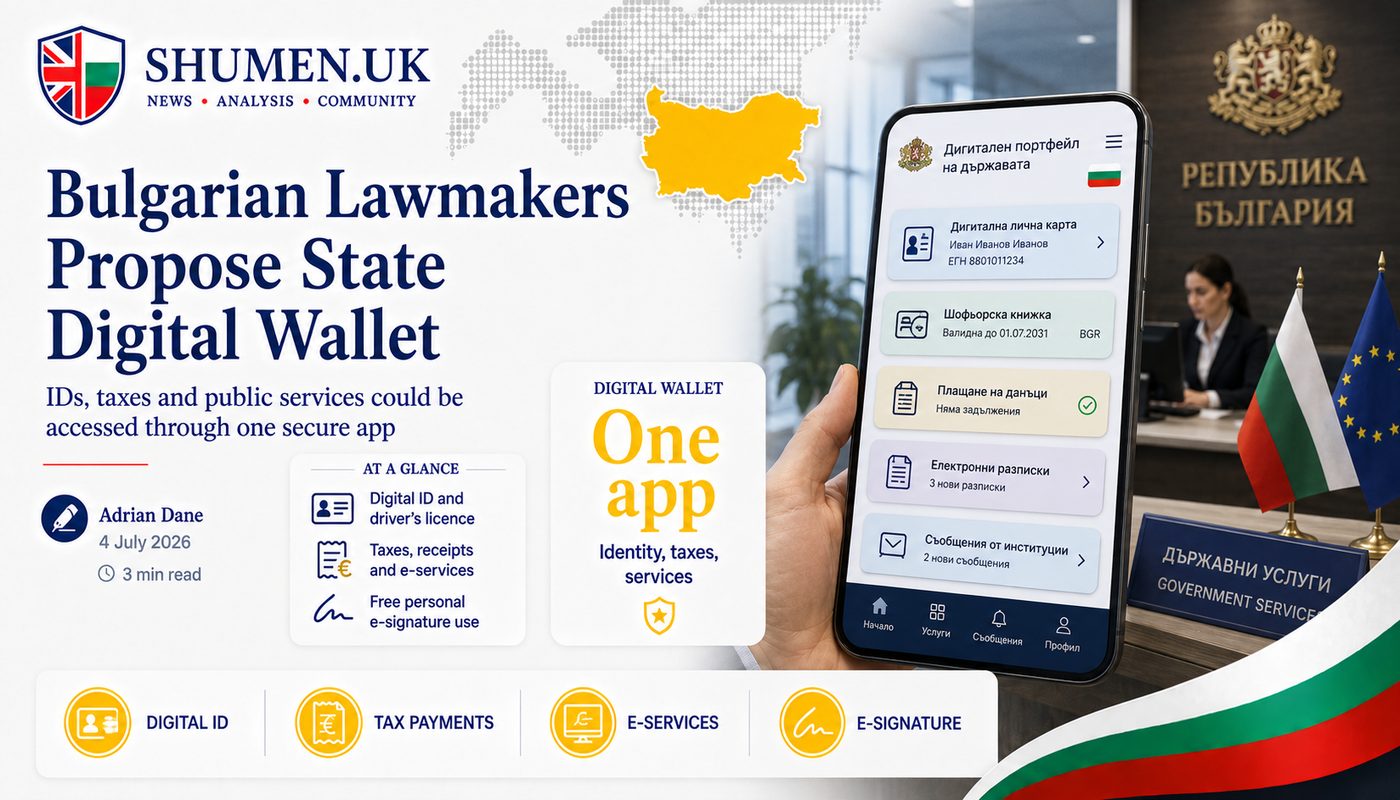
A group of MPs from Democratic Bulgaria has tabled amendments to Bulgaria's Electronic Identification Act that would hand every citizen a single digital wallet for their identity documents, their tax affairs and a long list of state services. The proposal, submitted by Bozhidar Bozhanov, Nadezhda Yordanova and colleagues, would bring Bulgarian law into line with the European Union's digital identity framework.
Two things would exist side by side under the draft. Any provider that meets the EU's requirements could build and offer a European digital identity wallet, creating a competitive market. Alongside that, the state would run its own digital identity and electronic services wallet, which the authors say would go beyond the EU minimum and fold in a broader range of public services.
Anyone who has spent a morning at a Bulgarian municipal counter clutching a folder of stamped and re-stamped documents will read the promised list of functions with cautious hope.
What the Wallet Would Actually Do
The authors describe a system meant, in their words, to allow things "to be done from a single place in the hand of every citizen." Under the proposal, a citizen with a wallet could:
- verify their identity when using electronic services in Bulgaria and other EU member states
- apply for administrative services online
- review the personal data that state institutions hold on them
- receive electronic receipts and official correspondence
- pay taxes
- carry digital versions of identity documents, including ID cards and driving licences
That is a broad list, and it is worth being clear about what it is: a set of intentions written into a bill, not a working app you can download this week. Bulgaria already runs an e-government portal and an electronic identification scheme; the e-government guide covers what is actually live today. The wallet is the next step the EU is pushing everyone towards.
The EU Deadline the Bill Is Racing
The source frames this as Bulgaria choosing to modernise. The context it leaves out is the reason for the timing. The bill is built on Regulation (EU) 2024/1183, the reform known as eIDAS 2.0, which the European Parliament and Council adopted on 11 April 2024.
Under that regulation, every one of the 27 member states must make at least one compliant digital identity wallet available by the end of 2026, and the official EU summary is explicit that it must be offered to "their citizens, residents and businesses." So this is not a Bulgarian flourish. It is Bulgaria doing in mid-2026 what Brussels has set as a legal requirement by December. The same EU rules make the wallet entirely optional for individuals and free to use, points the draft carries across.
What This Means for British Expats
Here is the detail worth watching. The EU regulation the bill implements covers "citizens, residents and businesses," not citizens alone. On paper that scope includes legally resident third-country nationals, which is the category most British expats fall into since Brexit, holding residence status under the Withdrawal Agreement.
The bill's own explanatory memorandum, as reported, talks about "every citizen." Whether Bulgaria's state-run wallet will actually be issued to British and other non-EU residents, or only to Bulgarian citizens, is not spelled out in the proposal as published. That is the single most important thing for a Brit to follow as the amendments go through committee, because the EU framework clearly contemplates residents while the national wording, so far, does not name them.
Either way, the services on the list are ones British expats already wrestle with in person. Filing and paying tax through the NAP, exchanging or renewing a driving licence, registering an address, checking what the state has on file. A working wallet would, in principle, move those off the counter and onto a phone. Our taxes guide explains how tax filing works now, and if you have swapped your UK licence for a Bulgarian one, the driving guide covers the paperwork a digital licence would eventually sit on top of.
None of this is live yet, and there is no sense pre-emptively deleting the document folder. But it is the clearest signal so far of where Bulgarian public services are heading, and of a question the reader has a direct stake in: who, exactly, gets a wallet.
Electronic Signatures and the Centres Being Phased Out
The draft also deals with the fiddly matter of qualified electronic signatures. EU rules say individuals must be able to use a qualified electronic signature free of charge for personal purposes, so the proposal calls for a methodology to work out how the providers offering that service would be compensated.
The authors argue the cost should stay modest. They point out that amendments to the Electronic Government Act back in 2023 already scrapped the mandatory use of a qualified electronic signature for individuals requesting electronic administrative services, so fewer signatures are being handed out in the first place. No specific figure for the compensation bill was disclosed in the proposal.
One structural change comes with it: the bill would eliminate the private electronic identification centres. The lawmakers argue these are no longer necessary under the updated model and should be phased out as part of the wider reform.
For now, it is a set of amendments on the parliamentary table rather than a working service. But with the EU's end-of-2026 deadline fixed, the direction is set. The open questions are the ones that matter to anyone living here: who is issued a wallet, and whether the state's version arrives before Brussels starts counting.