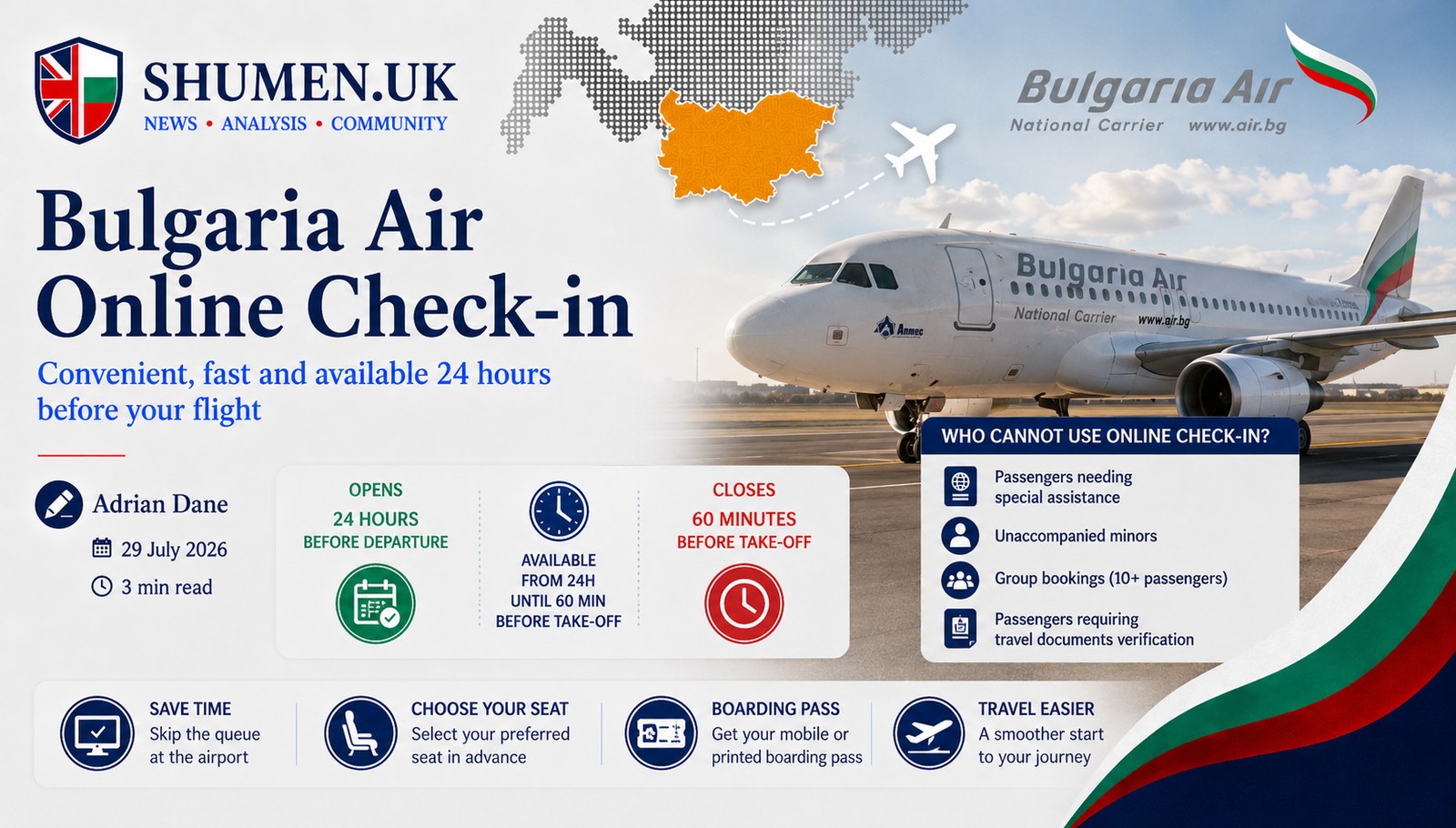
Flying out of Sofia on Bulgaria Air? Online check-in is usually the quickest way to grab a boarding pass and reserve a seat before you reach the terminal. The airline opens the service 24 hours before scheduled departure and closes it one hour before take-off. It runs on all scheduled direct flights the carrier operates, which for British expats means one route in particular: Sofia to London Heathrow, flights FB851 and FB852, out of Terminal 4. Bulgaria Air does not fly to Gatwick, Luton, Stansted or Manchester. Those are Wizz Air, Ryanair, easyJet, Jet2 and TUI, and their rules are different.
The process itself is simple. What catches people out is everything either side of it: a ladder of deadlines that are not the same number, a fare class that quietly includes no suitcase, and a border system that arrived after the airline last revised its advice on when to turn up.
The deadlines are four different numbers
Almost everyone remembers the 24-hour opening and forgets the rest. Bulgaria Air publishes four separate cut-offs, and missing any of them costs you the flight:
- Online check-in closes 60 minutes before scheduled take-off.
- Hold baggage drop closes 60 minutes before take-off, at the Business Class counter marked Drop-off.
- The airport check-in desk closes 50 minutes before take-off, on every scheduled flight including Varna and Burgas.
- Hand-baggage-only passengers must be at the gate 40 minutes before take-off, having gone straight to border control.
Two further quirks are worth knowing. If you did not print your boarding pass when you checked in, you can reprint it only up to two hours before the flight; after that you are collecting it at the Drop-off counter like everyone else. And if you want to change the seat you picked online, you cannot do it in the app. Seat changes after online check-in are handled at the airport counter only.
The service covers direct flights, so connecting itineraries may behave differently and could force you to check in at the first airport. If the departure airport does not support it, you present your passport at the desk instead. Check that the name on the booking matches the document exactly. Bulgarian airports are not forgiving about mismatches at security or boarding.
Who cannot use online check-in
Several passenger types are barred from online check-in and must use the airport desk. These include travellers who requested assistance at take-off and landing, including those using wheelchairs; unaccompanied minors aged 5 to 12; passengers travelling with firearms or ammunition; groups of more than nine people; anyone flying with pets, whether in the cabin or the hold; and passengers who bought an extra seat for a large musical instrument. The list is specific, so if any of those apply, plan extra desk time and do not rely on the app. This matters for British expats returning to the UK with pets, instruments or mobility assistance, because the standard web flow will simply refuse the booking and point you to a counter. Arrive early, bring the right paperwork, and treat the online clock as irrelevant for your case.
Check the fare before you check the bag
You can check in online whether you are travelling hand luggage only or checking a bag, but the online step never replaces the bag tag. It saves you the check-in queue, nothing more.
The trap is the fare class. Economy LIGHT includes no hold baggage whatsoever. If you booked on price alone, you may be arriving at Sofia with a suitcase and no entitlement to put it on the aircraft. A standard Economy fare with baggage included carries one piece up to 23 kg, and Business carries two pieces up to 32 kg each.
Cabin baggage on Economy is one piece up to 10 kg at 55 x 40 x 23 cm, plus a personal item up to 40 x 30 x 15 cm, with a combined ceiling of 12 kg. If your hand baggage busts the limits it goes in the hold, possibly with an excess fee attached. Worth knowing even when you comply: on busy flights the airline may gate-check compliant hand baggage anyway, free of charge, so take valuables, electronics and medication out of the bag before you hand it over.
Seat selection is not free. It runs to 25 euros per direction on most routes and 30 euros on a premium list that includes London, and it is non-refundable.
The border is now the slow part, not the check-in desk
Here is what the airline's own guidance does not tell you. Bulgaria Air asks desk passengers to arrive two hours before departure. That advice predates the EU Entry/Exit System, which became fully operational at every Schengen external border on 10 April 2026 and replaces passport stamping with fingerprints and a facial scan.
The good news for anyone flying out of Sofia, Burgas or Varna is that Bulgaria has handled this better than most. It finished rolling EES out across every one of its border crossings on 6 January 2026, three months inside the EU deadline, and its airports were the first in Europe fitted with a full biometric stack. No Bulgarian airport appears on any credible list of problem borders.
The exposure is at the other end, and on the way through. Airport trade body ACI Europe recorded waits of two to three hours on the first day of full operation, with one UK-bound aircraft departing without 51 passengers who were still stuck in the queue. A joint letter from ACI Europe, Airlines for Europe and IATA to the European Commission on 1 July 2026 reported peak entry waits of up to five hours. Ryanair has repeatedly named the worst offenders: Palma, Alicante, Malaga, Tenerife South, Lanzarote, Madrid, Lisbon, Milan Bergamo, Paris Beauvais, Krakow. If your route home involves connecting through one of those, that connection is the risk, not Sofia.
On processing time, take your pick of official figures: the European Commission says registering a traveller averages 70 seconds, while IATA's regional vice president for Europe puts it at 90 seconds against 20 to 25 seconds under the old stamp. Either way it is three to four times slower than what the two-hour advice was built around.
If you live here, this mostly does not apply to you
British expats holding a Bulgarian residence document are exempt from EES registration entirely. That covers both the Article 50 TEU card issued to Withdrawal Agreement beneficiaries and ordinary long-term or permanent residence permits. The UK government states it plainly: if you are long-term resident in a Schengen country, you are exempt from EES in all Schengen countries.
The exemption only works if you use it. Present your passport and your residence card together, to a human officer, before anything gets scanned. An automated e-gate reads the chip in your passport and cannot see your residence card, so it has no way of knowing you are exempt and can log you as an ordinary tourist arrival. That starts a 90-day clock you were never subject to. Residence-permit holders elsewhere in the EU have reported exactly this after being funnelled into the wrong lane, though we have seen no such report from a Bulgarian airport. Use the staffed desk, and if a member of staff waves you at a kiosk, say you are resident and ask to be processed manually.
Our Brexit and Withdrawal Agreement guide covers the card, the exemption and the late-application route in full.
Practical tips
Have the booking reference and passport to hand before you start. The app is called simply Bulgaria Air and is usually quicker than the website if you are already travelling. Use the passport option rather than an ID card. Screenshot the boarding pass once it appears, because Sofia and Varna terminals have patchy reception and a flat battery at security is an avoidable disaster.
One route-specific note for Heathrow: the Terminal 4 multi-storey car park closed for redevelopment on 23 June 2026, and all T4 passenger parking has moved to Zone A of the Park and Ride, with a free shuttle every five minutes. Factor it in if someone is meeting you.
Online check-in remains one of the quieter digital wins for travellers here. For government portals, tax logins and health accounts, see our guide to E-Government in Bulgaria.