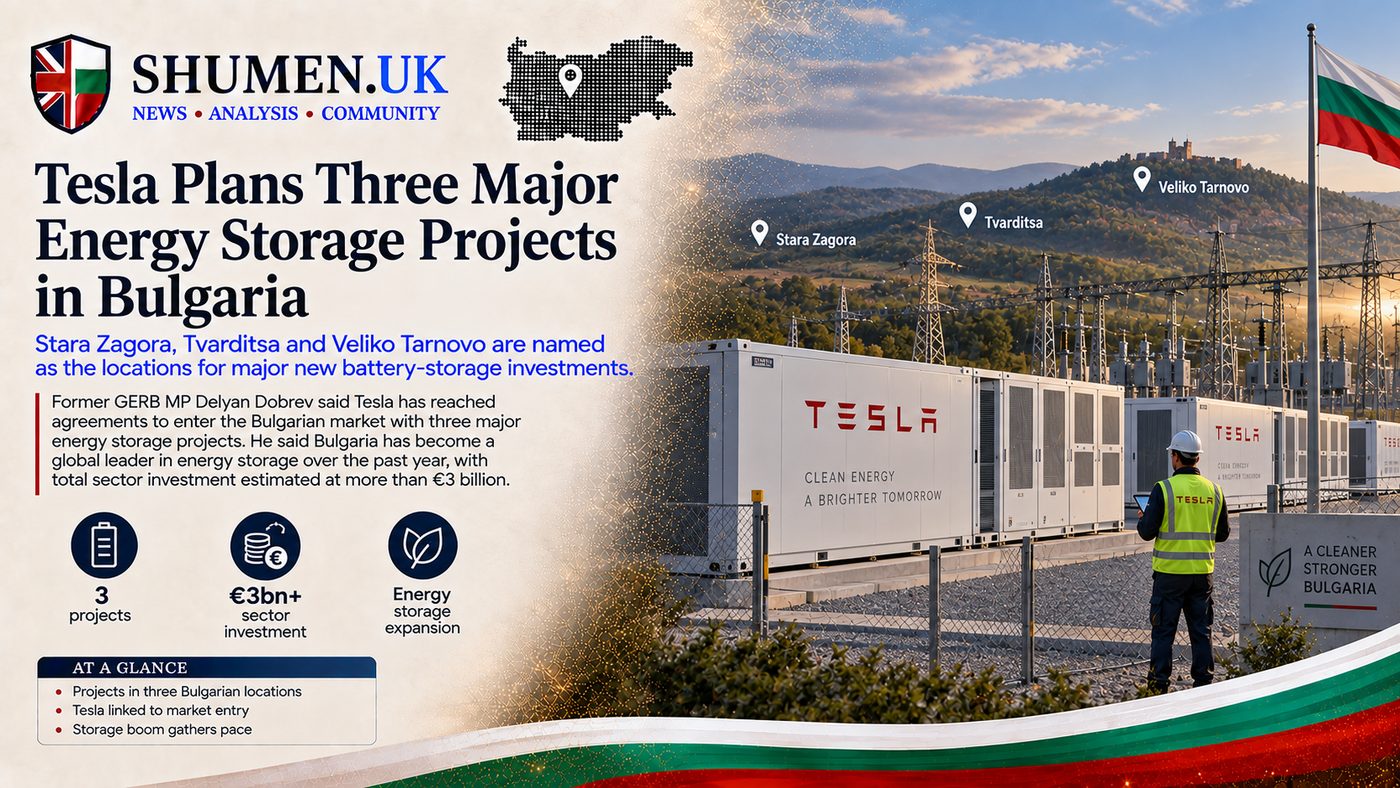
Former GERB MP Delyan Dobrev says agreements involving Tesla cover three large battery storage developments in Bulgaria, with locations in Veliko Tarnovo, Stara Zagora and Tvarditsa. His comments, reported on 14 September 2026, put a familiar company name behind an ambitious electricity story. They leave the household savings question open.
Speaking to Radio Focus, Dobrev argued that expanding storage could push regional electricity prices down, with a clearer effect over the following year. For British expats paying Bulgarian energy bills, that is a prospect worth understanding before adjusting the household budget.
Will Tesla's batteries bring the electricity bill down?
No reduction in your tariff has been established by this announcement. Dobrev's argument concerns the wider electricity market: buy power when prices are low, store it, then sell when demand and prices rise. That describes an opportunity for storage operators. It does not specify a saving for an individual customer.
The distinction is visible in Energo-Pro's tariff announcement effective from 1 July 2026. It gives regulator-approved household rates of €0.12927/kWh by day and €0.07733/kWh at night, both excluding VAT. Those are customer prices, rather than whatever electricity happens to fetch on the wholesale market at lunchtime.
For a household on those tariffs, compare the relevant day and night consumption lines on your invoice and check whether the figures you are comparing include VAT. Customers of another supplier should use that supplier's schedule. Our Bulgarian utilities guide explains the wider billing arrangements.
At a kitchen table in Shumen, the useful Tesla announcement would be a smaller number on the electricity bill. The brand name does not do the arithmetic.
Three locations, several missing particulars
Dobrev singled out Veliko Tarnovo for a development he expects to rank among Europe's biggest storage installations. That remains his assessment: the announcement gives no capacity with which to test the comparison. Stara Zagora and Tvarditsa are the other named locations.
The account also leaves Tesla's precise commercial role unclear. Supplying batteries, owning an installation and committing investment capital are different propositions. The reported agreements do not establish which arrangement applies at each location, and no Tesla statement accompanies the announcement.
For anyone living nearby, the next useful details are quite specific:
- The developer and exact site, so a place name can be connected to an actual proposal.
- The storage capacity, so claims about European scale have a measurable basis.
- The construction and operating dates, so an agreement can be distinguished from a working installation.
Dobrev gave a general battery-project construction estimate of six to 12 months. He did not attach a completion date to any of these three developments. Treating that estimate as a countdown from today's headline would get ahead of the announcement.
Bulgaria's battery programme predates this Tesla claim
There is substantial documented activity behind the broader storage story. On 17 April 2025, the Energy Ministry announced that 82 projects, representing 9,712.89 MWh of usable storage capacity, had been selected for funding through RESTORE. That was a funding-selection announcement, not proof that every installation was operating. Energy Ministry announcement.
The European Commission describes RESTORE as an investment backed by €603 million from the Recovery and Resilience Facility, intended to support renewable electricity and system stability. Its project description set a completion deadline of 30 June 2026; a deadline on a programme page does not establish what was actually delivered. European Commission project description.
Neither figure identifies the three developments Dobrev has now named as RESTORE beneficiaries. They provide context for Bulgaria's storage ambitions, rather than confirmation of Tesla's contracts.
There is also a small but relevant inconsistency in the headline investment claim. Novinite describes sector spending as more than €3 billion, while quoting Dobrev describing nearly €3 billion. It gives no reconciliation. Both formulations concern the wider sector, so neither should be read as the price tag for these three projects.
A separate check for a British-run business
If you run a workshop, shop or other business in Bulgaria, start with the supply contract for that premises. Ask the supplier to identify how the energy price is calculated, which charges sit alongside it, and when a change in market prices would reach your invoice. Get the explanation in writing before building a forecast around lower costs.
That is a practical question the investment announcement cannot answer. A household rate quoted in a news story is not a substitute for checking the terms attached to your business account.
Dobrev's central argument is that storage allows electricity generated at one time to be used or sold at another. He also acknowledged that batteries need generation to charge them. The potential is understandable. For customers, the next evidence that matters is equally concrete: operating projects, published tariffs and the price calculation on their own bill.