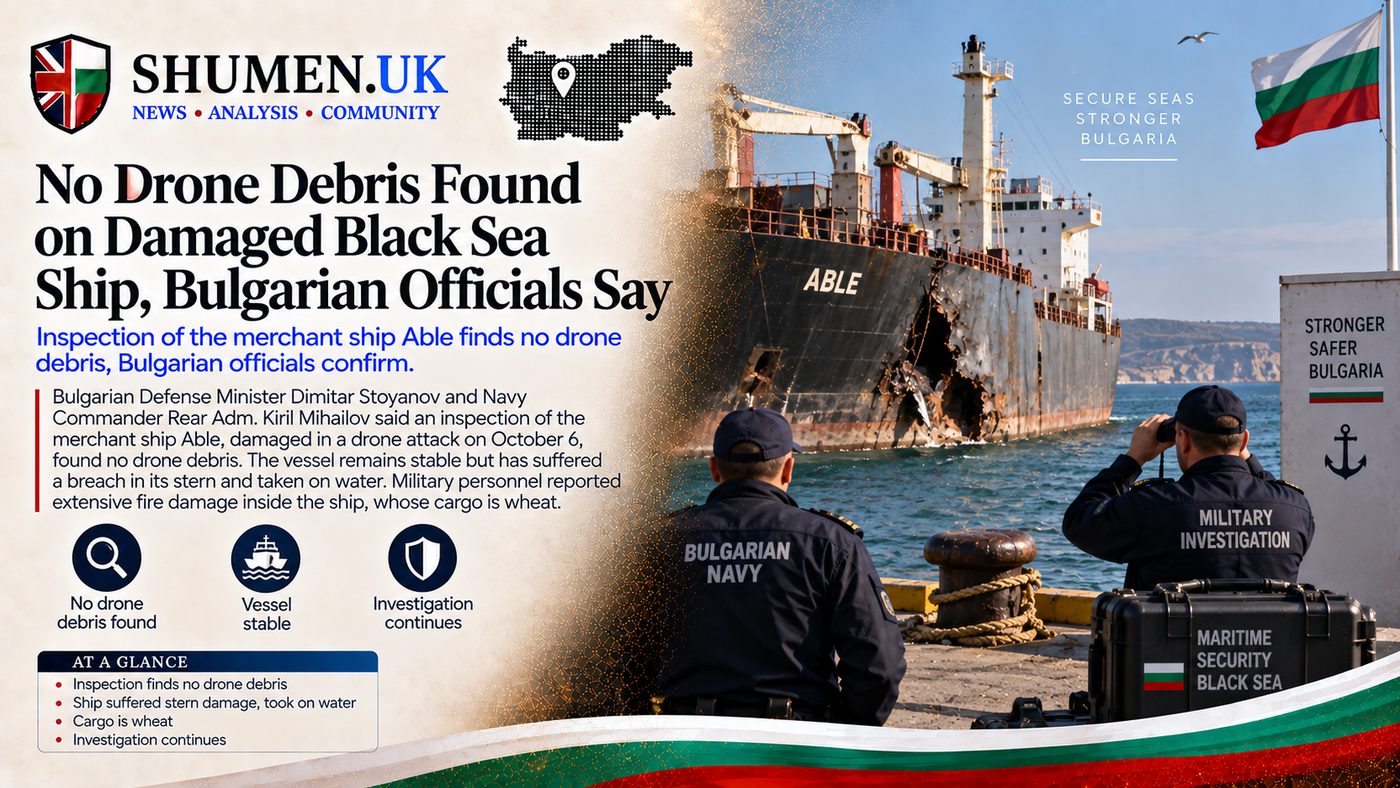
Bulgarian military inspectors who boarded the damaged merchant ship Able have found no drone debris, so nobody in authority can say whose drone struck it. Defence Minister Dimitar Stoyanov announced the result on Friday 9 October, alongside Navy Commander Rear Admiral Kiril Mihailov, three days after the vessel was hit overnight on 6 October in the Black Sea. Without physical evidence, Stoyanov said, there is no way to tell whether the weapon was Russian or Ukrainian.
Able is still afloat, though not in good shape. A breach at the back of the ship has let water in, the engine room is thought to be partly under water, and the hull sits tilted towards the stern with extensive fire damage inside. Mihailov said it is too early to say whether it will sink. The cargo is wheat, signs aboard suggest the crew got away in the ship's own emergency craft, and the inspectors found no pollution or spillage. The other vessel hit that night, the Alfa Watan, sank, and its crew has not been found.
Everyone Has a Theory, Nobody Has a Fragment
Prime Minister Rumen Radev praised the inspectors for a thorough search and said the various theories doing the rounds had no evidence behind them, so no firm conclusion about the attack was yet possible. Ukrainian President Volodymyr Zelensky has blamed Russian drones. Radev has called Russian involvement a hypothesis, and a Ukrainian origin equally so, and said after the Consultative Council for National Security met that Sofia and Kyiv had not been in contact about the attacks, according to Novinite's account of his remarks.
Elsewhere the theories have been more specific. GERB leader Boyko Borissov said in Petrich on 8 October that security-service reports shown to the Consultative Council indicated the sunken vessel may have been carrying people or troops, and asked President Iliana Yotova to declassify the relevant part of the transcript so the public could compare accounts. Novinite's report of his remarks carries no documents and no reply from the government or the security services. Captain Todor Georgiev, a shipping-agency owner, told bTV that talk of ships carrying weapons for Ukraine is speculation, arguing among other things that the insurance on such a cargo would cost more than the cargo was worth.
The Other Ship Sank, and Its Crew Is Still Missing
Friday's coverage centred on Able, but the people aboard the Alfa Watan are the part that matters most. Syria's borders and customs directorate says the crew numbered ten, nine Syrians and one Egyptian, and that nine Syrian sailors remain missing. Rumen Nikolov of the Maritime Administration said on Wednesday 7 October that none had been found and the search had been called off. Headcounts differ between outlets, from nine missing Syrians in some headlines to twelve missing sailors in others, so treat any single figure with care. Syria has asked Bulgaria and the International Maritime Organization for an independent investigation and wants to know why the search ended. Georgiev made a related point to bTV: seven days is the normal length of a search, he said.
Naming the weapon from the wreck will not be simple. Maritime.bg, as cited by Novinite, puts the Alfa Watan roughly 2,000 metres down, while the European Maritime Safety Agency (EMSA) can currently inspect to about 1,500 metres with remotely operated vehicles. The government says an underwater examination could be done with partners including EMSA and NATO. The European Commission is supplying Bulgaria and Romania with satellite data on the attacks, EMSA has offered to examine any recovered debris free of charge, and the frigate Verni has gone back to the site after a first deployment on Thursday 8 October. Foreign Minister Velislava Petrova said inspecting the site needs outside help, and that Bulgaria would summon the Russian ambassador if clear evidence showed Russia was responsible.
Is the Coast Covered? Two Officials, Two Answers
Mihailov offered reassurance and a warning in one sentence: “Our coast along the territorial lines is sufficiently protected, but the war is being fought in the Black Sea and is close to us”. More drones will come down in the water while Russia and Ukraine keep striking each other, he added, and the wind and sea currents may push some of them towards the coast. That same day the Navy destroyed a drone some 15 nautical miles (roughly 28 km) east of Sinemorets, on the southern coast.
Stoyanov was blunter: “There is no one to guarantee 100% protection”. Bulgaria has anti-drone systems, some built by Bulgarian firms, and expects more deliveries, he said, but drones are developing quicker than the defences against them.
The twelve-mile line on the chart means a great deal to a lawyer and very little to a drone. Bulgaria's territorial sea, where its sovereignty is fullest, reaches 12 nautical miles out, and the wider economic zone where the ships were hit stretches well beyond it. The Navy puts the vessels it is watching some 40 nautical miles out from the coast, while Novinite's earlier coverage placed the strike about 70 nautical miles east of Byala. Nothing published so far reconciles the two figures, though both are far outside the line. Nor is it explained how the second merchant vessel the Navy is watching, one its crew abandoned, relates to the Alfa Watan, which other coverage describes as sunk.
The drone traffic was building before this week. A Novinite editorial counts about 60 drone incidents on Bulgarian territory between January and August, including five drones washing up within 24 hours in late August; that is the editorial's tally, not an official one. Shumen.UK reported on one of them in August, when a drone exploded in a Dobrich sunflower field and, as Radev confirmed, neither Bulgarian nor Romanian radar had tracked it.
Sea Water, Washed-Up Objects and the Price of Freight
The Environment Ministry's Black Sea basin directorate in Varna took sea-water samples at three coastal sites on 6 October, including Byala and Sozopol, and found no petroleum products and no sheen on the surface. Nutrient readings at Byala and Sozopol exceeded thresholds, which directorate director Yavor Dimitrov put down to diffuse agricultural pollution rather than the ships; the ministry adds that Sozopol is about 150 km from the stricken vessels. Results for further substances are due next week and monitoring continues. For British expats living on the coast year-round, that is the headline. The footnote is Georgiev's claim to bTV that Bulgaria is not equipped to respond to an oil spill at sea.
Mihailov's warning that currents may deliver drones to the shoreline raises a question the reported remarks do not answer: what should anyone do on finding one? The sensible default for any unidentified object on a beach is to leave it alone, keep other people back and call 112, the free, round-the-clock emergency number. Our emergency services guide covers what to say when you call.
Then there is the shopping basket. Economists quoted by NOVA News and relayed by Novinite see no major shock yet, but flag the risk: Varna and Burgas handle about 20 million tonnes of goods a year, and if insurers class the Black Sea as a war-risk zone, higher costs could feed through to prices. Economist Kuzman Iliev says insurance premiums have doubled since August and warns that international firms could route around Bulgarian ports; Mikhail Krastev of the Union for Economic Initiative says maritime trade is still possible but far more dangerous. Neither was reported putting a euro figure on any price effect. Georgiev describes the region as becoming a dead zone for shipping, and Novinite reports that major Ukrainian and Russian ports remain closed. Anyone tracking household bills can set the freight story against the dated figures in our cost of living guide.
Zelensky's Chief of Staff Came to Sofia Quietly
The briefing also touched on a visit that was kept quiet at the time. Kyrylo Budanov, who is Zelensky's chief of staff, arrived in Sofia on 7 October, according to the Faktor website as cited by Novinite, and met Radev on 8 October. The Council of Ministers says Budanov asked for the meeting, that it was kept confidential on security grounds, and that he set out Ukraine's views on a possible peace settlement. Stoyanov says he never met Budanov and understands that only the prime minister did. Kostadin Kostadinov, leader of the Revival party, accused Radev and Yotova of hiding the visit. Radev used the moment to urge support for peace efforts, saying the war's social and economic price falls on Europe as a whole.
Budanov was due to join Ukraine's delegation for talks in the United States, where, Novinite reports citing Axios, one proposal would halt strikes on energy infrastructure and grain shipments. Ukraine is ready to accept it; Russia has shown little interest.
What to Watch Next
- More Environment Ministry sea-water results, due next week.
- Whether the Verni, with EU and NATO help, can survey the Alfa Watan wreck, and what it finds.
- The EU summit on 15-16 October, where a Novinite editorial says the Consultative Council wants the Black Sea moratorium proposal raised.
- A further Consultative Council meeting once expert assessments are in, which Borissov says Yotova has proposed.