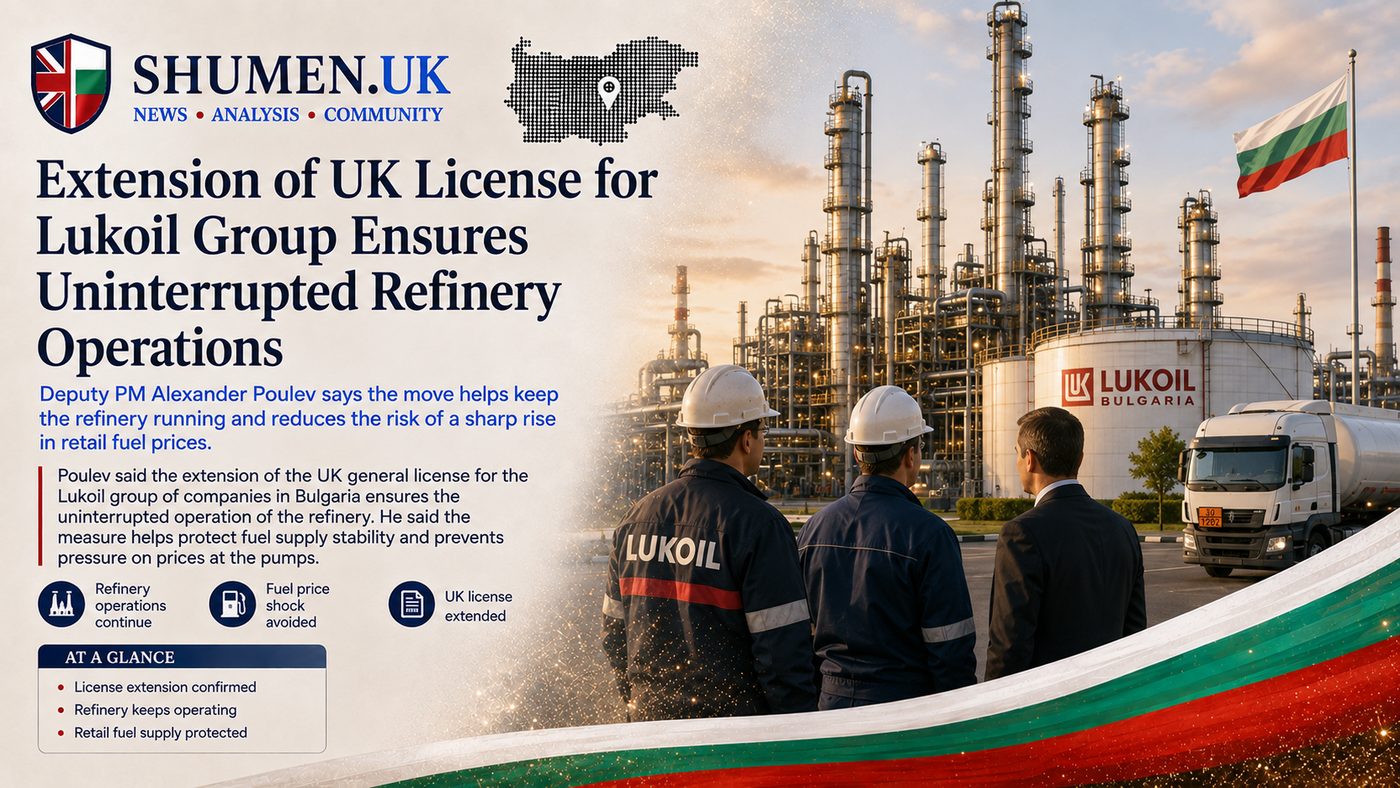
Bulgaria's largest industrial enterprise will keep running, for another eleven weeks at least. Deputy Prime Minister and Economy Minister Alexander Poulev said on Thursday 13 August that the extension of the UK general licence covering Lukoil's Bulgarian companies allows the Burgas refinery to continue operating and removes the immediate risk of a sharp jump in pump prices.
Speaking in Burgas alongside the special commercial administrator of Lukoil's Bulgarian group, Evgeni Simeonov, and Deputy Economy Minister Mihaela Karadimova, Poulev said that without the extension the refinery could have run into financial and operational difficulties serious enough to push retail fuel prices up. BTA reported separately on 12 August that the extended licence runs until 29 October.
Poulev described the risk in blunt terms. The government, he said, had only a few days to stabilise the refinery, and the prospect of petrol stations being unable to operate, with shortages following, was real.
Four Clocks, and None of Them Line Up
What triggered the scramble was a court ruling, not a sanction. Poulev said the Constitutional Court's decision striking down the 2025 amendments to the so-called Lukoil law took effect on 4 August, which created the risk that the refinery would no longer comply with the sanctions regimes applying to it, and therefore might have to stop.
Line up the dates the government is now working to and the picture is less settled than the reassurance suggests:
- The Constitutional Court ruling has been in force since 4 August.
- The UK licence now runs to 29 October.
- Crude supply is another matter again: BTA reported on 13 August that Lukoil Neftochim Burgas has secured oil supplies through September, with negotiations underway for October.
- The American licence is not settled at all. Poulev tied the UK extension directly to the opening of talks with US partners about renewing their own.
Poulev was explicit that this is the problem he is trying to solve. Bulgaria's aim, he said, is to synchronise the periods covered by the exemptions and licences issued by Sofia, London and Washington, so the country is not running several uncoordinated negotiations at once. He said the government is in constant dialogue with its partners and goes through the outstanding issues weekly.
That is a candid description of a refinery running on rolling short-term permissions from three different capitals. It is also the reason to treat "uninterrupted operation" as a statement about the next few weeks rather than a settled position.
What Is Actually at Stake in Burgas
Lukoil Neftohim Burgas is one of the largest oil refineries in the Balkans and the largest industrial enterprise in Bulgaria, with capacity to process around 7 million tonnes of crude a year. It employed 1,348 people as of 2019 and has been in Lukoil's hands since 1999.
It has also spent three years being pulled away from Russian oil. Bulgaria fined the operator €100 million for abuse of a dominant market position in April 2023, ended the oil terminal concession that August, imposed a punitive 60% tax rate in October 2023, and from January 2024 the refinery switched to crude from Kazakhstan, Iraq and Tunisia. The plant that the government spent a few days in August keeping open is therefore not the same plant, in supply terms, that it was in 2022.
Why This Reaches Your Pump
For anyone living here and running a car, this is the story behind the number on the forecourt sign. The government's own case for the extension is that the alternative was higher retail prices and possible shortages, which is as clear a statement as you will get that the Burgas plant sits underneath what Bulgarian drivers pay.
Nothing changes at the pump this month as a result of Thursday's announcement. The dates above are the ones worth keeping half an eye on: late September for the crude contracts, 29 October for the UK licence, and whenever the American talks produce something. If you are budgeting a year of fuel, or costing up a move that involves a long weekly commute, that is the horizon you are actually planning against, not a stable one. The cost of living tracker follows fuel and household prices as official figures land, and our guide to running a car in Bulgaria covers the rest of what a vehicle costs here.
Poulev said the government would do everything it could to bring fuel prices back to historical levels, provided there are no fresh geopolitical shocks. That is an aspiration with a large caveat attached, and it is his, not a forecast anyone has published.
The forecourt on the road out of any Bulgarian city looked the same on Thursday morning as it did a month ago. The legal scaffolding holding it up has been rebuilt twice since.
The Ownership Question Sofia Does Not Control
Asked about a possible sale of Lukoil's Bulgarian assets, Poulev was careful. The refinery formally remains Russian-owned. There is information about talks involving strategic investors, partners and consortia, he said, but those are being conducted at holding-company level in Russia. Bulgaria's assets form part of the wider deal under discussion, and Bulgaria is not an active participant in the negotiations.
Recent history explains why he was hedging. The United States imposed further sanctions on Lukoil on 22 October 2025. The following month the commodities trader Gunvor bid around $22 billion for Lukoil's international holdings, a package that included the Bulgarian and Romanian refineries and its European filling stations. The US Treasury blocked it, called Gunvor a "Kremlin's puppet" and said no licence would be issued while Russia's invasion of Ukraine continued. Gunvor withdrew.
So the question of who ends up owning the plant that supplies Bulgarian forecourts is being settled in Moscow and Washington, with Sofia managing the consequences. Poulev said Bulgaria is acting under established procedures while respecting private property and protecting both the national interest and the interests of Bulgarian consumers. If the Russian owners take a strategic decision, and Bulgaria's partners approve it, and separate talks on the Bulgarian assets follow, he said the government will take that into account.
Three conditionals in one sentence is a fair summary of where this stands.