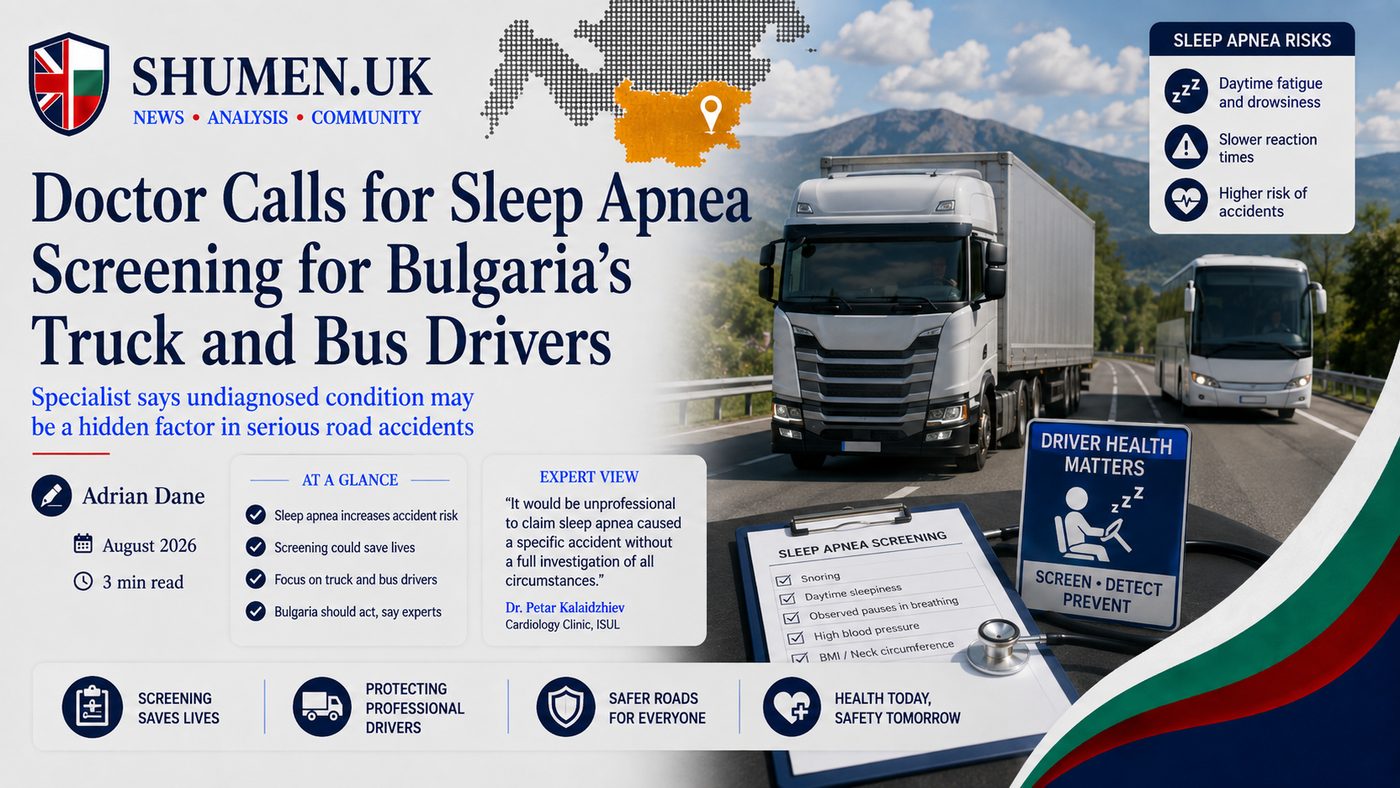
A Bulgarian cardiologist has called for mandatory sleep apnoea screening for the country's lorry and bus drivers, arguing that a common, treatable and largely undiagnosed condition is being left out of the medical checks professional drivers already sit.
Dr Petar Kalaidzhiev, of the cardiology clinic at University Hospital "Tsarina Ioanna, ISUL", told Novinite that undiagnosed obstructive sleep apnoea may be a preventable risk factor behind some serious road accidents, particularly those involving professional drivers. He was careful about how far he pushed that. It would be unprofessional, he said, to claim apnoea caused any specific crash without a full investigation of everything around it: the state of the vehicle, the road conditions, the driver's health. His actual question is narrower and harder to wave away. Are the authorities overlooking a risk factor that can be detected and treated?
"Obstructive sleep apnoea is not just snoring," Kalaidzhiev said. "It is a disease in which breathing stops repeatedly during sleep. The patient is often unaware of this, but in practice fails to get full and restorative sleep." People with the condition can wake up feeling more or less fine and still drive with slower reactions, reduced concentration and a raised risk of nodding off briefly on a monotonous road. Long hours, shift patterns and sleeping in a different bed every night put professional drivers near the top of the risk list, and obesity, high blood pressure and diabetes push it higher still. Anyone who has spent an hour stuck behind a lorry on the Hemus knows the exact kind of monotony he means.
The Screening He Is Asking For Is The Cheap Part
Kalaidzhiev is not proposing that every lorry driver in Bulgaria be sent for an expensive night in a sleep lab. His suggestion is that the existing medical examination for professional drivers should include a short screening step: an established questionnaire such as STOP-Bang or the Epworth Sleepiness Scale, plus an assessment of the main risk factors. Only drivers flagged as high risk would go on to a sleep medicine specialist for respiratory polygraphy or polysomnography.
He was explicit that the point is not to strip anyone of a licence. "Today we have easy and validated screening questionnaires, and if necessary, the diagnosis can be confirmed through respiratory polygraphy or polysomnography. Most importantly, this is a disease that can be successfully treated," he said. Treating it, he argues, improves sleep quality, cuts fatigue and lowers the risk of hypertension, heart rhythm disorders, stroke and heart failure, on top of whatever it does for road safety.
Bulgaria Already Has The Rule. What It Lacks Is The Machinery
This is the part the original report left implicit. Bulgaria is not missing a law here. Commission Directive 2014/85/EU, adopted on 1 July 2014 and applicable in member states from the end of 2015, added obstructive sleep apnoea to the EU's driving licence fitness annex. It defines moderate OSAS as an apnoea-hypopnoea index of 15 to 29 and severe as 30 or more, requires drivers suspected of either to be referred for authorised medical advice before a licence is issued or renewed, and sets periodic medical review at intervals of no more than three years for ordinary car and motorcycle licences and one year for lorry and bus licences.
Bulgaria went further than the directive when it transposed it. A 2025 survey of national driving regulations across the EU, published in the European Respiratory Journal by Walter McNicholas and colleagues, found that Bulgaria and Greece are the two countries that set the bar at an apnoea-hypopnoea index of 5 or more with daytime sleepiness, rather than the directive's 15. On paper, that is among the strictest thresholds in Europe.
And yet, as Kalaidzhiev describes it, there is no nationwide screening policy, no clear rules for bringing sleep specialists into driver assessments and no broad access to diagnosis or treatment. Sleep medicine has grown here and has a recognised medical standard, but the system has no reliable way of finding the drivers its own rulebook would disqualify. The same European Respiratory Journal survey found that most countries report problems implementing their national rules, including inadequate resources to diagnose and treat patients, and under-reporting of symptoms by patients, professional drivers especially, who worry about losing their licence. A strict threshold that nobody is measured against is not a safeguard.
The Bill Lands On The Patient
Here is the detail with the sharpest edge for anyone living here. The National Health Insurance Fund covers neither the diagnosis nor the treatment of obstructive sleep apnoea. Respiratory polygraphy, polysomnography and CPAP therapy, which is the international standard treatment, are all paid for by the patient. Kalaidzhiev's view is that the lack of cover pushes people into delayed diagnosis or no treatment at all, which is a health risk before it is ever a road one.
British expats should read that as applying to them in full. If you are here on an S1, issued because you draw a UK State Pension or an exportable benefit, it entitles you to healthcare in Bulgaria on the same basis as a Bulgarian citizen. That is the point people miss: the S1 buys you into the Bulgarian package, not a portable version of the NHS one. If the fund does not cover apnoea diagnosis and CPAP for a Bulgarian, it does not cover it for you either. Our Brexit and paperwork guide covers what the S1 does and does not carry across, and the health guide has the wider picture on what you pay for at the point of use.
The practical consequence is that this is a budgeting question rather than an entitlement one. A sleep study and a CPAP machine are private purchases in Bulgaria, and a private health policy may or may not include them, which is worth checking before you need to know.
If You Drive Here On A UK Licence
The duty to declare follows the licence, not the address. The DVLA must be told if you have confirmed moderate or severe obstructive sleep apnoea syndrome with excessive sleepiness, or mild OSAS with excessive sleepiness lasting three months or more. You must not drive until the sleepiness has gone or your symptoms are controlled and you are sticking to the treatment. Car and motorcycle licence holders report it online or on form SL1; bus, coach and lorry holders use SL1V. Failing to declare a medical condition that affects your driving carries a fine of up to £1,000, and prosecution if you have an accident as a result.
Exchange that licence for a Bulgarian one and you move onto Bulgaria's rules, with the stricter written threshold and the thinner screening behind it. Our driving guide walks through the exchange itself.
For scale on the underlying problem, the Interior Ministry's provisional figures put 219 deaths on Bulgaria's roads in the first half of 2026, 32 more than the same period a year earlier, across 3,032 accidents involving death or injury, with 3,759 people seriously hurt. Nobody has attributed any part of that to sleep apnoea, and Kalaidzhiev conspicuously declined to. The argument he is making is the reverse one: that a treatable condition sits in the risk pool untested, and the cost of finding it is a questionnaire.
Whether the health ministry or the transport authorities intend to do anything about it is not clear. No legislative proposal has been announced, and Kalaidzhiev did not point to one.