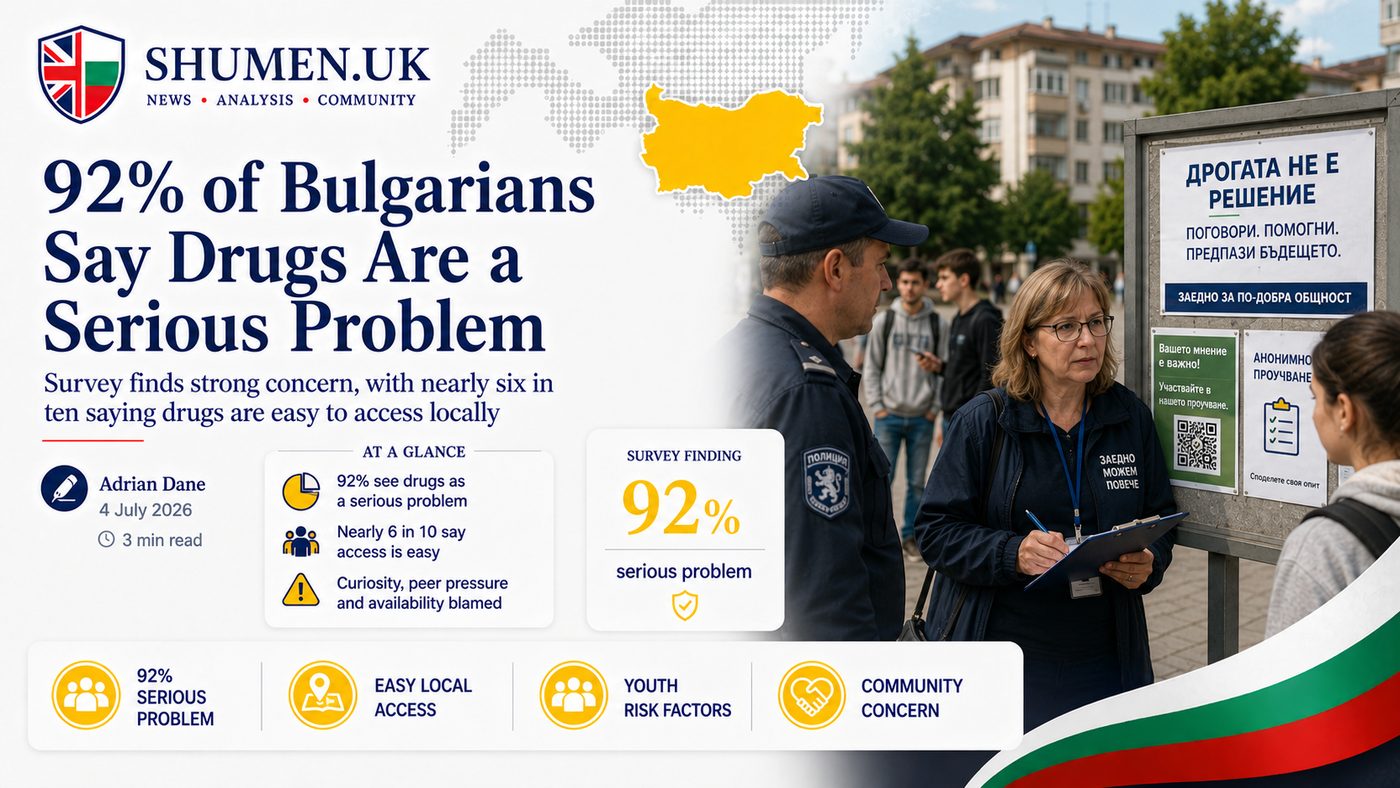
Bulgarians overwhelmingly regard drug use as a serious problem for the country, according to new polling from the Trend agency, reported by BTA: up to 92% of respondents rate it a serious issue, and roughly one respondent in three goes further, rating the problem very serious. Behind the headline number sits an equally striking one about supply: nearly six in ten believe drugs are easily accessible where they live.
The fieldwork is recent and conventional: 1,000 adults, interviewed in person nationwide between 9 and 15 June 2026.
How Close to Home It Gets
What lifts this beyond an abstract worry is how many people report personal proximity. More than 40% report knowing someone who has taken drugs or still does, and close to half count at least one affected person in their circle. The breakdown is telling: for 2% it is close family, for 7% a colleague or classmate, and for 11% a friend or casual acquaintance, with exposure running noticeably higher among people under 30.
'Nearly six out of ten believe that there is easy access to drugs in their locality,' the survey notes. Ask around any kafene and you will hear the same conviction delivered as settled fact; Trend has now put a number on it.
What Bulgarians Blame, and What They Want Done
Asked why young people take drugs, respondents most often point to curiosity and experimentation (50%), followed by peer pressure (42%), easy availability (39%) and a lack of parental control (37%).
On responses, the public mood is firmly for enforcement over other approaches. Stiffer sentences for dealers draw 65% support and tighter control of the supply chain 64%, while 45% want more police around schools and other risk points.
Reading It as a Survey, Not a Census
One honest caveat belongs next to every figure above: this is a perception study. It measures what 1,000 adults believe about drugs, not how much is actually consumed or seized; the six-in-ten figure on easy access records a conviction, not a test purchase. That does not make it unimportant, public perception is what shifts policy, but the survey offers no measurement of actual drug prevalence, and it did not report comparisons with earlier years. Where the source leaves those questions open, so does this article.
What This Means for British Expats
For British expats raising children in Bulgaria, the findings worth sitting with are the two about proximity: exposure is most common among the under-30s, and a majority of adults believe supply is easy to come by locally. Neither should induce panic, and neither says anything about your particular town, but they are a reasonable prompt for the same conversations parents would be having in the UK. On schools, the survey records the wish, not a plan: 45% of respondents want a more visible police presence around them. Our education guide covers how Bulgarian schools work day to day.
And the political read is short: when nearly two thirds of the country wants tougher penalties for dealers, parties will notice. Whether that hardens into legislation is not something the survey can say.