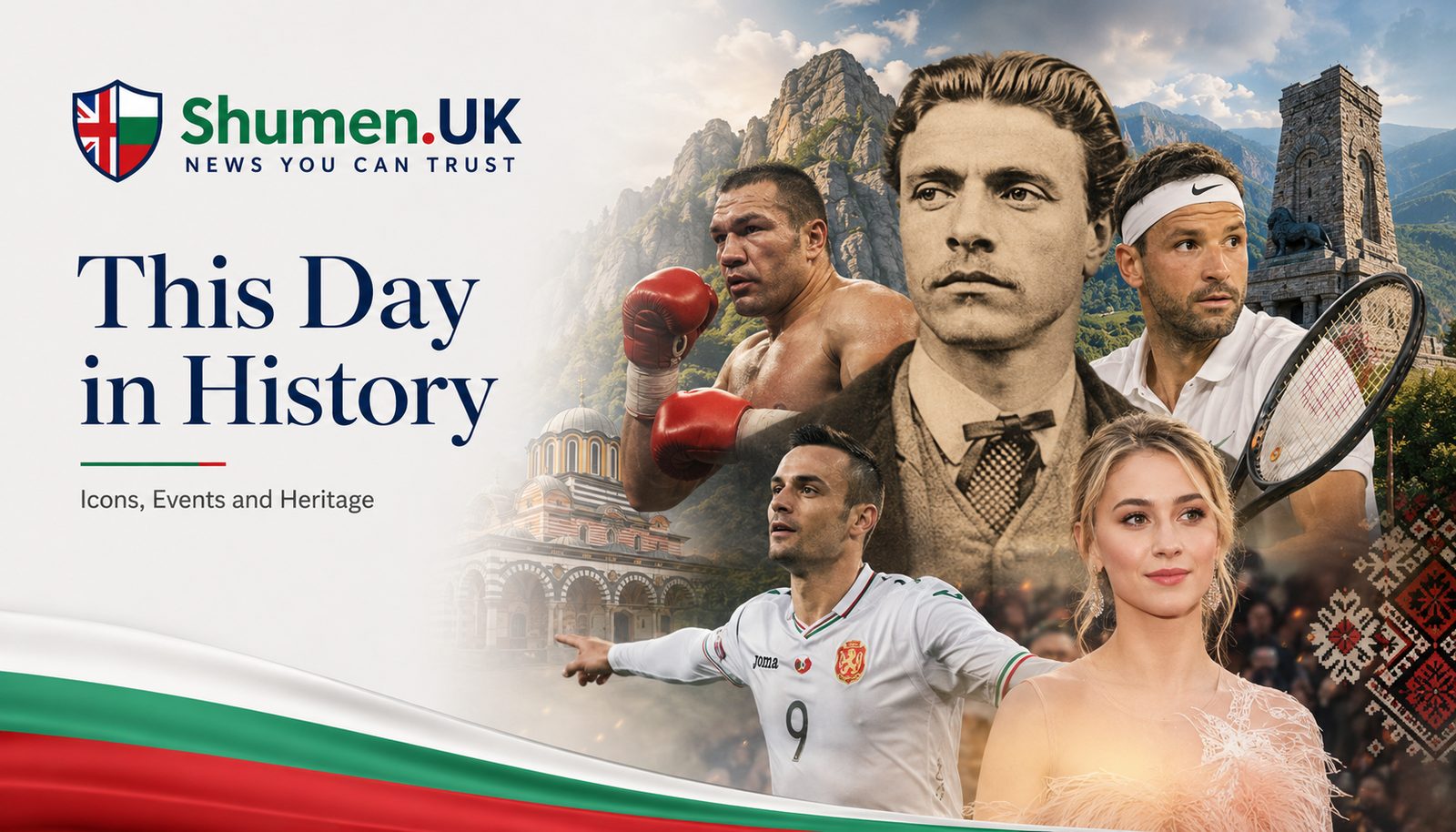
If you learn one Bulgarian name, learn this one. Vasil Levski is not merely a national hero here; in 2007 the country voted him, by some distance, the greatest Bulgarian who ever lived, ahead of every tsar, saint and poet. He was born on this date in 1837, in the rose-growing town of Karlovo, and the way Bulgarians talk about him is closer to reverence than to admiration.
What happened on this day
He was born Vasil Ivanov Kunchev; the name Levski, from lev, the lion, came later. He trained for the church and briefly became a monk, then walked away from all of it to give himself to a single idea: that Bulgaria, after nearly five centuries under Ottoman rule, should free itself. Where others wanted to march in an army from outside, Levski built something harder and more lasting from within, a clandestine Internal Revolutionary Organisation, a web of secret committees threaded through towns and villages the length of the country, all quietly preparing for one coordinated rising.
What lifts him above an ordinary freedom-fighter is what he wanted to build. Levski's Bulgaria was to be a democratic republic, and a strikingly generous one for its day. 'People of whatever ethnicity live in this heaven of ours,' he wrote, 'they will be equal in rights to the Bulgarian in everything.' Turk, Jew, Bulgarian, all equal. He was describing a country that did not exist, and would not for a long time.
He never saw any of it. Betrayed and captured at the Kakrina inn in December 1872, he was tried in Sofia and hanged there on 18 February 1873, aged just thirty-five, five years before the liberation his committees helped make possible. A monument now stands on the spot in Sofia where the gallows once did. Bulgarians still leave flowers at it.
Today's name days
Today is also a quieter name day, for Emil, Emilia and Emilian. The name traces back to the Roman Aemilius, and the day honours St Emilian, an early martyr of the Bulgarian lands. If you know an Emil, the usual courtesies apply: a Bulgarian name day is an open house, you drop in without an invitation and never empty-handed, a cake or a bottle in hand. Say chestit imen den, happy name day.
Towns celebrating today
Two places mark the day for Levski's sake. The first is Karlovo itself, his birthplace, a handsome town of around 19,000 in the Valley of the Roses at the southern foot of the Balkan mountains, as famous for the rose oil that ends up in the world's perfumes as for its most celebrated son. His childhood home is now the Vasil Levski National Museum, taking in his house, an exhibition hall and a memorial chapel, and every year on the evening of 18 July the town sends up a fireworks display in his honour. The second is the village of Levski, in the Panagyurishte hills, one of a number of places across Bulgaria that carry his adopted name and celebrate today.
Why this matters for British expats
You cannot spend long here without meeting Levski, even before you realise it. His name is on the national football stadium in Sofia, on one of the country's two great football clubs, on a military university, and on a street in very nearly every town in Bulgaria, Shumen included. Once you know the face, the stern young man with the neat beard, you start noticing his bust in school yards and town squares wherever you go.
But the deeper reason to know him is what he stood for. In a corner of the world too often defined by which group was doing what to which other, Levski, back in the 1860s, was quietly insisting that a free Bulgaria must belong equally to everyone who lived in it. He was executed for a country he never got to see. When your Bulgarian neighbours speak about him with that particular softness in the voice, this is what they are remembering: not only a man who died for freedom, but one who had an unusually decent idea of what freedom was for.
Sources and further reading
The account of Levski's life and death draws on his English and Bulgarian Wikipedia biographies. Karlovo's rose valley, its Levski museum and the 18 July fireworks are set out on the town's English Wikipedia entry.