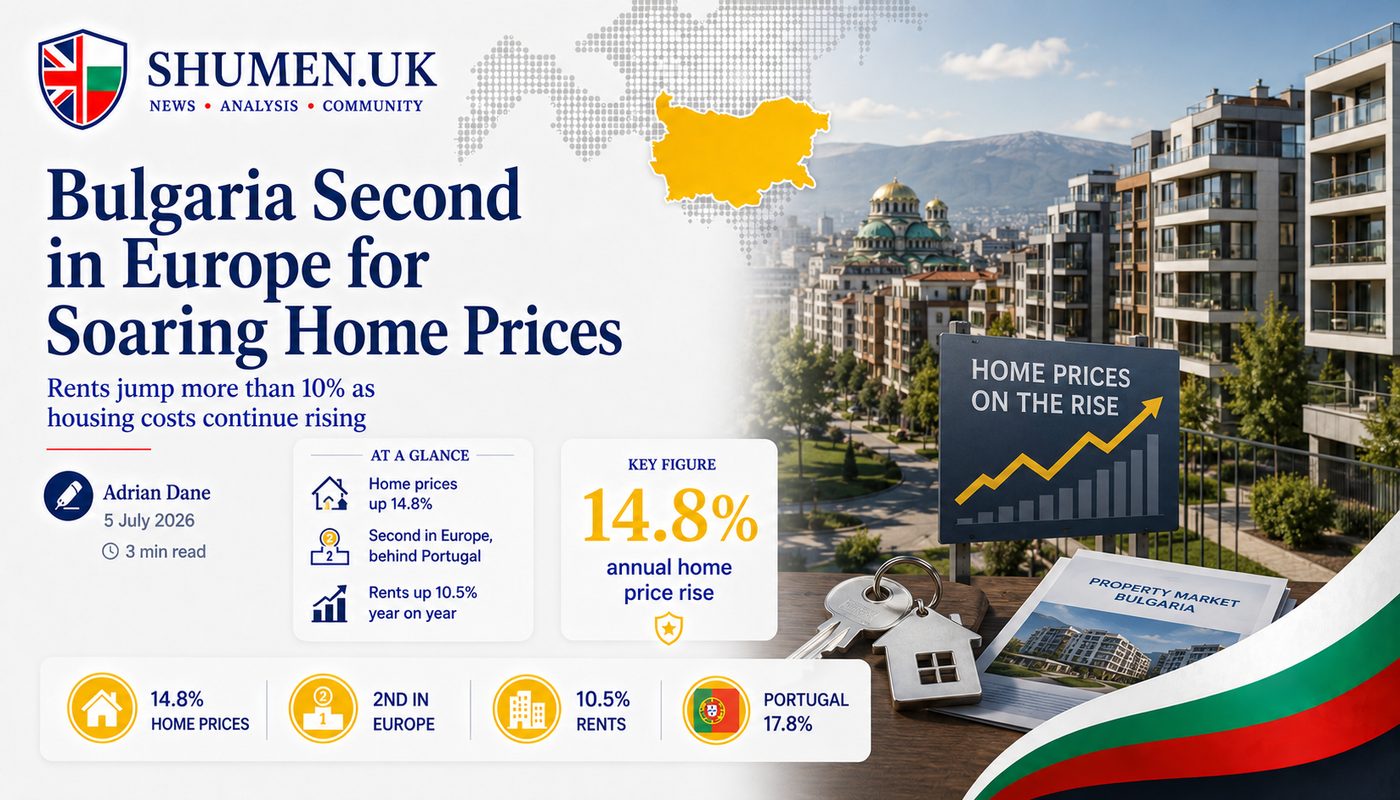
Bulgarian house prices rose 14.8% in the year to the first quarter of 2026, the second-steepest climb anywhere in the European Union, according to Eurostat. Only Portugal, at 17.8%, rose faster. Rents kept pace in their own way, up 10.5% over the same period, a rate beaten only by Croatia. Both numbers sit far above the European average, and both matter directly to anyone who is buying, selling or renting a home in Bulgaria right now.
The figures are the latest confirmation of something British expats here have watched happen in slow motion: the old idea of Bulgaria as a place where property is an afterthought purchase, bought with the loose change from a UK house sale, is steadily becoming untrue. Anyone who has watched the asking prices in a Shumen estate agent's window drift upward over the past couple of years already had the gist. Eurostat has now put a figure on it.
Where Bulgaria sits in the table
Strip out the league-table drama and the comparison is what tells the story. Across the EU as a whole, Eurostat recorded house prices up 5.1% and rents up 3.0% year-on-year, against bloc-wide inflation of 2.3%. In the euro area the price rise was gentler still, at 4.7%. Set Bulgaria's 14.8% against that 5.1% average and the country is running at close to three times the European pace, and roughly ten percentage points ahead of its own inflation rate.
On prices, the order at the top was:
- Portugal, up 17.8%
- Bulgaria, up 14.8%
- Slovakia, up 14.4%
- Croatia, up 14.3%
Spain, Lithuania, Hungary, Latvia and the Czech Republic also posted double-digit rises. At the other end, German prices barely moved (up 1.4%), France was flat (0.1%), and Finland was the only EU country where homes actually got cheaper, down 2%.
On rents, Croatia's 39.1% surge is in a category of its own, but Bulgaria's 10.5% still put it second, ahead of Iceland and Romania (both 8.4%) and Greece (8.1%).
What it means if you are buying
The practical consequence is simple and slightly uncomfortable: a property that would have cost you a given sum a year ago costs, on average, close to a seventh more today. The bargain framing that pulled a lot of people towards Bulgaria in the first place is wearing thin, and budgeting on last decade's prices is a good way to get a nasty surprise at the notary. Our guide to buying property in Bulgaria walks through the actual process and costs.
One important caveat the headline number hides: Eurostat's index is national. It blends Sofia, the coast and every quiet inland town into a single figure, and the market is not remotely uniform. A 14.8% national rise does not mean a village house near Shumen went up 14.8%; the heat is concentrated in the places where demand is strongest. Treat the number as the direction of travel, not a valuation of your street.
What it means if you are renting
The rent figure is the one the source rather buries behind Croatia's headline, and it is arguably the more relevant of the two for our readers. Not every Brit in Bulgaria is a mortgage-free retiree who bought outright; plenty rent, and plenty work here on Bulgarian wages rather than a UK pension. A 10.5% annual rise means a tenancy coming up for renewal now can reasonably expect a double-digit increase, and there is no UK-style framework here to soften that. Our renting guide covers what a Bulgarian tenancy agreement should and should not contain.
Why prices keep climbing
Eurostat does not editorialise, but the analysts cited alongside the data point to the same three causes seen across much of Europe: expensive construction, a shortage of newly built homes, and demand that simply refuses to cool. In markets like Bulgaria, where that demand stays strong, those pressures keep feeding through to both prices and rents. There is nothing uniquely Bulgarian in the mechanism; what is notable is how far above the European average the result has landed.
The wider point for anyone weighing a move is that this is not a one-quarter blip. Bulgaria has been running well ahead of EU inflation on housing for some time, and the gap between what a home costs here and what it costs in Western Europe, though still real, is narrowing year on year. It remains cheaper in absolute terms than the UK; it is no longer the giveaway it was once sold as. Our cost of living guide keeps the broader numbers in one place.
Sources and further reading
The figures come from Eurostat's Q1 2026 house price and rent release, as reported by Novinite and corroborated by Bulgarian National Radio, Euronews and Eurostat's own news bulletin.