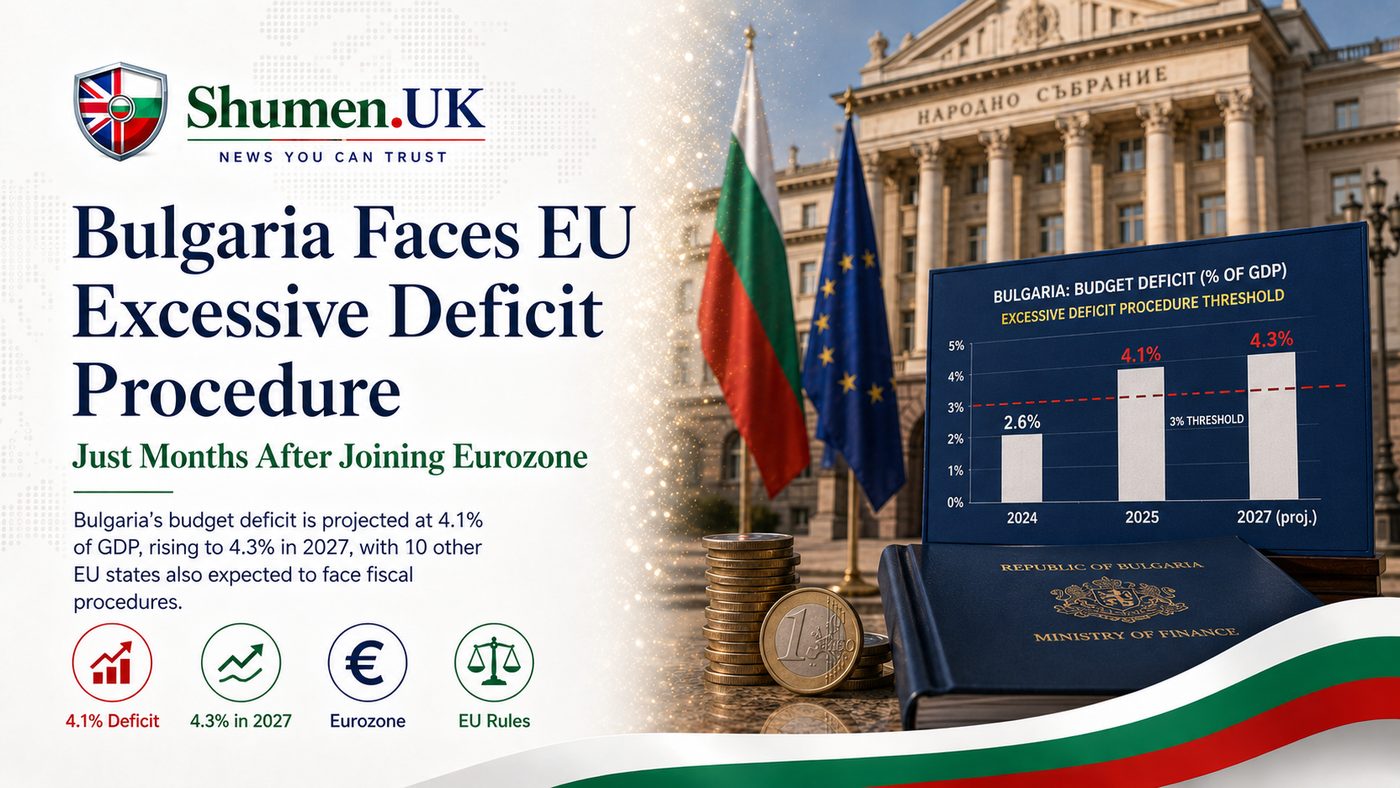
Bulgaria is heading for an EU excessive deficit procedure, according to reports in the Financial Times and confirmed by Bulgarian officials. The European Commission is expected to launch the procedure within days, placing Bulgaria under closer fiscal scrutiny just five months after the country joined the eurozone on 1 January 2026.
The Commission forecasts Bulgaria's budget deficit will reach 4.1% of GDP this year, rising further to 4.3% in 2027. Both figures exceed the EU's 3% limit. The procedure would require Bulgaria to bring spending back into line with EU budgetary rules, potentially forcing unpopular fiscal adjustments.
If you've been following the post-euro optimism in Sofia's business press, this is where the champagne goes flat. Bulgaria was supposed to have entered the eurozone with its fiscal house in order. Instead, Brussels is preparing the paperwork before the country has completed its first year in the single currency.
What the Excessive Deficit Procedure Means
An excessive deficit procedure is the EU's enforcement mechanism when member states breach fiscal rules. Under the process, Brussels monitors the country's budget more closely and can impose corrective measures. The timing is awkward: Bulgaria adopted the euro in January 2026, and the procedure arrives before the ink has dried on the convergence certificates.
Prime Minister Rumen Radev warned publicly this week that Bulgaria risks entering the procedure, calling it a development that could lead to increased oversight in the coming years. Petar Vitanov, MP from Progressive Bulgaria, stated that Bulgaria has officially entered the procedure and that urgent fiscal measures are required. Former Finance Minister Georgi Klisurski, now Deputy Mayor of Sofia, disputes this, arguing Bulgaria is not yet subject to the procedure and can still avoid it if the government acts.
The conflicting statements reflect political uncertainty. No EU document has yet confirmed the formal start date or specific terms, though the Commission's assessment is expected in early June 2026.
What This Means for British Expats in Bulgaria
British expats with businesses or investments in Bulgaria should note the increased fiscal scrutiny. Tighter budgets can affect public procurement, infrastructure projects and economic stability. For expats managing pensions, savings or property income in Bulgaria, the procedure itself does not directly change tax rates or residency rules, but fiscal adjustments announced later could.
Anyone with leva-denominated savings converted those to euros in January 2026 at the fixed rate of 1 EUR = 1.95583 BGN. The excessive deficit procedure does not reverse euro adoption, but it does signal that Bulgaria's fiscal position entering the eurozone was weaker than the convergence criteria suggested.
The practical impact depends on which measures the government chooses. Spending cuts could affect public services, tax rises could increase the cost of living. Neither has been announced yet, and the political debate over how to respond is ongoing. For British expats, the fiscal squeeze arrives at an inconvenient moment. Bulgaria's first year in the eurozone was supposed to validate the country's economic convergence with the rest of the EU. Instead, Brussels is about to put it under stricter oversight.
Bulgaria Not Alone
Bulgaria is one of eleven EU countries expected to face procedures for breaching fiscal requirements. Italy, Romania and Finland are also on the list. Malta, by contrast, reduced its deficit to 2.2% and exited monitoring, showing the procedure can be reversed with sustained fiscal discipline.
The European Commission's spring forecast, published 21 May 2026, cut Bulgaria's GDP growth forecast to 2.5% for 2026 and flagged rising inflation alongside the worsening deficit. The figures underpin the case for the procedure.
What Happens Next
The Commission is expected to publish its formal assessment in early June 2026. If the procedure is confirmed, Bulgaria will be required to submit a fiscal consolidation plan outlining how it intends to bring the deficit below 3%. The government will face pressure to cut spending, raise revenue, or both.
For British expats in Bulgaria, what started as a success story about eurozone convergence is turning into a fiscal squeeze before the first year is out. The queue of drivers at the Shumen petrol station this week serves as a quiet reminder that rising fiscal pressures are biting into everyday wallets, and the formal EU paperwork is now catching up with what locals have already started to feel.