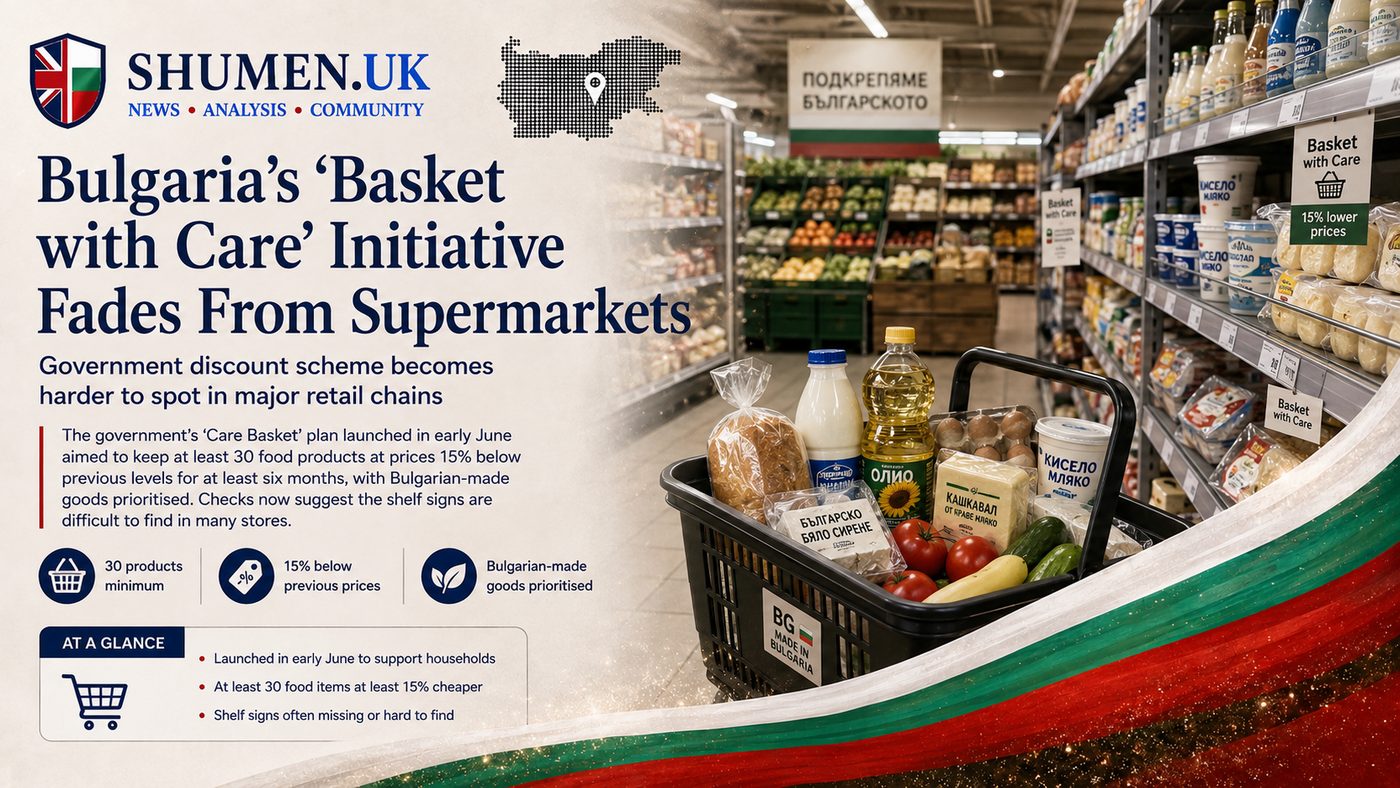
The government's "Basket with Care" scheme has largely disappeared from Bulgarian supermarkets, two months after it was announced with some fanfare. Checks by the newspaper Sega at the major chains found the signs that identify products in the programme now hard to find, and in some outlets that had publicly signed up, absent altogether.
The deal, struck in early June between the Progressive Bulgaria government and the retail chains, was that each would carry at least 30 food products at prices at least 15% below their previous levels, for at least six months, with Bulgarian-made goods given priority. The pitch was that this was not another week-long promotion but a durable cut, something you could plan a shop around into the winter.
Agriculture Minister Plamen Abrovski and Progressive Bulgaria lawmakers are still presenting it as a success, and still linking it to the easing of food inflation. The shelves are telling a slightly different story.
The Signs Went. The Red Labels Never Moved.
What has not thinned out is ordinary promotional signage. The chains continue to paper the aisles with red discount labels, frequently at reductions considerably deeper than the 15% the government scheme required. Walk into any of the big stores on a weekday and the wall of red is exactly where it always was, which is rather the point: a chain already discounting more deeply than 15% on its own weekly promotions has little reason to keep advertising the commitment it signed in June.
There is a gap in the scheme that explains a lot of the rest. Fruit and vegetables were excluded from it entirely, and those are among the products bought most frequently. A basket that covers dry goods but skips the tomatoes and the peppers is not a basket anyone plans a shop around.
One retailer published its own study of which cheaper-basket products customers actually bought most. The answer was granulated sugar, sunflower oil and bread. That is a store cupboard, not a trolley.
The practical conclusion for anyone shopping here is not to hunt for a sign. Compare the price per kilo or per litre on the shelf edge and take whichever number is lower on the day, scheme or no scheme. Our supermarket guide covers how the chains differ on own-brand ranges and where the real savings sit, and none of that changed because a sign came down.
What the Inflation Figures Actually Show
The claim that the basket eased food inflation deserves the numbers next to it. National Statistical Institute data show prices for food and non-alcoholic beverages fell 1.9% in June against May, with annual inflation in that category at 2.4%. Overall inflation was running considerably higher at 5.4%, driven mainly by transport, restaurants and hotels.
Neither the ministry nor the reporting establishes that the scheme caused the fall. What the figures do show is that food is currently the calm part of the basket and the pressure has moved elsewhere, which matters if you are British and living here, because it decides whose inflation you are actually experiencing. A household that cooks at home most nights is closer to the 2.4%. A household that runs a car for a long commute and eats out at the weekend is a good deal closer to the 5.4%, and no supermarket scheme touches that at all.
The Part That Did Not Fade: Longer Controls, Bigger Fines
While the basket was quietly emptying, the enforcement machinery around it was extended and sharpened, which got far less attention.
Controls on what the authorities call economically unjustified price increases were due to expire on 8 August 2026, under the temporary legislation that accompanied the euro changeover. In July the government extended them for a further year through amendments to the Consumer Protection Act, saying more time was needed to balance the market. The National Revenue Agency and the Consumer Protection Commission (KZP) can continue to require a trader to demonstrate that a price rise on a basic food product is supported by objective economic factors.
The penalties went up with the extension. A trader who cannot show a legitimate economic reason for an increase faces a fine of 1,000 to 10,000 euros, while sole traders and legal entities can be hit with property penalties of 10,000 to 100,000 euros.
This is the bit worth knowing how to use. The KZP takes complaints through an electronic complaint form on kzp.bg and a national consumer hotline on 0700 111 22, and parts of its site are published in English. If a shop is charging above its own displayed shelf price, or a price on a basic food item has jumped in a way that looks arbitrary, that is the body that can require the trader to justify it, and our money guide sets out where the KZP fits alongside the other consumer routes. Most British expats never make the call. The machinery exists, and it has just been handed another year and a bigger stick.
The Price Portal Has Been Running Since Last Autumn
The source treats the "How Much Does It Cost" portal as another government effort. It is worth being more precise than that, because it is the single most useful thing in this story and most people here have never opened it.
Kolkostruva.bg launched on 30 September 2025, required by the Euro Adoption Act as a guard against speculative pricing ahead of the changeover. Large chains must submit their selling prices daily, by 7am, in machine-readable format, and the portal lets you compare what a given product costs by city and by retail chain. That obligation has now also been extended for another year.
One detail deserves flagging rather than smoothing over. At launch the duty applied to retailers with turnover above a threshold set in the old currency, equivalent to roughly 5.1 million euros at the fixed rate, as The Sofia Globe reported at the time. The extended obligation reported now applies to chains with annual turnover above 25 million euros. Those are very different catchments, and neither the government nor the reporting has explained the change in scope. We are noting both figures rather than picking one; if the higher threshold is the operative one, the portal covers fewer retailers than it did.
The portal has also drawn criticism over the administrative burden of producing that volume of daily data. That is a real objection, and it is also the reason the thing works at all.
It matters more this week than it did last week. The requirement for shops and restaurants to show prices in both euros and the old currency ended on 9 August, taking the easy mental cross-check with it, which we covered in detail when the dual labels came off. With that gone, a portal that tells you what a product costs three streets away is no longer a curiosity.
From October, a "Fair Value" for the Weekly Shop
The next mechanism arrives in the autumn. From October, the government intends to publish so-called fair values for basic food and non-food products: not mandatory prices, but reference figures on the KZP portal, so a shopper can compare what a product costs in a particular store in a particular city against its calculated fair value.
The Economy Ministry has published a draft methodology, with public consultation running until 7 September. The list is expected to cover bread, flour, rice, beans, pork, chicken, sausages, fresh milk and yoghurt, cow's cheese, eggs, sunflower oil, tomatoes, cucumbers, potatoes, apples and lemons, alongside cigarettes and beverages.
Read that list against the scheme that just faded and something jumps out. Tomatoes, cucumbers, potatoes, apples and lemons are all in it. Those are precisely the products the Basket with Care left out, and their absence is a large part of why shoppers ignored it. Whether a reference figure with no obligation behind it does better than a discount sign with no enforcement behind it is the open question, and October will answer it faster than any minister will.
For now the honest summary for a British household here is short. The cheap-basket sign is not worth looking for. The unit price on the shelf edge and the portal on your phone are worth more than the scheme ever was. The complaint line is real, and the penalties behind it now reach 100,000 euros. And the number that decides your year is not the 2.4% on food, it is the 5.4% that transport and eating out are driving, which no basket was ever going to fix.