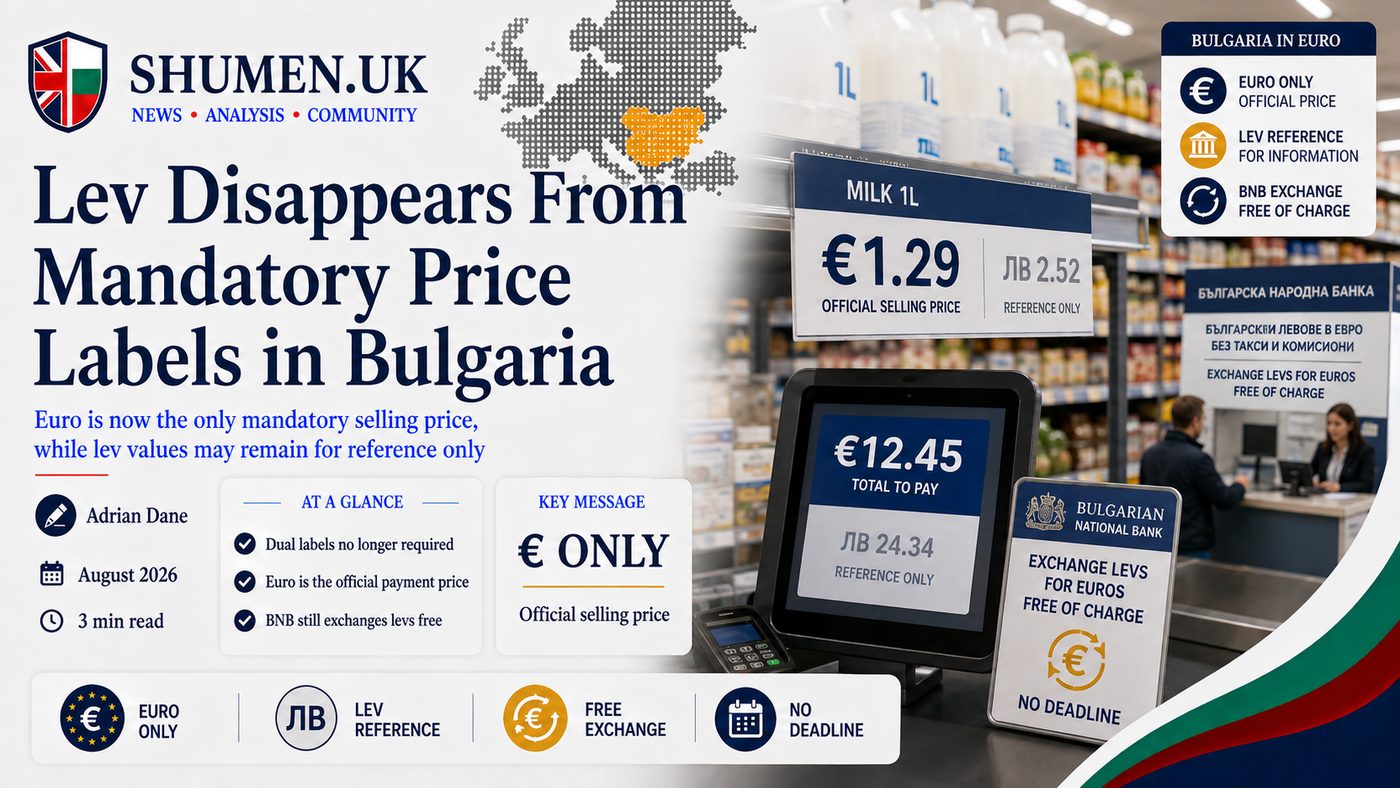
The euro is now the only price a Bulgarian shop is obliged to put on the label. The one-year period requiring every price to be shown simultaneously in leva and euro ended on 8 August 2026, and from 9 August the euro is the sole official selling and payable price for goods and services.
Retailers are not banned from printing the old lev figure alongside it. They are simply no longer required to, and where they choose to keep it, the law is explicit about the hierarchy: the euro amount is what you hand over at the till, and the lev value is a reference number with no legal standing.
The Lev Can Stay, But Only as a Footnote
The Euro Adoption Act sets no separate transition period for menus, price lists, catalogues, brochures and other printed material that still carries both currencies, Bulgarian National Radio noted, and nothing obliges a business to pulp and reprint. A restaurant sitting on a thousand laminated menus with two numbers on them can carry on using the lot, provided the euro price is the current payable one and the lev value is clearly marked as reference only.
So the second number is not going to disappear from Bulgarian life on a fixed date. It will fade unevenly. The shelf edges in Shumen's supermarkets have carried two prices since last August, and since 9 August the smaller one is a courtesy; the kafene menu and the village shop's hand-written card will still be showing leva long after the chains have moved on, because nobody reprints a card that is still perfectly legal.
The rate behind the conversion has not moved and will not. It is fixed at 1 EUR = 1.95583 BGN under Article 12 of the Euro Adoption Act, the same figure used since 1 January.
The Cross-Check Goes, the Legal Protection Stays
For most of us the dual label was doing quiet work. Two numbers on the same sticker meant anyone could see at a glance whether the euro price was an honest conversion of the old one or a hopeful rounding-up, which is precisely why the measure was introduced for the changeover year. From 9 August, on most labels, that check is gone.
The protection behind it has not gone with it. Companies are still not permitted to raise a price merely because the currency changed. An increase is lawful only where objective economic factors justify it, and that rule did not expire alongside the dual display. It applies to a shop that quietly re-stickers its shelves next week exactly as it applied in January.
Enforcement has not been theoretical either. The Sofia Globe reports that since the euro arrived, 1,550 fines and around 700 penal decrees have been issued under the Euro Introduction Act, totalling roughly 1.8 million euros, according to official data from the National Revenue Agency. Those are the tax authority's penalties, and they are a separate track from the consumer route: if a price on your regular shop jumps for no visible reason other than the label change, the body that takes pricing and conversion complaints is the Commission for Consumer Protection, the KZP. Our money and banking guide sets out how the changeover rules work in practice, and the cost of living guide is where we track what has actually moved on Bulgarian shelves this year.
If You Still Have Lev Cash in a Drawer, This Is the Part to Read
The old notes have mostly gone home. By 30 June 2026, some 94.48 per cent of the leva banknotes and coins in circulation at the start of 2025 had been exchanged, around 29.4 billion leva of them, leaving roughly 1.7 billion leva still outside the central bank's vaults. A fair slice of that is sitting in kitchen drawers and holiday-home safes, and a good deal of it belongs to people who only visit Bulgaria a few times a year.
The Bulgarian National Bank exchanges leva for euros free of charge, in unlimited amounts, with no deadline whatsoever. That offer does not run out. The catch is geography rather than cost: the BNB does it at its Sofia head office and through the Cash Service Company offices in Sofia, Plovdiv, Burgas, Varna and Pleven. For those of us in the north east, Varna is the nearest free counter, and Shumen has none.
Bulgarian Posts will also exchange, but now charges for it:
- 6 euros for amounts up to 1,000 leva (about €511)
- 7.20 euros from 1,000.01 to 3,000 leva (up to about €1,534)
- 8.80 euros from 3,000.01 to 6,000 leva (up to about €3,068)
- 10 euros from 6,000.01 to 10,000 leva (up to about €5,113)
Do the arithmetic before you join the queue. On a full 10,000 leva, a 10 euro fee is about 0.2 per cent and plainly worth paying to avoid the drive. On a jam jar holding 150 leva, worth roughly €77, the 6 euro charge takes nearly 8 per cent of the money, and that is a poor trade for the convenience.
Commercial banks will keep exchanging leva until 31 December 2026, and since 1 July they have been free to charge a fee for the service, having done it for nothing in the first half of the year. That end-of-year date is the one genuine deadline in this story. After it, the bank counter is closed to lev cash and the BNB is the route that remains.
What Actually Changes at the Till
Nothing you pay. The euro figure has been the payable price all year; the lev figure was never the amount coming out of your account. What changes is how easily you can audit it, and how long the old number lingers where a business has no reason to reprint.
The practical response is unglamorous and worth the effort anyway: keep half an eye on the handful of items you buy every week, because a drifting price shows up in the weekly shop long before it shows up in a statistics release. Our supermarket guide covers which chains are where and how their pricing tends to behave.
And for anyone still converting in their head at the checkout, the shortcut has not changed: halve it, then add a bit.