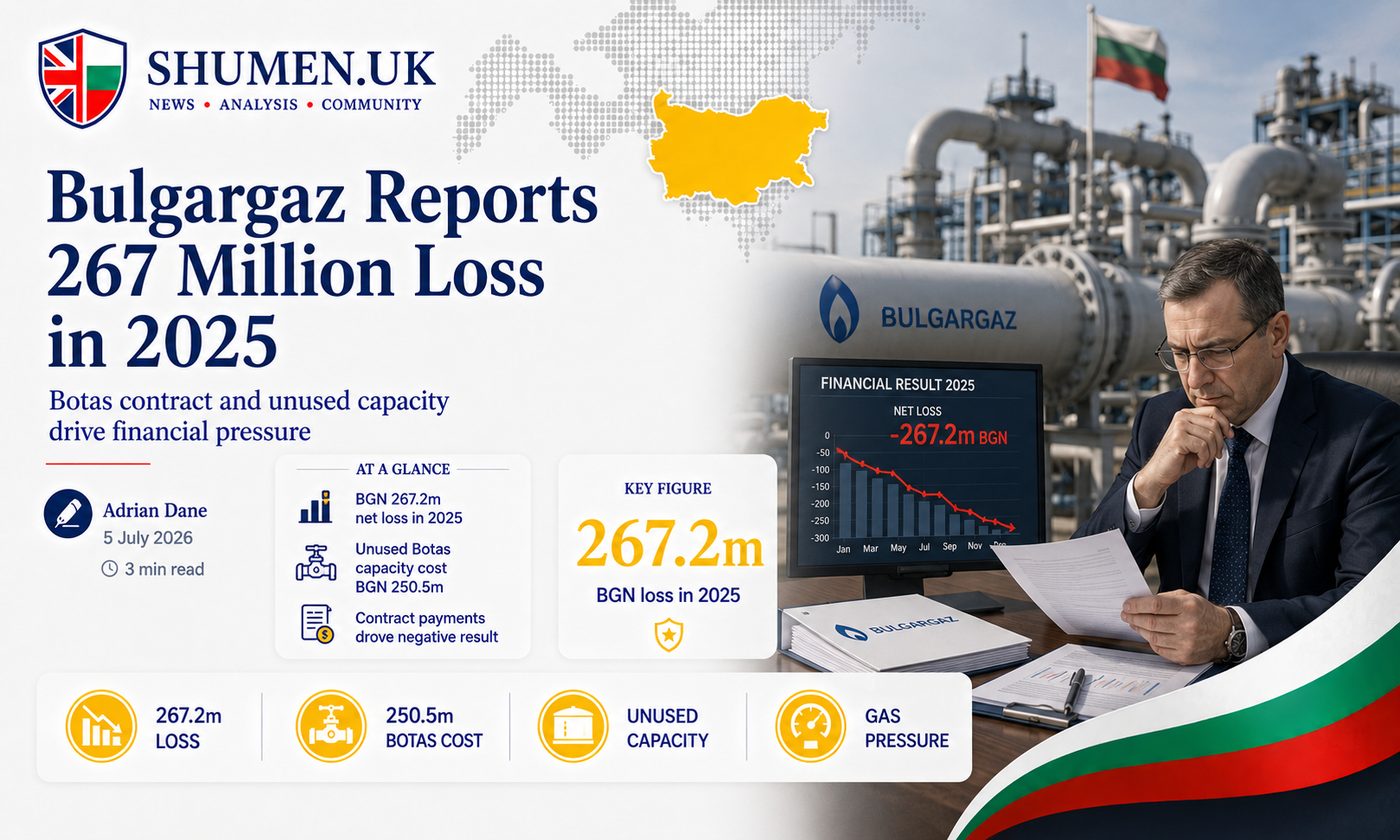
Bulgaria's state-owned gas supplier, Bulgargaz, lost roughly €137 million in 2025, and the single biggest reason is almost comic on paper: it paid about €128 million for gas pipeline and terminal capacity it never used.
That figure comes from the company's 2025 annual report, published on 8 July. It was the second losing year in a row, after a deeper loss of around €162 million in 2024, and it leaves Bulgargaz with negative equity of about minus €234 million, meaning it now owes more than it owns and leans on state guarantees and loans to keep the lights on.
For a company most British expats never think about, Bulgargaz sits surprisingly close to the winter heating bill. It is the regulated public supplier behind much of the gas that warms Bulgarian flats, and its problems have a way of arriving, eventually, at the household tariff.
Paying For Gas It Never Took
The wound is a 13-year contract signed with Turkey's state gas company Botas at the end of 2022. On paper it looked like sensible diversification: access to up to 14 liquefied natural gas cargoes a year through Turkish terminals, plus pipeline capacity to the Bulgarian border. In practice, Bulgargaz used only about 23% of that capacity in 2025 and paid for the rest regardless.
The unused pipeline capacity alone cost around €128 million, with another €18 million wasted on idle capacity at the Alexandroupolis LNG terminal in Greece. Independent auditors flagged the deal as an "onerous contract" under international accounting rules, the technical term for an agreement where the costs are expected to outrun the benefits. Bulgargaz management disputes that, arguing the contract still buys security of supply and flexibility. The auditors put a number on it; the management put a principle on it. The number is the one that shows up in the accounts.
Bulgargaz stopped paying the monthly capacity invoices back in July 2024, which tells you how long this has been coming.
The Freeze That Arrived Just In Time
Here is the part the bare results miss, and it matters more than the loss itself. Two days before the report landed, on 6 July 2026, Bulgargaz and Botas signed a protocol freezing the contract for 15 months and opening a full renegotiation. The deal was struck after Bulgarian President Rumen Radev met Turkish President Recep Tayyip Erdogan in Ankara.
Crucially, during the freeze Bulgargaz will pay only for the capacity it actually uses, on improved terms. That is a direct fix for the precise mechanism that produced the 2025 loss. It does not claw back the money already gone, and 15 months is a pause rather than a solution, but it stops the bleeding while the two sides argue over a permanent rewrite.
The Sofia Heating Bill Loop
The Botas contract is only half the story. The other half is money Bulgargaz is owed and cannot collect. Overdue bills from Toplofikatsiya Sofia, the capital's district heating company, ballooned to about €658 million by the end of 2025, up from roughly €504 million a year earlier. Chasing that unpaid mountain cost Bulgargaz an extra €26 million in financing charges.
Anyone who has opened a January Toplofikatsiya bill in a Sofia block has a small personal stake in this: the heating company that bills the flats is the same one not paying the gas supplier that heats them. Our utilities guide explains how the Toplofikatsiya system and its tariffs actually work.
What It Means For Your Bills
None of this makes gas cheaper. Bulgargaz's gross profit from gas trading roughly halved, to about €31 million, and its share of the Bulgarian market slipped again to 60.23%, down from nearly 62% a year earlier and well below the 76% it held in 2022 and 2023. A shrinking, loss-making, state-backed supplier is not a recipe for falling prices.
The regulator has already nudged the number up: the July regulated gas price was set at €37.70 per megawatt-hour, a 5.84% monthly rise. For British expats here, the practical read is less about the corporate accounting and more about the direction of travel: gas, and the heating that depends on it, is not getting cheaper, and a supplier this stretched has little room to absorb shocks before they reach the tariff. Our cost of living tracker follows the underlying figures as they land.
Because Bulgargaz is state-owned, its losses are ultimately a public liability, propped up by its parent Bulgarian Energy Holding and the Energy Ministry through guarantees and loans. That is money not spent elsewhere.
The Honest Reading
Bulgargaz did keep the gas flowing. It actually supplied slightly more in 2025 than the year before, around 18 million megawatt-hours, with the bulk still arriving cheaply by pipeline from Azerbaijan. The company is not about to go dark. But it is running on state life support, its two biggest problems are a contract it overpaid on and a customer that will not pay, and 2026 now hinges on whether the Botas renegotiation sticks and whether Sofia's heating company ever settles its bill. The freeze buys time. It does not balance the books.