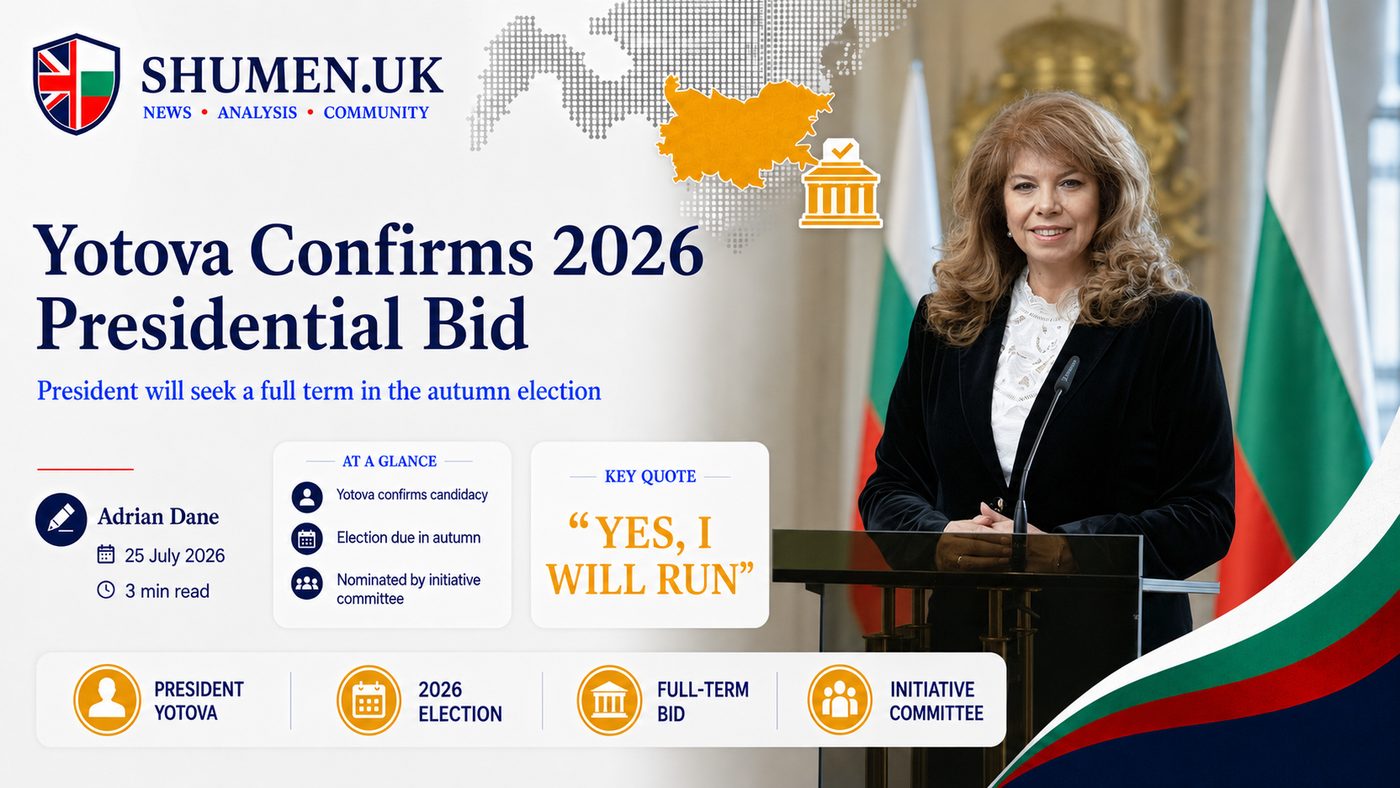
President Iliana Yotova will stand in Bulgaria's presidential election this autumn, ending months of speculation with two words on live television. "Yes, I will run," she told BNT's Panorama programme, confirming for the first time that she wants a full term in an office she did not win outright but inherited in January.
She confirmed the manner of it as well. Her candidacy will be put forward by an initiative committee rather than by a political party, and she said the backing she valued was not only that of public figures. "The support of different people will be important to me, not only famous people, but also the many Bulgarian citizens who meet me every day and tell me, 'Madam President, don't give up, we are with you.' Many of them will be part of my initiative committees," she said.
Yotova became head of state on 23 January 2026, when Rumen Radev resigned the presidency to fight the parliamentary election, and she moved up from the vice presidency she had held for nine years. She is the first woman to hold the office and the first Bulgarian vice president to take it over mid-term. Radev's Progressive Bulgaria won the April vote and now governs with an independent majority, and Radev himself is prime minister, at the head of the cabinet Novinite set out in May. Asked whether he would back her campaign, Yotova said the decision was his alone.
The nomination she is not asking a party for
An initiative committee is a citizens' nomination: a group of voters, rather than a party apparatus, formally puts the candidate on the ballot. It is less a break with her past than a repeat of it. Yotova and Radev were nominated the same way in both 2016 and 2021, on both occasions with the Bulgarian Socialist Party's backing behind the committee.
Her career has run through that party. She sat on the BSP's National Council from 2000 until she became vice president, ran its press office between 1997 and 2007, served as an MP from 2005 to 2007, then became one of Bulgaria's first MEPs after accession, sitting with the Socialists and Democrats group until 2017. BSP leader Krum Zarkov posted his backing for her candidacy on Facebook shortly after the interview.
The committee route is looking busy. Former caretaker prime minister Andrey Gyurov has public backing from Democratic Bulgaria's leaders, We Continue Change say they are still working towards a joint nominee, and former education minister Daniel Valchev has said he would stand only if citizens rather than a party put him forward. Two of the three names circulating want to reach the ballot without a party logo attached.
What the office actually controls, and what it does not
This matters more than the horse race, because the Bulgarian presidency is a narrow office with two sharp edges. It does not set your tax rate, your residence permit conditions or your pension. Parliament and the government do that.
What the president does hold is the power to refuse to sign a bill and return it to the National Assembly. The chamber can override her and oblige her to sign, but only on a majority of all its members, at least 121 of the 240 MPs, rather than a simple majority of whoever happens to be in the room that day. That power is live right now. Yotova confirmed she has received the opposition's petition urging her to veto the 2026 state budget, and said she would examine the arguments before deciding. She was blunt about how she thinks the country arrived here, blaming former finance minister Assen Vassilev. "If we are in this situation today, it is largely due to Mr. Asen Vassilev," she said, describing the current plan as "a borrowed budget" and noting that Bulgaria has effectively been running on last year's numbers while already operating in euros, with an excessive deficit identified by the European Commission. If you are watching what the state does with its money in the first full year of the euro changeover, the president's desk is where that argument pauses next.
The second sharp edge is the one that touches British expats directly. The president grants, restores and withdraws Bulgarian citizenship, and grants asylum. Everything short of that, the D visa, the residence permit, the address registration, is decided by officials and set out in the residency rules. Naturalisation is where a politician signs. For a Brit here long enough to be weighing citizenship, whoever wins in the autumn is the person whose signature ends the process, and that is a five-year appointment.
The pump is her stated trigger
The quietly useful line in the interview was about escalation. Yotova said she would convene the National Security Advisory Council only if the conflict in the Middle East escalates further and creates direct risks for Bulgaria, and she named two of them: higher fuel prices and increased migration pressure.
That is a head of state saying out loud that the forecourt is one of her thresholds. Most of us here would register a Middle East escalation at the pump long before we registered it in a communique, and fuel feeds into everything else in a country where the weekly shop arrives by lorry. Our cost of living tracker carries the underlying numbers as official figures land.
On the American tanker aircraft at Bezmer Air Base, she defended the government's handling of the request. "Bulgaria is not involved in a war, Bulgaria is not a party to the conflict in the Middle East, and Bulgarian airspace has not been given to a foreign power," she said, arguing that ministers had acted transparently by putting the US request to the National Assembly for approval. She was less generous elsewhere in foreign policy, calling the Coalition of the Willing short on unity and on realistic prospects for ending the war in Ukraine, and saying Bulgaria's foreign minister had erred in his recent actions in Kyiv through insufficient coordination. On North Macedonia she repeated the standing position: Bulgaria supports Skopje's European integration, but the commitments on human rights and historical questions have to be met.
What happens next, and what you will see of it
No date has been named. Yotova put the vote in the autumn and left it there, and the election is due to be held by then in any case.
Bulgarian presidents are elected in two rounds. A candidate wins outright only by taking at least half the vote on a turnout of at least fifty per cent, and if nobody clears both bars the top two go to a runoff.
British expats without Bulgarian citizenship cannot vote in it, so the autumn will be a logistical experience rather than a civic one: the chitalishte or the school hall requisitioned again, the folding tables, the list on the wall, and the posters that go up on every lamp post in Shumen and come down slowly afterwards. Anyone who has been here through the seven snap parliamentary elections since 2021 will recognise the furniture. What is different this time is that the office being contested carries a five-year term, so whoever wins will be signing citizenship decrees and weighing vetoes well into the next decade.