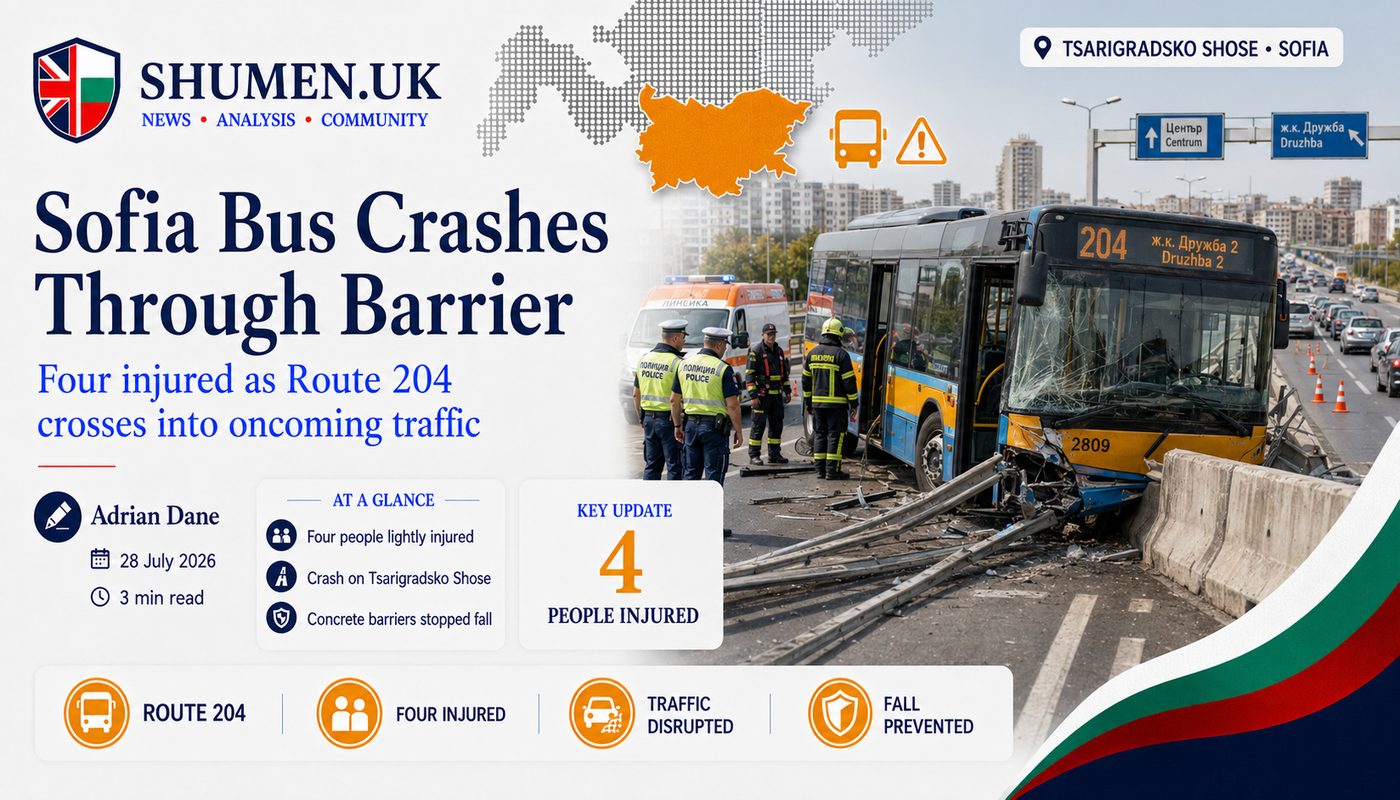
Four people were injured on Monday after a Sofia city bus smashed through the central guardrail on Tsarigradsko Shose and ended up across the oncoming carriageway, shutting one of the capital's busiest arteries for much of the afternoon.
The Route 204 bus, running from the Mladost district towards Orlov Most, broke through the barrier near the Fourth Kilometer interchange. Only the concrete safety blocks on the overpass stopped the vehicle going over the edge. According to Bulgarian media reports, the four casualties, a 16-year-old girl, a woman and two men, all suffered minor injuries. Two were taken to ISUL University Hospital and two to Pirogov, the capital's main emergency hospital, where doctors later confirmed that the teenager and a 76-year-old man had been treated and discharged.
Anyone who has inched down Tsarigradsko Shose in the morning crawl will know the stretch: eleven kilometres of grade-separated dual carriageway, an 80 km/h limit that everyone treats as a polite suggestion, and the flyover at Fourth Kilometer where the boulevard starts its run out to the ring road and the A1 towards Plovdiv. Monday's crash closed that outbound flow, with traffic diverted through the roundabout below for hours before normal movement resumed later in the afternoon.
A Week-Old Inspection and a Brake Failure Claim
The central question for investigators is an uncomfortable one for the city's bus operator. Witnesses told reporters the driver said the bus had suffered a brake failure, leaving him unable to stop before the barrier. A second eyewitness said the vehicle appeared to be travelling at a moderate speed, probably within the posted limit.
Chief Commissioner Nikolay Peltekov, Sofia's police director, said the driver's alcohol and drug tests came back negative and that preliminary evidence points to a possible technical malfunction. What makes that awkward is the paper trail. According to Peltekov, the bus passed its mandatory technical inspection on 21 July, six days before the crash, and was found roadworthy. Stolichen Avtotransport, the municipal bus company, said the vehicle also underwent routine maintenance on 25 June.
The bus itself was built in 2003, which makes it 23 years old. The driver, aged 59, is described by police as an experienced operator, though their records show three previous minor accidents and four speeding citations. He had been on leave from 22 to 24 July, followed by two scheduled rest days, and Monday was his first shift back. A pre-trial investigation has been opened, and the authorities say criminal liability will be considered if the evidence points to the driver. Investigators also want the onboard camera footage, although retrieving the recordings has been delayed by a fuel leak discovered after the crash.
The Same Guardrail, Four Years Apart
If the location sounds familiar, it should. In September 2022 another city bus crashed through the guardrail at the same interchange, and Monday's incident has revived questions about road safety on the boulevard and the condition of Sofia's public transport fleet. The Sofia Municipality said it had ordered a full investigation by Stolichen Avtotransport and apologised to the injured and to everyone caught in the disruption.
None of the official statements so far explains how a bus certified as roadworthy a week earlier could suffer a catastrophic brake failure, if that is indeed what happened. Investigators say they will examine mechanical failure, road conditions and other factors, and will review the inspection centre's documentation alongside a technical examination of the vehicle.
What British Expats Should Take From This
For most Brits in Bulgaria this is a Sofia traffic story rather than a personal emergency, but it is a decent prompt to know the drill before the day you need it.
- In any emergency, call 112, the EU-wide number that covers ambulance, fire and police in Bulgaria.
- If you are injured, state hospitals treat emergency casualties, and a UK GHIC covers medically necessary state treatment in Bulgaria on the same terms as a local. It does not cover private care or repatriation, which is why proper insurance still matters. Our healthcare guide explains how the GHIC fits alongside the Bulgarian system.
- If you are driving and involved in a collision, the traffic police, the KAT, attend and their accident report becomes the key document for any insurance claim. Keep your licence, insurance and vignette documents current and in the car; the driving in Bulgaria guide covers the paperwork in detail.
Pirogov, where two of Monday's casualties were treated, has been Sofia's specialist emergency hospital since 1951, and it is where anyone seriously hurt in the capital is most likely to end up. For those who ride the 204 rather than drive, the thing to watch is Stolichen Avtotransport's investigation report when it appears.