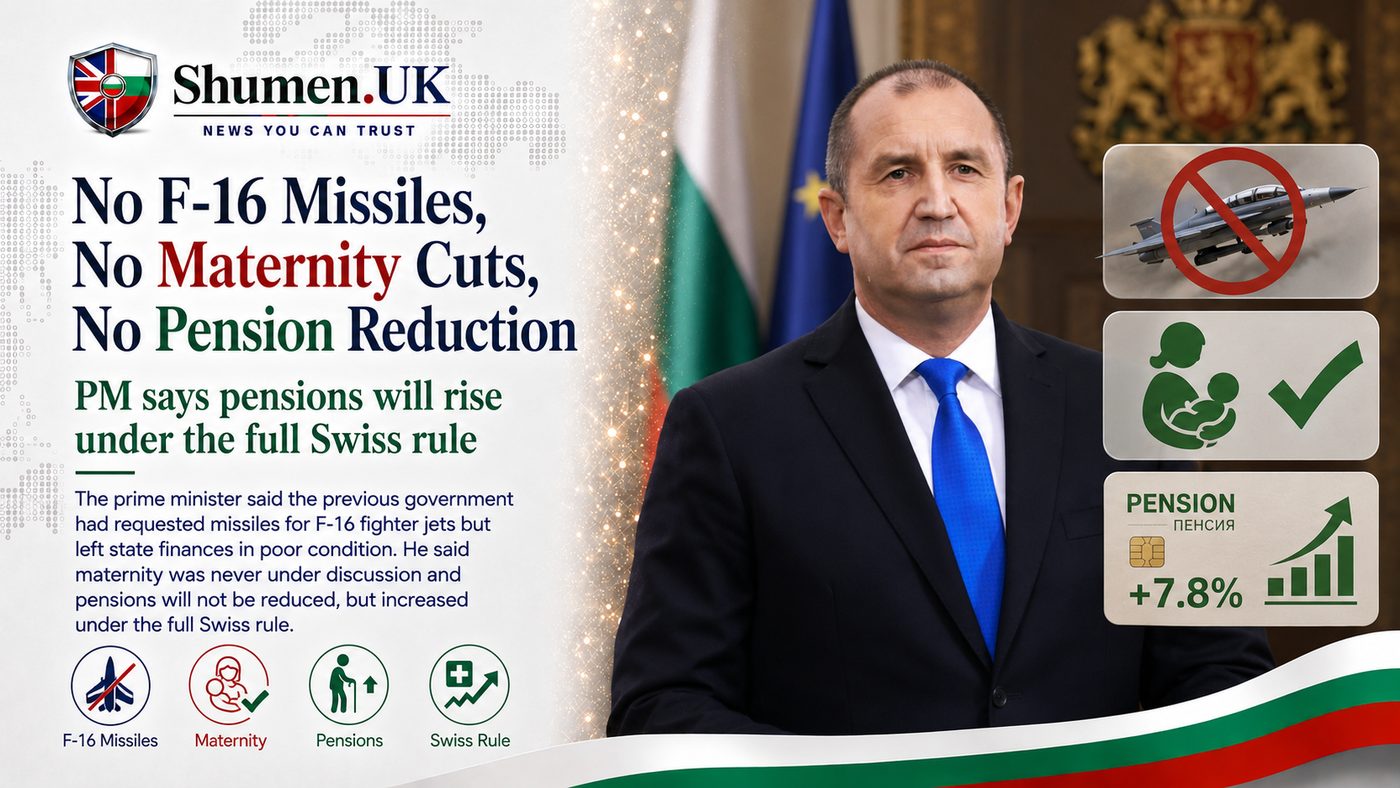
Bulgaria's Prime Minister Rumen Radev spent Wednesday morning insisting his government would not reduce pensions, cut maternity benefits, or purchase missiles for F-16 jets. The problem: his own Progressive Bulgaria party had proposed all three in parliament the day before.
"Last week we heard that we would buy missiles for one billion euros, cut maternity leave, and reduce pensions. None of that is true," Radev told his cabinet on 3 June. "Maternity was never under discussion. Pensions will not be reduced. On the contrary, they will be increased according to the full Swiss rule."
The contradiction is sharp. Progressive Bulgaria's Budget Committee Chairman Konstantin Prodanov presented amendments on 2 June that included ending COVID pension supplements to new retirees from July onwards. The party also tabled a proposal to raise the state debt ceiling before withdrawing it under opposition pressure. Radev acknowledged the previous government had requested F-16 missiles but confirmed his coalition would not proceed.
Walk past Shumen's social security office any weekday morning and you'll see the queue: pensioners with plastic folders, checking over paperwork, trying to work out what the latest parliamentary rows mean for next month's payment. This week, the queue got noticeably longer.
The Pension Row British Expats Have Been Following
Anyone watching Bulgaria's eighth government formation in five years already knows the pattern: proposals emerge, public anger follows, the government retreats. This week's pension row followed the script precisely.
Progressive Bulgaria initially proposed scrapping the COVID pension supplement for new retirees after 1 July 2026. Prodanov defended the move as restoring "the link between contributions and benefits" in the social security system. He also suggested pensioners on the minimum would lose roughly €2 per month, a comment that triggered immediate outrage. "Not all 2.2 million pensioners in Bulgaria will die of hunger because of 2 euros," he said, according to reporting by Novinite.com.
The backlash was swift. Revival deputy Tsoncho Ganev accused the government of "canceling your own proposals out of fear." Opposition leader Asen Vassilev, formerly of We Continue the Change, warned that the proposed minimum pension of €347 would still leave roughly 800,000 retirees €43 below the poverty line. "These people should not have to choose between food and medicine," Vassilev told parliament.
By Wednesday, Progressive Bulgaria had softened. Prodanov confirmed the COVID supplement would remain for existing pensioners. The Swiss rule adjustment (linking pensions to inflation and wage growth) will now apply from 1 July for over 800,000 pensioners receiving minimum payments, earlier than originally planned under a full budget. Whether that counts as an increase or a reprieve depends on whom you ask.
What the Swiss Rule Actually Means
For British expats in Bulgaria unfamiliar with the Swiss rule: it's a pension adjustment formula that ties increases to a combination of inflation and wage growth. Applying it from July rather than waiting for a full state budget means minimum pension recipients get the adjustment sooner. The government presents this as generosity. Opposition figures point out the resulting €347 monthly minimum (roughly £295) still leaves pensioners well below the poverty threshold.
The practical impact matters. A British retiree in Bulgaria drawing a UK state pension plus a small Bulgarian component, or British nationals with Bulgarian partners claiming local pensions, should note: the minimum is rising, but it remains inadequate by most measures of living costs. The government insists no cuts are planned. The opposition insists the planned increases aren't enough. Both statements can be true simultaneously.
A Record Deficit and Missing Billions
The pension row played out against a fiscal backdrop that would make any finance minister wince. Bulgaria's official budget deficit reached €2.5 billion by May 2026, the highest in 20 years according to the Fiscal Council. Prodanov told Nova TV that usable budget funds stood at roughly €1 billion, with additional unpaid obligations representing a "hidden fiscal burden."
Progressive Bulgaria has promised audits across ministries, targeting what Radev called "years of mismanagement, wasteful spending, questionable public procurement contracts, and excessive salaries in state-owned companies." Prodanov specifically pointed to major road projects and the National Railway Infrastructure Company as areas of concern. The government says information will be made public soon, though no timeline has been confirmed.
The coalition also proposed cutting state subsidies to political parties from €4.09 to €3 per valid vote starting 30 April 2026. Prodanov acknowledged the fiscal impact would be small (between €2 million and €3 million this year) but called it "an important symbolic gesture" while "billions were disappearing through questionable spending channels." The measure passed parliament alongside a freeze on lawmakers' salaries.
What This Means for British Expats
British expats in Bulgaria watching pension policy closely should note: the government insists no cuts are planned, but the minimum pension increase proposed still leaves retirees below the poverty line by Vassilev's figures. The Swiss rule adjustment from July is real, advancing pension increases that would otherwise wait for a full budget. Whether €347 per month (roughly £295 at current rates) constitutes an adequate safety net is the political fight neither side has settled.
The broader fiscal picture matters for long-term residents. A €2.5 billion deficit and ongoing procurement audits suggest structural budget problems that could affect public services, infrastructure spending, or future tax policy. Progressive Bulgaria's promise to expose mismanagement may deliver transparency or simply provide cover for austerity measures framed as anti-corruption. British expats with pensions, property, or businesses in Bulgaria should follow the audits closely when details emerge.
On maternity benefits, Radev's denial is categorical: "Maternity was never under discussion." That contradicts earlier reporting suggesting the government was considering reductions to one of Europe's most generous systems. For now, British families in Bulgaria planning around existing maternity leave rules can assume they remain unchanged, though the contradiction between parliamentary proposals and prime ministerial denials leaves room for confusion.
The F-16 Missile Contradiction
Radev's denial on missile purchases contradicts recent reporting. The US State Department approved a nearly $1 billion missile package for Bulgaria's F-16 jets earlier this year, including AIM-120C-8 AMRAAMs and AIM-9X Sidewinders. Radev confirmed the previous government requested the purchase but insisted his coalition would not proceed. "We will not buy those missiles," he told his cabinet.
The statement leaves the procurement status unclear. Bulgaria joined NATO in 2004 and has committed to raising defense spending toward 5% of GDP by 2035, according to Defense Minister Dimitar Stoyanov. Whether canceling the missile order affects that trajectory is unstated.
The Just Transition Plan Reboot
Radev also announced his government is restarting work on the Just Transition Plan for coal-dependent regions. Talks are beginning with authorities in Stara Zagora, Pernik, Kyustendil, Radnevo, Galabovo, and Bobov Dol to ensure EU transition funds reach affected communities. The plan had been "neglected for years," Radev said, without specifying how his government's approach would differ.
The Cabinet confirmed it would replace the special commercial manager of Lukoil following a recommendation from the Minister of Economy. No further details were provided on timing or successor.
The Denials and the Record
Wednesday's session began with a minute of silence for GERB MP Lyuben Dilov Jr., who died 2 June. Parliament Speaker Mihaela Dotsova said Dilov had "left a lasting mark on Bulgarian public life." Following a 30-minute break, lawmakers resumed debate on the budget amendments that Radev would later deny.
The contradiction is not subtle. Progressive Bulgaria tabled the pension supplement removal, the debt ceiling increase, and implicitly supported the missile procurement inherited from the previous government. Radev rejected all three in a single cabinet meeting. Whether that reflects internal coalition disagreement, tactical backtracking, or simply poor coordination between the executive and parliamentary wings is unclear.
For British readers tracking Bulgarian politics, the pattern is familiar: proposals emerge, opposition mobilizes, the government retreats while insisting it never intended what it just proposed. The eighth government in five years has delivered its first major policy reversal within six weeks of taking office. The question is whether Radev's denials hold or whether the next round of budget amendments will quietly reintroduce what Wednesday's cabinet meeting explicitly ruled out.