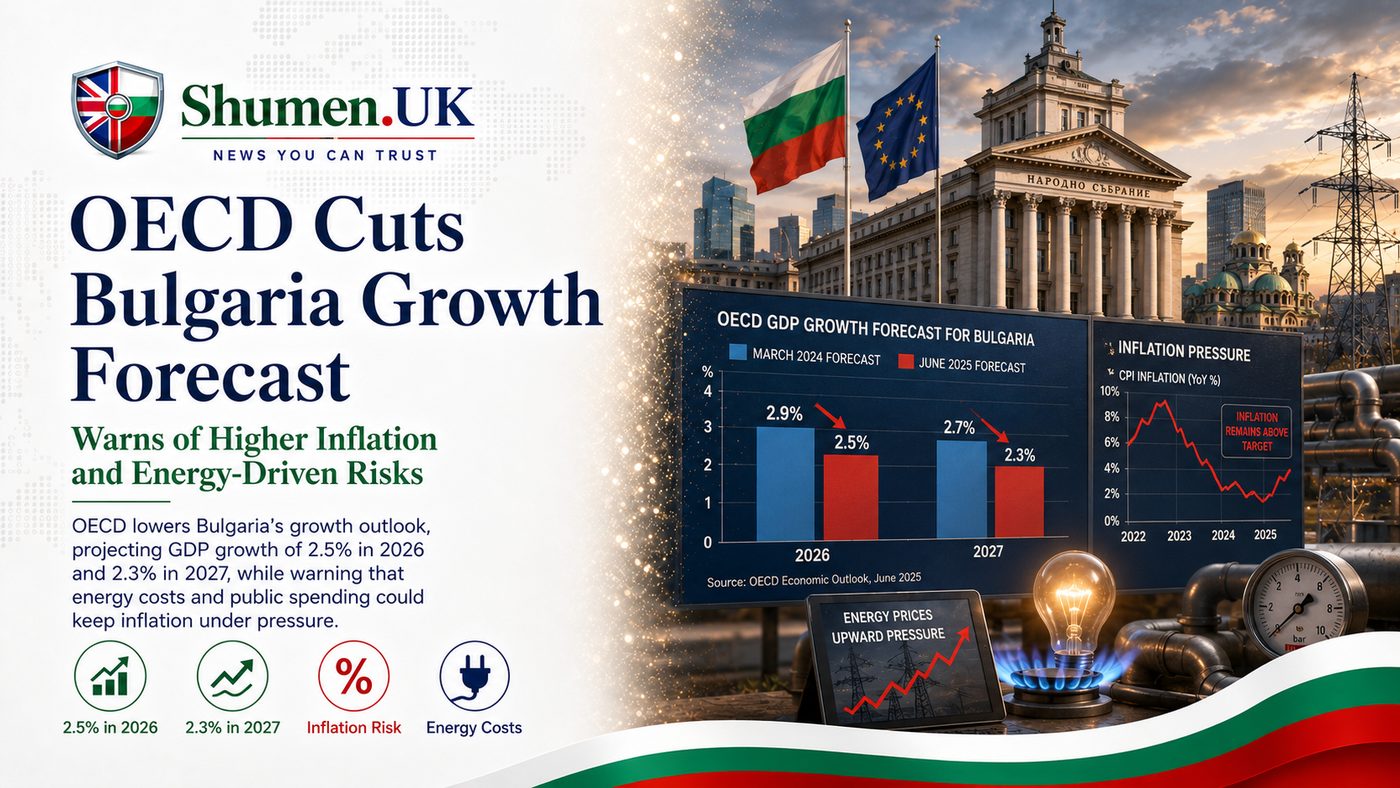
The OECD has revised down Bulgaria's economic outlook, projecting GDP growth of 2.5% in 2026 and 2.3% in 2027. The report, published on 3 June, attributes the slower expansion to weaker domestic demand, higher energy prices tied to geopolitical tensions in the Middle East, and easing consumption growth.
Anyone filling up at a Bulgarian petrol station in recent months already knows the numbers. The OECD has now put institutional weight behind what household budgets have been showing since the start of the year: energy costs are up, and the broader economy is feeling it.
Inflation to Stay Elevated Through 2026
Inflation is expected to remain at 4.3% in 2026 before easing to 3.4% in 2027, according to the OECD. The organisation warns that sustained energy price increases could prolong inflation and continue to erode real household incomes. The European Central Bank's April 2026 Economic Bulletin corroborates these figures, linking Bulgaria's inflation trajectory directly to energy market volatility.
The OECD report notes that headline inflation reached 6% in April 2026, rising from a temporary dip in February, driven by fuel and electricity price increases tied to Middle East tensions. These specific monthly figures are drawn from OECD economic modelling and have not been independently verified by Bulgarian statistical authorities.
For British expats in Bulgaria, higher inflation means squeezed purchasing power. The cost of filling a tank, heating a home, and buying groceries continues to climb. Real household incomes are under pressure, particularly for those with fixed sterling pensions or incomes.
Budget Deficit Above EU Threshold
Bulgaria's budget deficit has moved above the 3% of GDP threshold, driven by increased spending on social and healthcare services, higher public sector wages, and rising investment outlays. Multiple sources, including SeeNews and Reuters, confirm that the European Commission has recommended launching an excessive deficit procedure against Bulgaria, the EU's formal mechanism for fiscal discipline.
The OECD calls for a medium-term fiscal adjustment strategy to reinforce public finances and address longer-term pressures linked to demographic change, climate policy, and defence spending. For British nationals with business or property interests in Bulgaria, this signals a period of tighter fiscal conditions ahead. Whether the government moves to cut spending, raise taxes, or some combination of both remains to be seen.
Weaker Domestic Demand, Slower Private Investment
According to the OECD report, GDP growth moderated to 2.9% in the first quarter of 2026, with private consumption remaining the main driver, supported by rising real incomes, credit expansion, and social transfers. Investment activity exceeded expectations due to faster implementation of EU-funded projects following a period of greater political stability. These quarterly figures are drawn from OECD analysis and have not been independently confirmed by Bulgarian statistical authorities.
Sentiment indicators have weakened, however. The OECD notes that business and consumer confidence fell to their lowest levels since 2022 after the government resignation in December 2025. Industrial output has also continued to contract in early 2026, though the labour market remains tight, with unemployment recorded at 3.5% in 2025. These indicators reflect OECD assessment rather than separately verified data.
The OECD projects that investment activity will be supported primarily by public spending financed through EU funds, while private investment is likely to recover only gradually as uncertainty declines. It is not yet clear whether the fiscal adjustment required by Brussels will affect the pace of EU-funded projects.
Government Support Measures
To cushion the impact of rising costs, the Bulgarian government has introduced a series of temporary measures:
- Monthly support for low-income vehicle owners
- Reduced fuel excise duties for agricultural producers
- Targeted subsidies for energy-intensive industries
- Deferred toll increases for transport operators
- Adjusted electricity compensation schemes for businesses with more frequent payments
Whether these measures will materially slow inflation or simply redistribute the pain remains to be seen. The OECD's forecast assumes they remain in place, but temporary measures have a way of expiring when budgets tighten.
Energy Security and Structural Reforms
The OECD concludes that Bulgaria's relatively high dependence on energy makes the economy vulnerable to external price shocks, despite limited direct exposure. The report emphasises that structural reforms in energy and infrastructure, including renewable energy expansion, improved grid connectivity, and investment in storage capacity, would strengthen long-term energy security.
It also highlights the importance of developing demand-side measures and improving public transport in order to reduce energy consumption and stabilise inflationary pressures. These recommendations align with broader EU green transition objectives and could open opportunities for UK companies with expertise in renewable energy and infrastructure.
What This Means for British Expats
The OECD's forecast provides a sobering backdrop for British people living in Bulgaria or considering a move: slower growth, higher inflation, and a fiscal position that will likely require adjustment. The practical impact shows up in monthly bills and at the petrol pump. The institutional confirmation has now arrived.
British expats should prepare for continued cost pressures, particularly around energy and transport. Those with fixed incomes or pensions denominated in sterling will feel the pinch more acutely if inflation remains elevated through 2026. The government's support measures are targeted and temporary, they are unlikely to shield all households from rising costs. Whether the fiscal squeeze ahead translates into cuts in public services or higher local taxes depends on decisions yet to be made in Sofia.