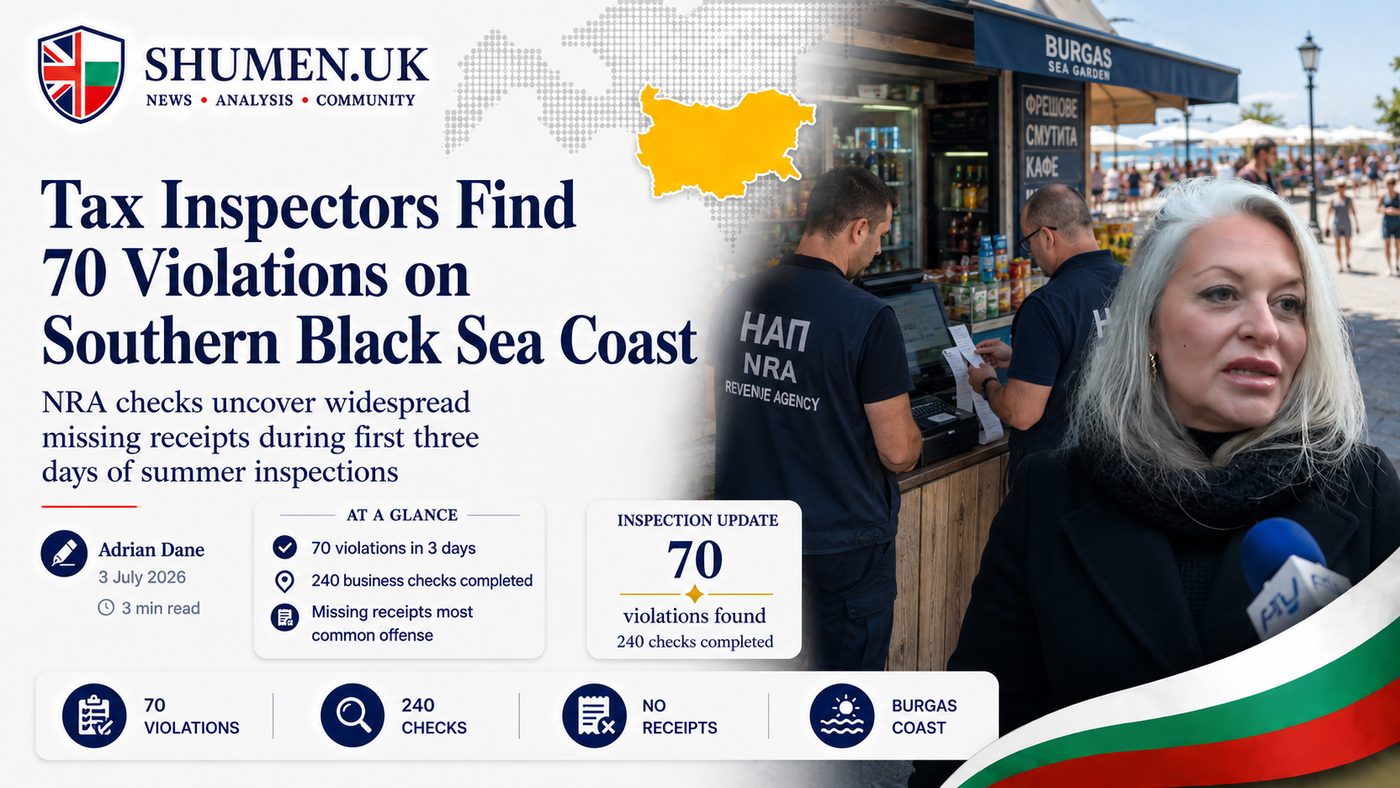
Bulgaria's National Revenue Agency has opened its summer inspection season on the southern Black Sea coast the way it evidently means to go on: 240 checks in the first three days, and 70 violations found. The campaign started on Monday 29 June, and the running tally was announced in Burgas by the agency's communications director, Anna Mitova.
The headline offence will surprise nobody who has ever waited at a beach bar while the till stayed mysteriously shut. The most common violation is the simple failure to issue a fiscal receipt, followed by discrepancies between the cash actually sitting in the register and the figures the fiscal device has recorded.
Where the Inspectors Have Been
Of the 240 checks completed by Wednesday, 140 fell under the Burgas Territorial Directorate, which accounts for 45 of the 70 violations found so far. On Thursday the teams moved through Burgas' Sea Garden, visiting restaurants, kiosks, beach facilities and the businesses renting out umbrellas and sun loungers.
That day's work had already produced at least one confirmed case of a missing receipt while checks were still under way. "At this point, we have identified one violation for not issuing a receipt, but the inspections are continuing and more information will be available in the coming days," Mitova said.
The agency, known to every taxpayer here by its Bulgarian initials NAP, is running its summer sweep of the coast. What is new in 2026 is the second thing on the inspectors' clipboard.
The Euro Price Checks
Alongside the receipts, inspectors are checking whether businesses have pushed through unjustified price increases in connection with the euro changeover, under the Euro Adoption Act. The method is straightforward: current prices are compared with what the same business charged before 1 January, or with last summer's prices for seasonal operations that were trading then.
Where a rise looks suspect, the trader has five days to hand over documentation justifying it. "If there is a price increase, they must prove the economic reasons for it. If they cannot justify it, they are subject to sanctions," Mitova said.
The agency is also working through the complaints about steep seaside prices circulating on social media, and Mitova was candid that the reports are a mixed bag: each is reviewed individually, some prove accurate, others do not. "The state cannot set prices in a market economy, but it can monitor whether consumer trust is not being abused and whether there is an unjustified increase in prices," she said. This is not a new front either: Novinite reported back in April that hundreds of violations had been uncovered and a post-changeover price spike confirmed.
Anyone who has paid for two loungers and a coffee on the southern coast since January will have a private view on which direction prices have travelled. The difference now is that a trader who cannot show the paperwork behind an increase has a five-day problem, and our money guide covers the consumer-protection side of the changeover in detail.
What a Missing Receipt Actually Costs
The year-to-date numbers give the campaign some teeth. Since January the NRA has carried out more than 20,000 inspections nationwide, some jointly with the Consumer Protection Commission, resulting in over 1,300 administrative penalty notices and fines equivalent to roughly 870,000 euros.
For an individual business, a first offence of failing to issue a receipt carries a fine of up to the equivalent of around 1,020 euros, and a repeat offence doubles that. Where inspectors conclude that a mismatch between the till and the fiscal records was deliberate concealment of revenue, the sanction can exceed 5,100 euros.
If You Are on the Coast, or Trading There
For British expats holidaying or living along the southern coast, the practical takeaway is small but real: the receipt is the whole game. Every bar, kiosk and lounger operator is legally required to hand you one, and not doing so is precisely the violation inspectors are finding most often. If somewhere consistently does not, you are looking at the sort of business this campaign exists to catch, and the NRA does review the complaints that surface publicly, on their individual merits.
For the Brits who run coastal businesses, bars, guesthouses and beach operations among them, the checklist writes itself. Issue a receipt on every sale, however small. Reconcile the cash in the till against the fiscal device, because that mismatch is the second most common finding. And if you have raised prices since January, keep the costings that justify it close to hand: if an inspector asks, you have five days to produce them. The taxes guide covers how NAP operates and where the flat-tax paperwork fits.
The campaign runs on through the season, with the agency promising further updates in the coming days.