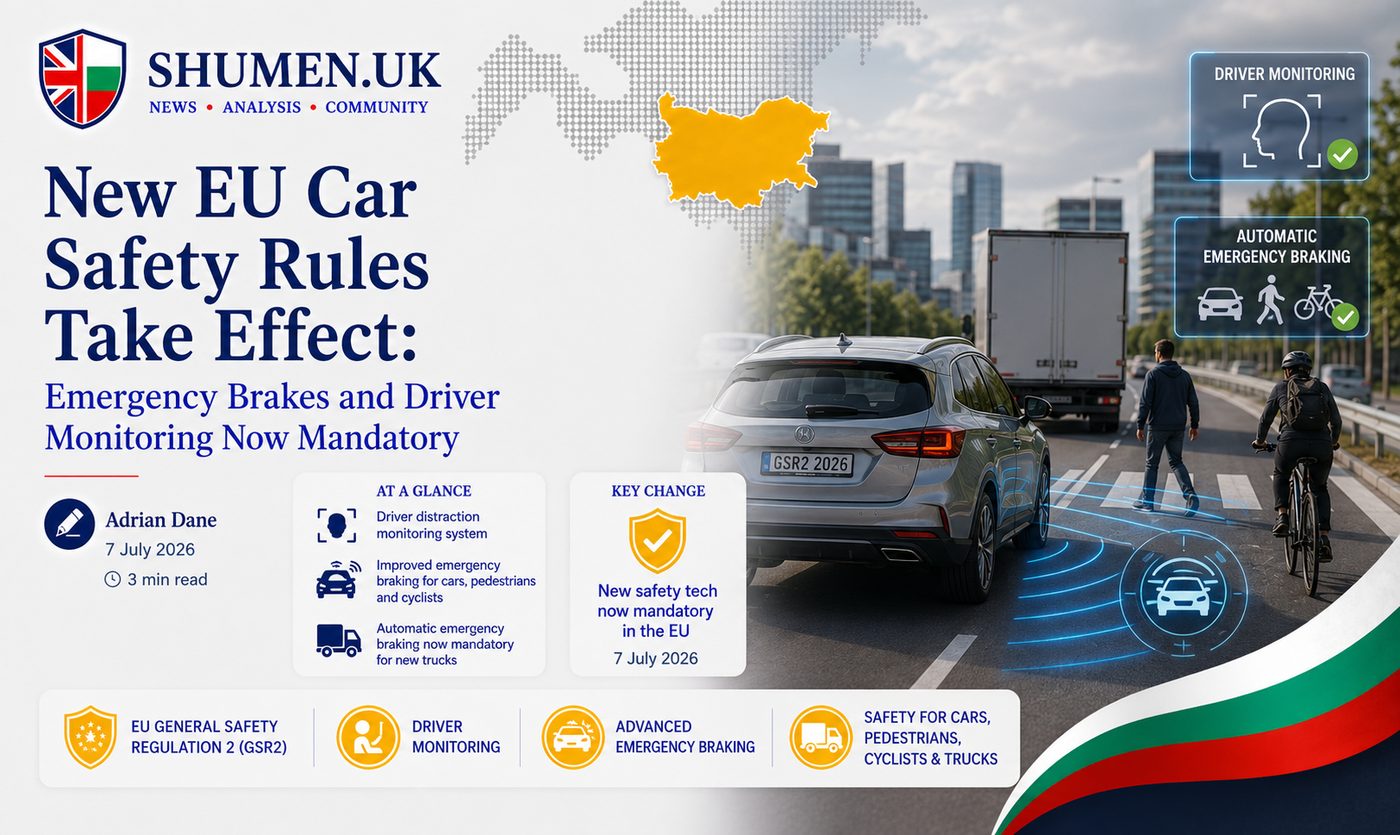
New cars and trucks registered in the European Union from 7 July 2026 must carry two additional safety systems: a driver-distraction warning that tracks eye and head movement through an infrared camera, and an expanded automatic emergency braking system that now detects pedestrians and cyclists as well as other vehicles. The requirement comes from the EU's General Safety Regulation 2, formally Regulation (EU) 2019/2144, and for the first time automatic emergency braking also becomes compulsory on new trucks.
The systems were already required on brand-new vehicle models launched from 2024 onwards. What changed on 7 July is that the same rules now apply to older models that are still in production, closing a gap that let some current-generation cars skip the newest tech.
Who Actually Has to Comply
The new requirements apply only to vehicles registered for the first time after 7 July 2026. If you already own a car in Bulgaria, you do not need to install anything, and the annual tehnicheski pregled (technical inspection) will not require existing vehicles to be fitted with these systems. The rule targets what leaves the factory and gets a first registration plate from now on, not what is already on the road. Our driving guide covers how the technical inspection and KAT paperwork actually work if you are registering a car in Bulgaria for the first time.
The Flashing Brake Lights, Explained
One of the more noticeable changes is the emergency brake warning system. Traditional brake lights stay steadily lit whenever the pedal is pressed. The new system instead makes the rear lights flash rapidly when the car brakes sharply while travelling above 50 km/h, giving drivers behind a faster, more obvious signal that something dangerous is happening ahead.
"It gives them a signal that the car is braking more sharply. They have to prepare to stop faster and understand that something dangerous is happening in front of them," said Teodor Popov, who drives a vehicle already fitted with the system. He argued it is particularly useful "on highways, ring roads and country roads" where higher speeds raise the risk of chain collisions.
Anyone who has driven the Hemus or the Trakia motorway already knows the informal Bulgarian version of this: brake hard, get stopped safely, then reach over and flick on the hazards. Several drivers interviewed by Novinite made exactly that comparison. "Now that we see that it is flashing, it is faster than reaching out and pressing the hazard lights, so the measure should be more adequate," Todor Popov said. The new system just automates, instantly, the habit most drivers already reach for a few seconds too late.
Bulgaria's Ageing Fleet Is the Catch
Road safety specialists expect the technology to cut accidents over time, but several of them flagged that Bulgaria will likely feel the benefit more slowly than most of the EU. "We have the oldest fleet in Europe. We buy the fewest new cars, and most people buy used vehicles," road safety expert Angel Popov said, adding: "God grant that it will come faster... this is an extremely useful system."
That detail matters more here than the headline EU rule does. A regulation that only bites on first registrations changes almost nothing, almost immediately, in a market where most vehicles on the road, and most vehicles being bought, are secondhand.
A Longer Rollout, With More to Come
This is the third stage of a regulation that has been arriving in pieces since 2022. GSR2 first entered into force that year, introducing intelligent speed assistance, reversing detection, driver drowsiness warnings, emergency stop signals, cybersecurity requirements and stronger safety glass. A second stage followed in July 2024, adding lane-keeping assistance, tyre pressure monitoring for vans, buses and trucks, and event data recorders, the automotive equivalent of a black box.
The next deadline is 7 January 2029, when heavy goods vehicles will need improved direct-vision systems to help drivers spot pedestrians and cyclists near the vehicle, and event data recorders become mandatory for all new trucks, buses and coaches. The European Commission estimates the full package of measures, once fully rolled out, could prevent more than 25,000 deaths and 140,000 serious injuries on European roads by 2038. Experts quoted in the report do not expect the new systems to noticeably raise prices, arguing that mass production should keep the cost of the hardware low: "The production of this system will be in millions of units and will not affect the value of the car," Angel Popov said.
What This Means for British Expats
None of this affects a car you already own or are about to buy secondhand, whether it is a Bulgarian-market vehicle or a UK-plated import: only vehicles with a first registration after 7 July 2026 are covered, and Bulgaria's technical inspection regime is not being extended to check for these systems retroactively. If you are buying a brand-new car in Bulgaria from now on, the driver-monitoring camera and expanded emergency braking come as standard, at no extra premium the experts quoted expect you to notice. Our car ownership guide covers the wider practicalities of buying, registering and insuring a vehicle here.
The more relevant fact for most British expats is the one about Bulgaria's fleet age, not the regulation itself. If you drive an older or imported car, as a large share of expats here do, you are, by the road safety expert's own account, part of exactly the fleet that will feel the benefit of this generation of safety tech last, not first.